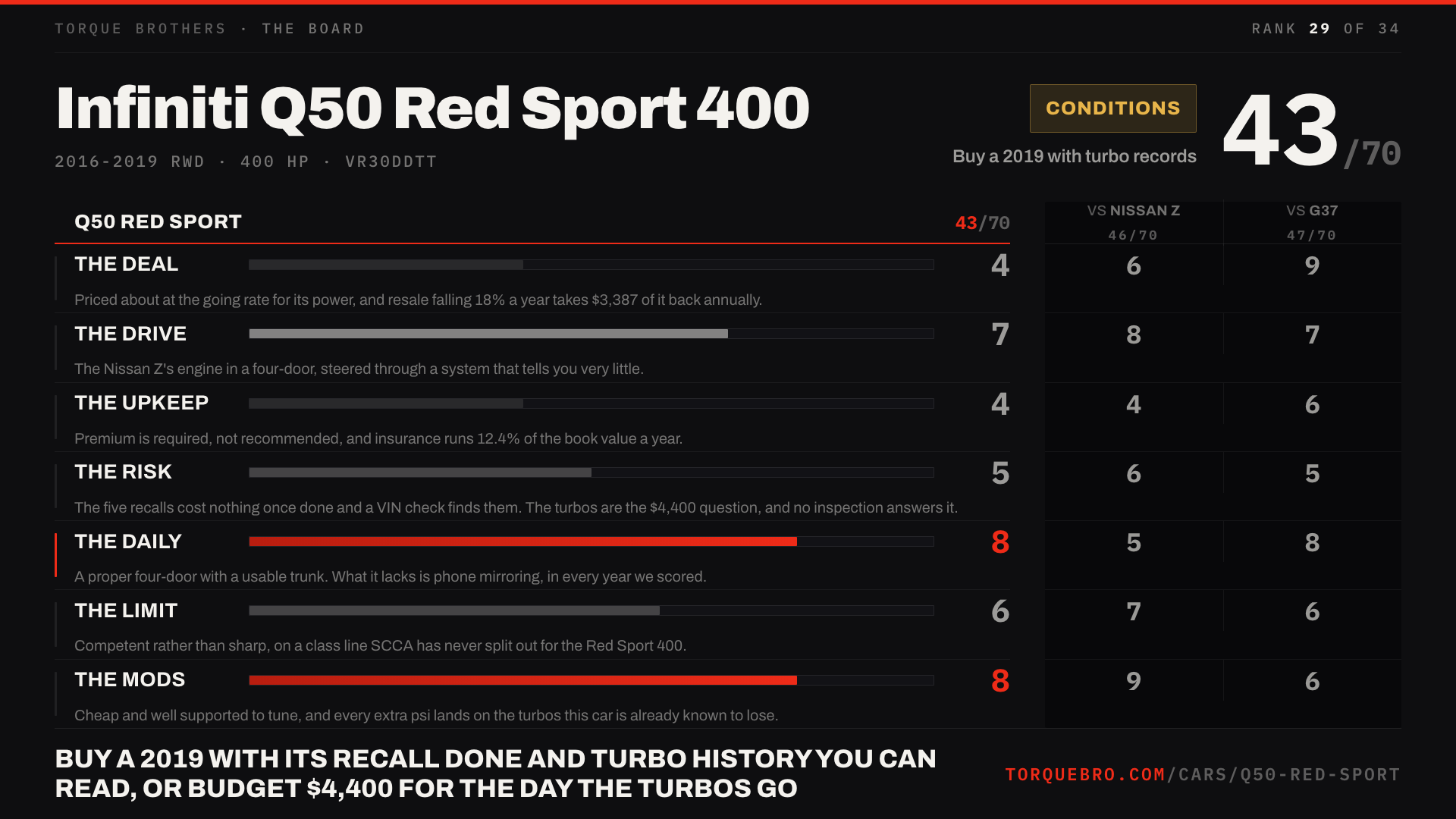
2016-2019 · Red Sport 400 · 3.0t VR30DDTT · Rear-wheel drive
Four hundred horsepower, five seats and the engine from the Nissan Z, for $18,540 on book. Buy a 2019 with its recall done and a turbo history you can read, and budget $4,400 for the day the turbos go.
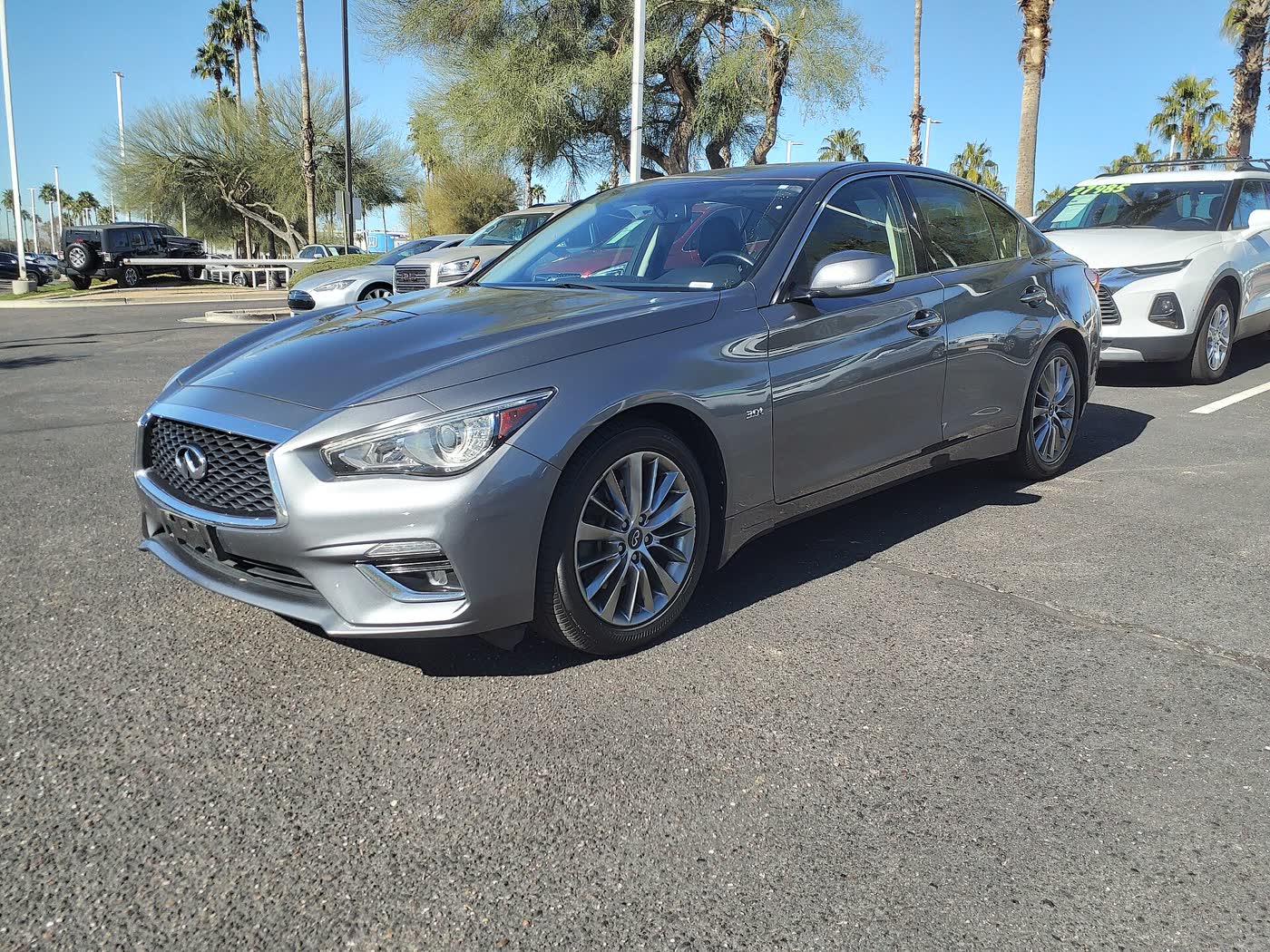
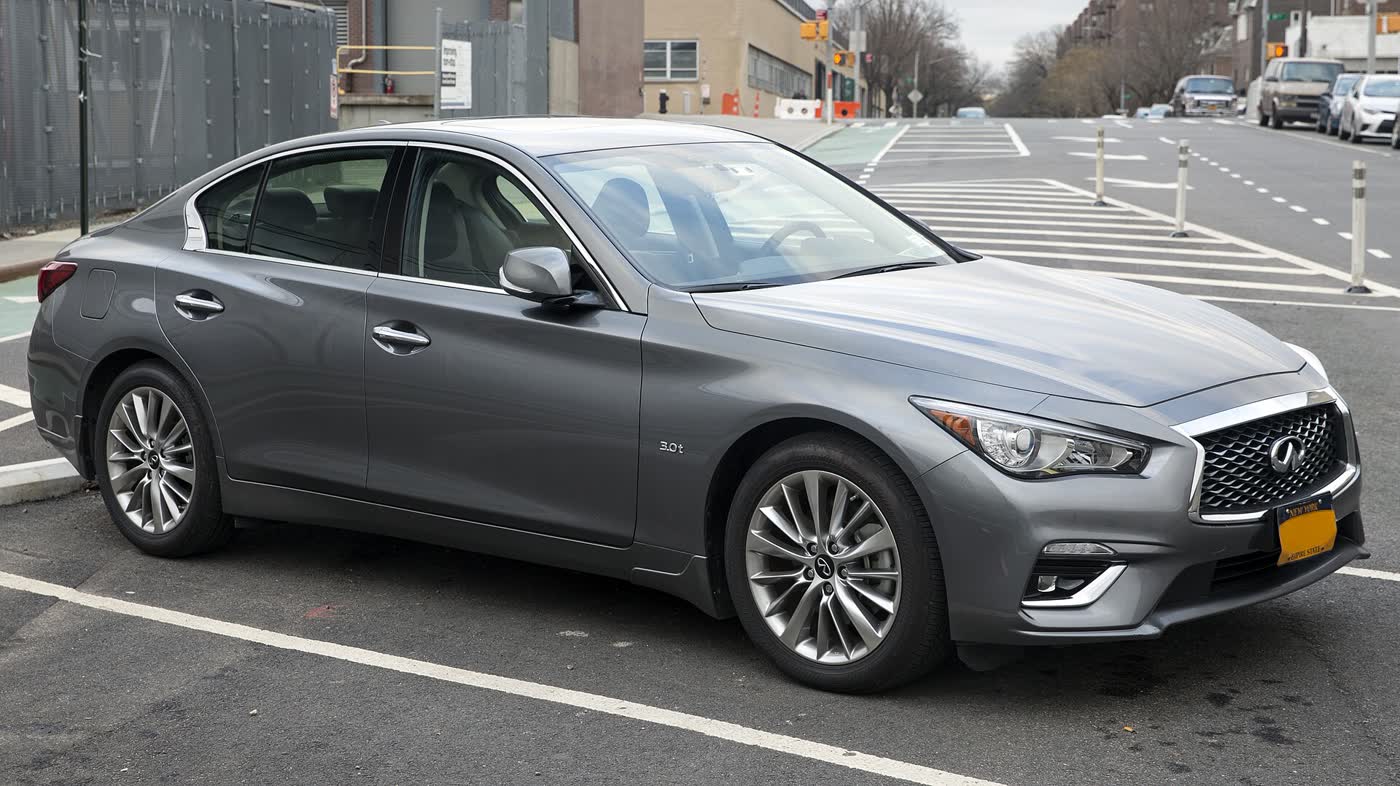
We scored the car as a 2016 to 2019 Red Sport 400 sedan with the 3.0-litre twin-turbo VR30DDTT, the seven-speed automatic and rear-wheel drive, and it landed at 43 out of 70, with a verdict of Buy a 2019 with turbo records.
This car is for someone who wants the Nissan Z's engine and needs a back seat, who can live with steering that tells them very little, and who will pay for a car whose turbo history is on paper.
All money figures use a fixed set of assumptions so they can be compared to other cars we cover: 12,000 miles a year, insurance for a 40-year-old with a clean record on full coverage, and premium fuel at $4.00 a gallon, which this car requires. Prices are Kelley Blue Book private-party in Good condition, on the 2019 model year. We scored rear-wheel drive: the all-wheel-drive car weighs 3,993 lb and runs square all-season tires, so its figures do not carry over.
| Figure | Q50 Red Sport 400 (2016-2019, VR30DDTT, RWD) | Source |
|---|---|---|
| Used buy-in, private party | $18,540, Good condition, 2019 Red Sport 400 Sedan RWD | KBB |
| Full condition range | $16,240 (Fair) to $20,340 (Excellent) | KBB |
| Live asking median | $25,437 across 8 Red Sport 400 listings, 2016-2019, $18,496-$32,998 | Cars.com |
| Asking against book | 1.37x | derived: $25,437 divided by $18,540 |
| Dollars per horsepower | $46.4/hp on book, $63.6/hp on the asking median | derived: $18,540 and $25,437 each divided by 400 hp |
| Resale value, 2023 to 2025 | $30,005, $23,603 and $20,043 for a 2019 Red Sport 400 sedan RWD | KBB value history |
| What you lose | About $3,387 a year, 18.3% a year | derived: $18,540 at the 2023-2025 rate of change in the row above |
| Against the going rate | $18,540 against about $19,473 for 9.6 lb per hp (0.95x) | derived: what our Board's cars pay for that power-to-weight, explained on How We Score |
| 2016 comparison point | $7,115 Good private-party, 2016 Red Sport 400 Sedan RWD (100,931 mi typical) | KBB 2016 |
~ our estimate, not a measured or quoted figure · [E] estimated: we found no source for it at all. Why we mark figures
Kelley Blue Book values a 2019 Red Sport 400 at $18,540 in Good condition private party, at its own typical 82,208 miles. The condition spread on the same page runs from $16,240 for Fair to $20,340 for Excellent.
The asking market sits well above that. Across 8 Red Sport 400 listings from 2016 to 2019 on Cars.com, the median ask was $25,437, which is 1.37 times book, with a spread from $18,496 to $32,998. Treat that as a reading rather than a census: the Red Sport 400 was 8 of about 104 Q50 listings we went through, and a deeper search would find more.
Most of the price spread across the scope is the model year. KBB puts a 2016 Red Sport 400 at $7,115 in Good condition, at a typical 100,931 miles, against the 2019's $18,540. We priced the 2019 because it carries one recall where a 2016 carries three, and The Risk explains why that matters.
Two figures decide the Deal score. What you lose: KBB's value for a 2019 Red Sport 400 went from $30,005 in 2023 to $23,603 in 2024 and $20,043 in 2025, falling about 18.3% a year, which is about $3,387 a year on the $18,540 buy-in. What you get: $18,540 buys 9.6 lb per hp, against about $19,473 for what that power-to-weight usually costs across our Board, so the price is fair rather than cheap. That is $46.4 per horsepower on book and $63.6 on the asking median. The resale loss is what holds the Deal to a 4.
| Figure | Q50 Red Sport 400 (2016-2019, VR30DDTT, RWD) | Source |
|---|---|---|
| Power-to-weight | 9.6 lb per hp | derived: 3,840 lb divided by 400 hp |
| Power | 400 hp at 6,400 rpm | Infiniti press kit |
| Torque | 350 lb-ft at 1,600-5,200 rpm | Infiniti press kit |
| Curb weight | 3,840 lb RWD. AWD is 3,993 lb. | Infiniti press kit |
| 0-60 mph | Not captured. No outlet-and-year-attributed instrumented test reachable. | no instrumented figure sourced; Car and Driver, MotorTrend and Road & Track are blocked |
| Transmission | 7-speed automatic only. No manual was ever offered on a Q50 3.0t. | Infiniti press kit |
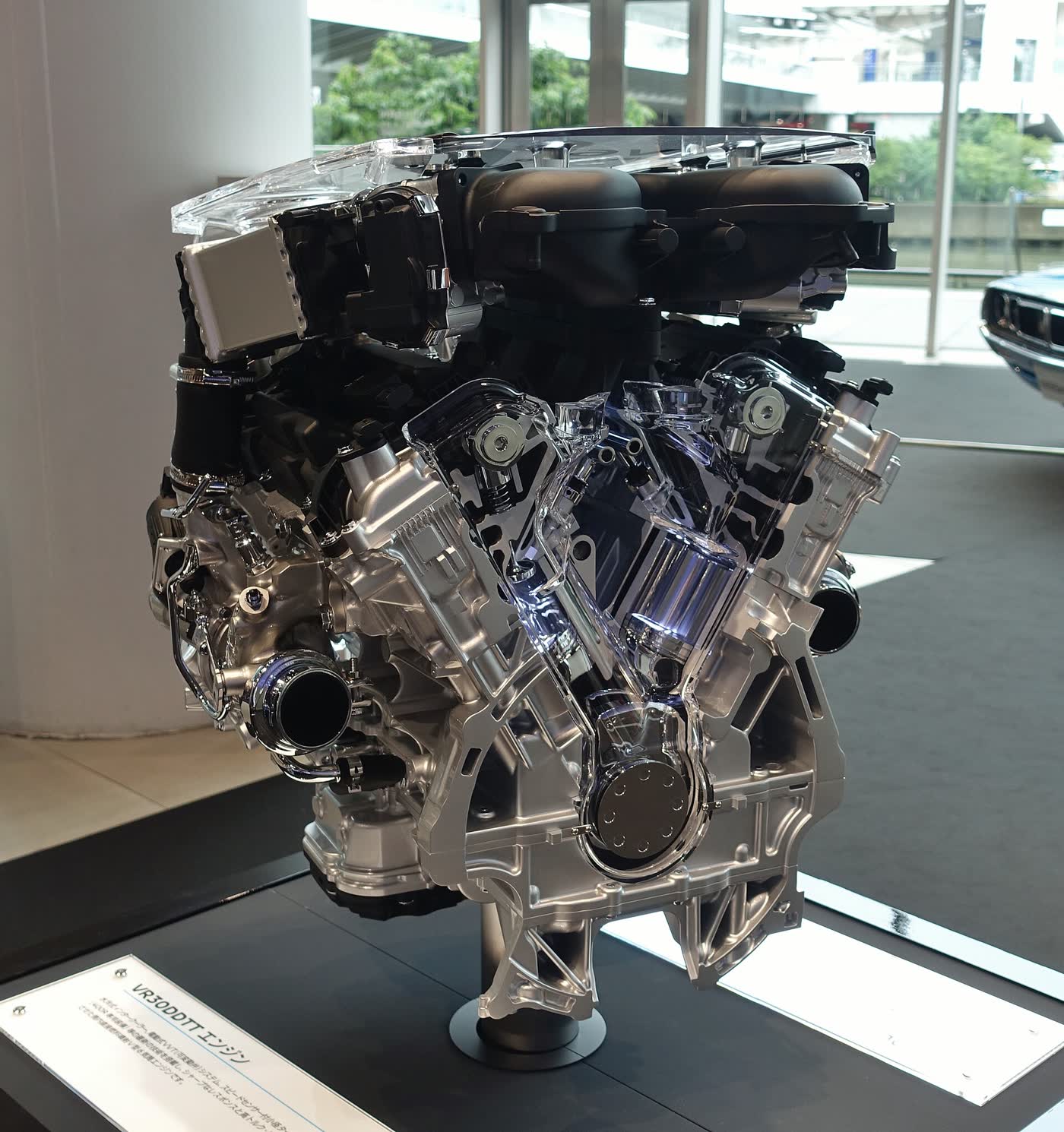
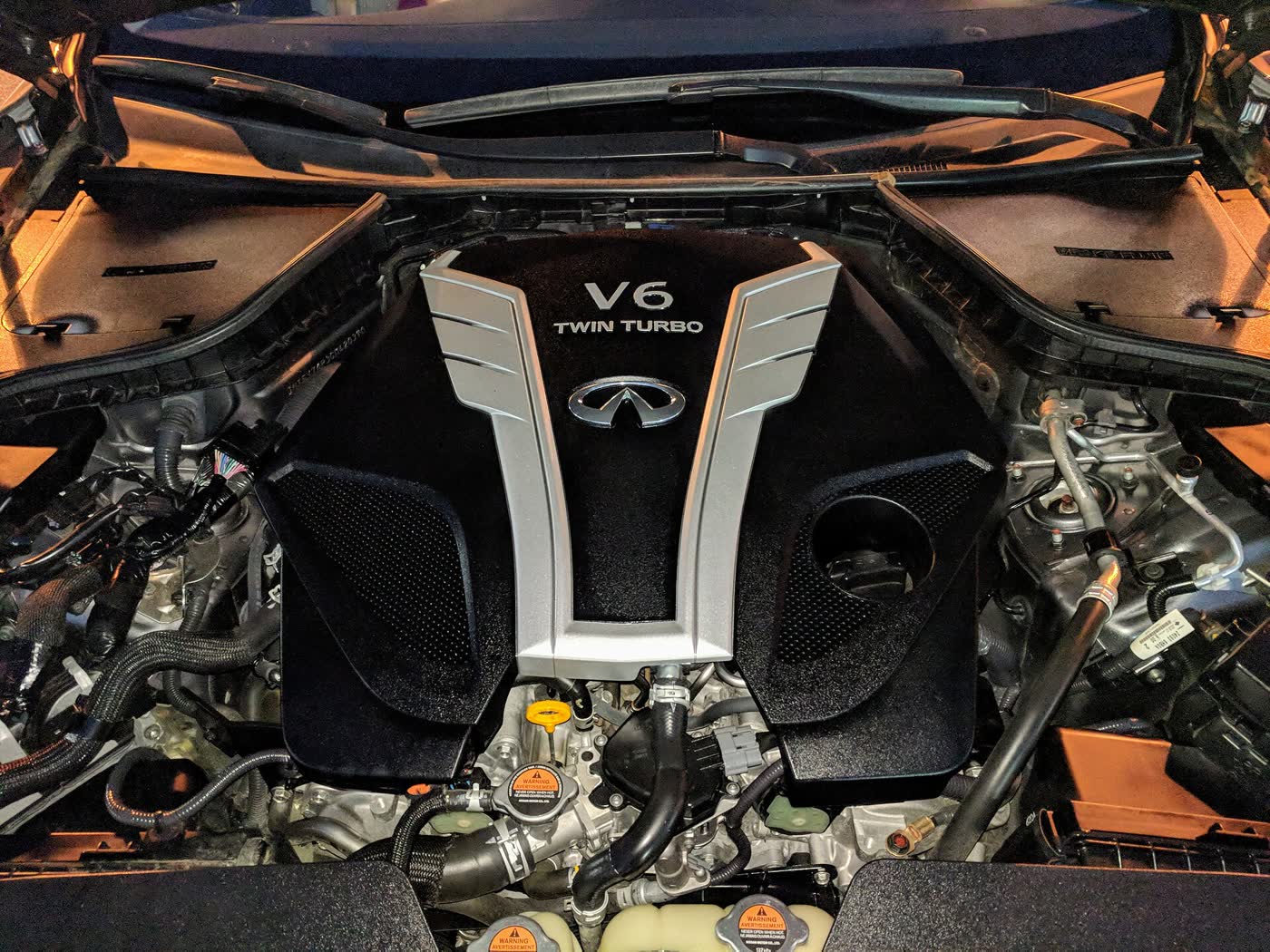
| Engine | 3.0L VR30DDTT twin-turbo V6, 14.7 psi boost | Infiniti press kit |
Four hundred horsepower at 6,400 rpm and 350 lb-ft from 1,600 to 5,200 rpm, in 3,840 lb. That is 9.6 lb per hp. The Nissan Z runs the same engine at the same 400 hp and 350 lb-ft in 3,550 lb.
The engine is the reason to buy this car. The Red Sport tune runs 14.7 psi of boost against 9.5 on the 300 hp version of the same VR30DDTT, and the torque arrives low and stays. The gearbox is a seven-speed automatic and nothing else: Infiniti never offered a manual on a Q50 3.0t.
What keeps the Drive to a 7 is the steering. The Red Sport 400 steers through Direct Adaptive Steering, Infiniti's steer-by-wire system, and it feels like it: numb and artificial, with mid-corner corrections that are guesses rather than responses. On a 2016 the same system also carries its own recall, 16V430000, for a steering ECU fault at startup.
Cornering is not in this score; that is The Limit. We have not published a 0-60 time, because no instrumented test we could attribute to an outlet and a year was reachable, and the aggregator figures in circulation name no test.
| Figure | Q50 Red Sport 400 (2016-2019, VR30DDTT, RWD) | Source |
|---|---|---|
| Annual running cost | $5,802 | derived: fuel $2,182 plus insurance $2,304 plus tires $616 plus service $700 |
| EPA combined | 22 mpg. Consistent between the 2016 and 2019 RWD listings. | fueleconomy.gov |
| Fuel requirement | Premium 91 required, not merely recommended | fueleconomy.gov |
| Fuel | $2,182 a year | derived: 12,000 miles at 22 mpg, 91 octane at $4.00 |
| Insurance | $2,304 a year. 2019 model year only; MoneyGeek has no 2016-2018 Q50 breakout. | MoneyGeek |
| Tires | $616/yr. 245/40R19 front, 265/35R19 rear, staggered, Continental ExtremeContact Sport 02 at $1,231.96 a set, one set per 24,000 miles | SimpleTire, Board tire rule |
About $5,802 a year: $2,182 in fuel, $2,304 in insurance, $616 in tires and about $700 in service. That puts it in our $5,650 to $6,100 band, and it is why the Upkeep is a 4.
Premium is required on this powertrain, not merely recommended, so there is no cheaper grade to fall back on. It returns 22 mpg combined, 20 city and 26 highway, and the 2016 is rated the same.
Insurance is $2,304 a year, and it is a 2019 reading. MoneyGeek prices the Q50 by model year only from 2019 onward, so there is no 2016 to 2018 figure to average in. It is their 2019 Luxe figure of $2,088 plus the $216 a year they say the Red Sport 400 adds. Against the $18,540 book value that is 12.4% of the car a year.
Tires are on our Board tire rule, the same for every sedan we cover: a Continental ExtremeContact Sport 02 in the factory sizes, priced at SimpleTire, one set every 24,000 miles. The rear-drive car runs staggered 245/40R19 front and 265/35R19 rear, so they cannot rotate: $270.99 a front and $344.99 a rear, a $1,231.96 set, or $616 a year. The factory tires were summer run-flats, and the rule prices a non-run-flat on every car. Service on a twin-turbo V6 at about $700 a year is our estimate.
| Scenario | Year-one cost | As a share of the $18,540 book |
|---|---|---|
| Maintained | ~$900 to $1,100 | 5 to 6 percent |
| Typical | ~$1,800 to $2,200 | 10 to 12 percent |
| Neglected | ~$5,200 to $6,400 | 28 to 35 percent |
Those are at 120,000 miles, parts plus independent labour. Maintained is brakes at about $550 and fluids and plugs at about $450. Typical adds a set of staggered tires at $1,231.96. Neglected adds the turbo pair: $2,026 in parts plus an estimated 10 to 15 hours of engine-out labour at $120-160 an hour. The recalls cost nothing if done and are not in the table.
| Figure | Q50 Red Sport 400 (2016-2019, VR30DDTT, RWD) | Source |
|---|---|---|
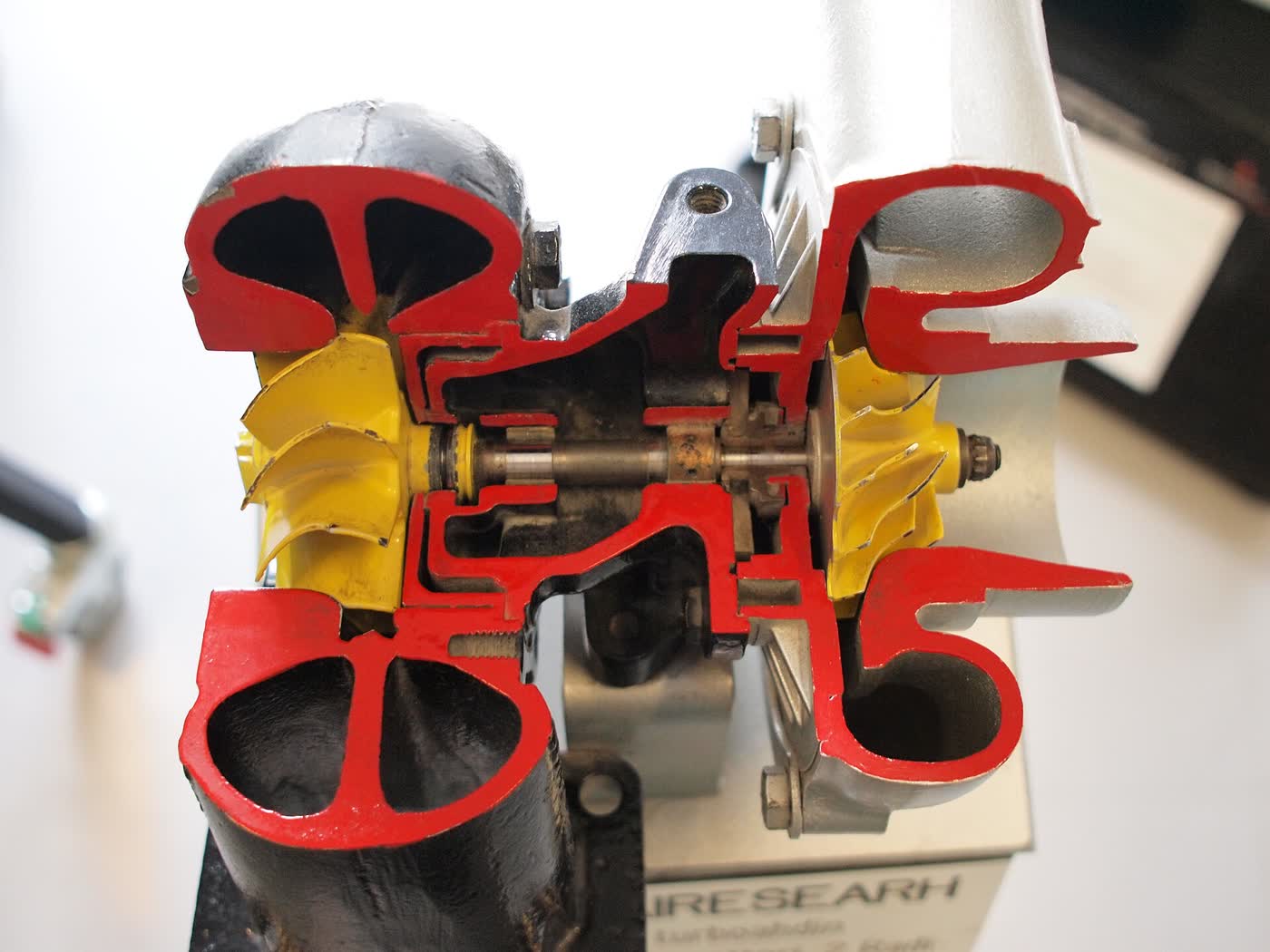
| VR30DDTT turbocharger pair | $3,200 to $4,400. Parts alone are $2,026 for both sides ($991.89 right + $1,033.89 left). An engine-out job: the turbos sit in the hot-V between the cylinder heads. | Turbochargers Direct, right side and left side |
| Driveshaft recall (24V470000) | Free if actioned. Covers 2014-2018 two-wheel drive only; notices mailed Aug 13, 2024. | NHTSA |
| OCS airbag recall (16V244000) | Free if actioned. Covers 2014-2017, 2016 included. Owners of 2018-2019 cars, outside it, report paying $6,000-8,500 for the same fault. | NHTSA |
| Steering ECU recall (16V430000) | Covers 2014-2016 only; ~28,182 Q50/Q50 Hybrid vehicles. | NHTSA |
| Airbag inflator weld recall (17V571000) | Free if actioned. Covers 2017 Q50 (and Q50 Hybrid) only; remedy began Oct 30, 2017. | NHTSA |
| Back-up camera display recall (19V654000) | Free if actioned. Covers 2018-2019 Q50 -- the only recall that reaches 2019. Remedy began Nov 11, 2019. | NHTSA |
| Total complaints | 39, 62, 43 and 30 across 2016 to 2019 | NHTSA |
One failure decides this section, and it is the turbos. The VR30DDTT's twin turbochargers are reported to fail from oil starvation and bearing wear, commonly between 75,000 and 100,000 miles and sometimes earlier. Engine and turbocharger complaints are one of the two largest categories in NHTSA's file for every model year we scored, 2016 through 2019.
It is an expensive job because of where they sit. The turbos live in the hot-V between the cylinder heads, so replacing them is engine-out work rather than a bolt-in. The parts alone are $2,026 for the pair, $991.89 for the right side and $1,033.89 for the left, and with an estimated 10 to 15 hours of labour the bill lands at $3,200 to $4,400.
No inspection clears a turbo that has not let go yet. What a good pre-purchase inspection can do is look for the tells: smoke on a cold start, lazy boost, and a history of topping up the oil. A car with documented turbo work is worth paying more for.
Then the recalls, and there are five. None of them costs you anything once it has been done, and every one shows up on a VIN check at nhtsa.gov, which is why they do not count against the Risk score the way the turbos do. What they do mean is that no model year in this scope is recall-clean.
By model year: a 2016 carries three, the steering ECU (16V430000), the passenger airbag occupant sensor (16V244000) and the driveshaft (24V470000). A 2017 carries three, a driver airbag inflator weld (17V571000), the same occupant sensor and the driveshaft. A 2018 carries two, the driveshaft and a back-up camera display that can go dark (19V654000). A 2019 carries one, the camera.
The driveshaft recall is the one to check twice. It covers two-wheel-drive cars from 2014 to 2018, the fault is a driveshaft that can fatigue and break, and Infiniti only began mailing owners on August 13, 2024. A car that changed hands before then may never have had it done, so check it by VIN rather than taking a seller's word for it.
The occupant sensor recall covers 2014 to 2017. Owners of 2018 and 2019 cars, outside it, report paying $6,000 to $8,500 for the same fault, so a lit passenger-airbag light on a later car is not a free fix. NHTSA's complaint totals run 39, 62, 43 and 30 across 2016 to 2019.
| Figure | Q50 Red Sport 400 Sedan | Source |
|---|---|---|
| Seats and doors | 5 seats, 4 doors | Infiniti press kit |
| Cargo volume | 13.5 cu ft | Infiniti press kit |
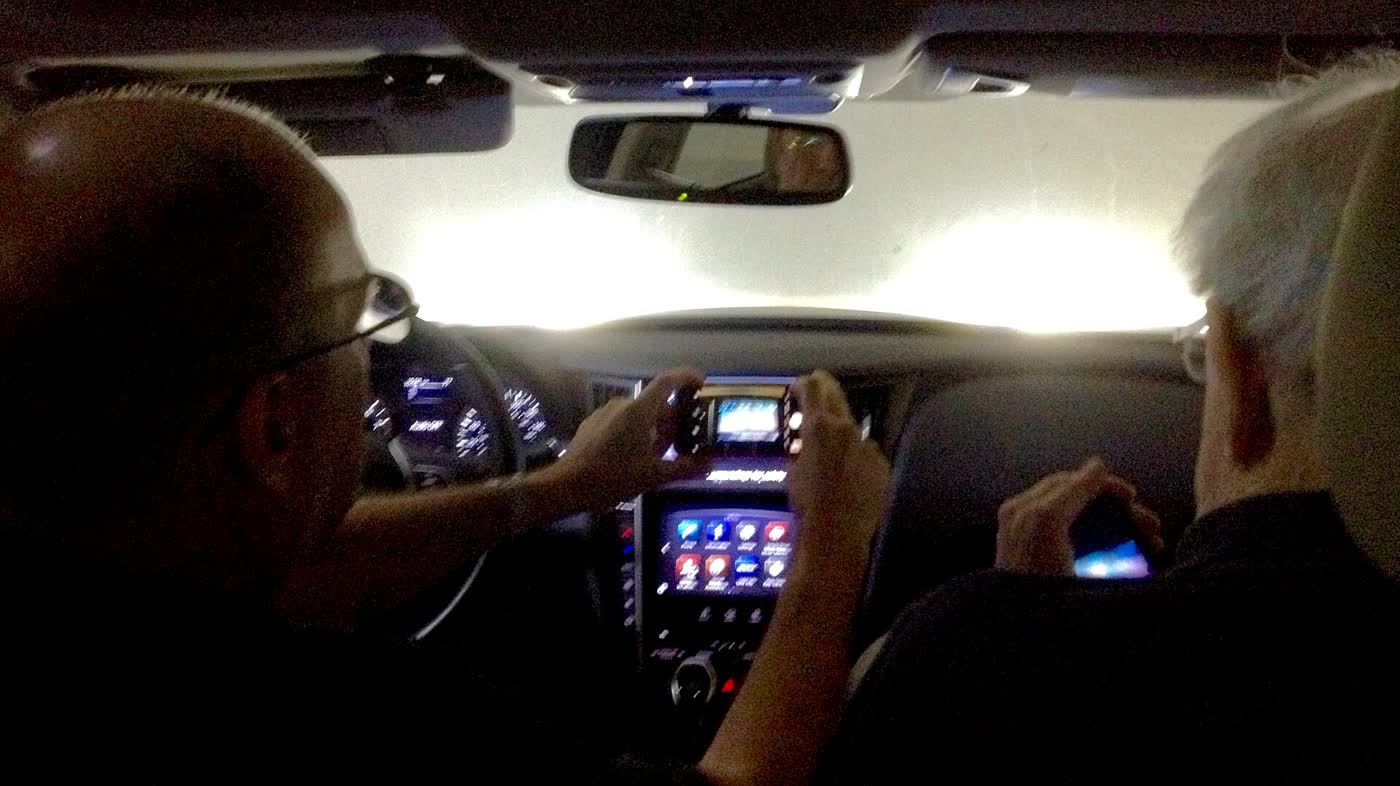
| Infotainment | No CarPlay or Android Auto anywhere in scope. Dual 8-in/7-in InTouch, nav optional. | Infiniti press kit |
| Interior volume | 100.0 cu ft with moonroof (standard on Red Sport 400) | Infiniti press kit |
Five seats, four doors and a 13.5 cu ft trunk, with 100.0 cu ft of interior volume. This is a proper sedan, and it answers the category's real question, whether it could be the only car you own, with a yes.
What holds it back is age. There is no Apple CarPlay or Android Auto in any year of the scope, the 2018 facelift included. You get Infiniti's InTouch on two screens, 8 inches and 7, with navigation as an option.
Against the Nissan Z, which shares its engine, this is the half of the pair you can carry people in: the Z seats two, with 6.9 cu ft behind them.
| Figure | Q50 Red Sport 400 (2016-2019) | Source |
|---|---|---|
| SCCA Solo class | F Street (FS), listed as “Q50 Sport (2014-25)”. SCCA lists no separate Red Sport 400 line, so this is the closest reading, not a confirmed one. | 2026 SCCA Solo Rulebook, Appendix A |
| Factory tires | Staggered 245/40R19 front, 265/35R19 rear, summer run-flat (RWD) | Infiniti press kit |
| Curb weight | 3,840 lb, which is what sets the ceiling | Infiniti press kit |
| Lateral grip | Not captured. No outlet-attributed skidpad figure reachable. | Car and Driver, MotorTrend and Road & Track are blocked; fastestlaps.com carries no named test |
F Street, on the closest reading of the 2026 SCCA Solo rules we have, and that reading is not settled. Appendix A lists one Q50 line, “Q50 Sport (2014-25)”, and no separate Red Sport 400 entry, and a 2019 reprint of the same list reads the same way.
The case against applying it: Infiniti's own press kit treats Sport and Red Sport 400 as two different grades, which suggests the SCCA line means the 300 hp car. The case for: the two share a chassis, suspension and wheel and tire package, and SCCA's Street splits usually follow hardware rather than power. We have classed it F Street, alongside the G37, and flagged it rather than pretended to know.
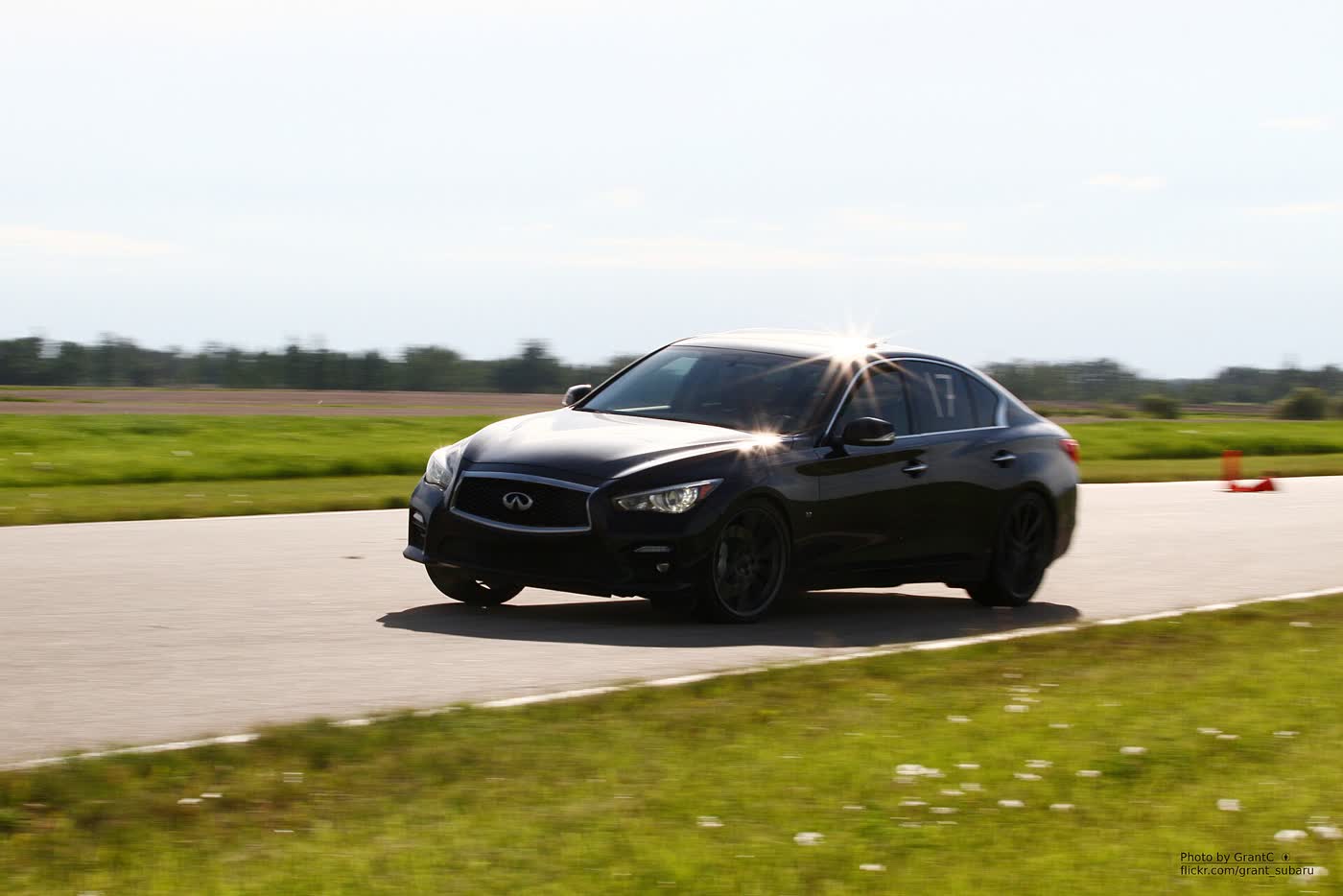
The hardware is staggered 245/40R19 front and 265/35R19 rear Dunlop summer run-flats under 3,840 lb. It is competent rather than sharp, and the steering from The Drive is part of the reason. We have no grip figure: the numbers in circulation name no test, and the outlets that would normally run one were not reachable to us.
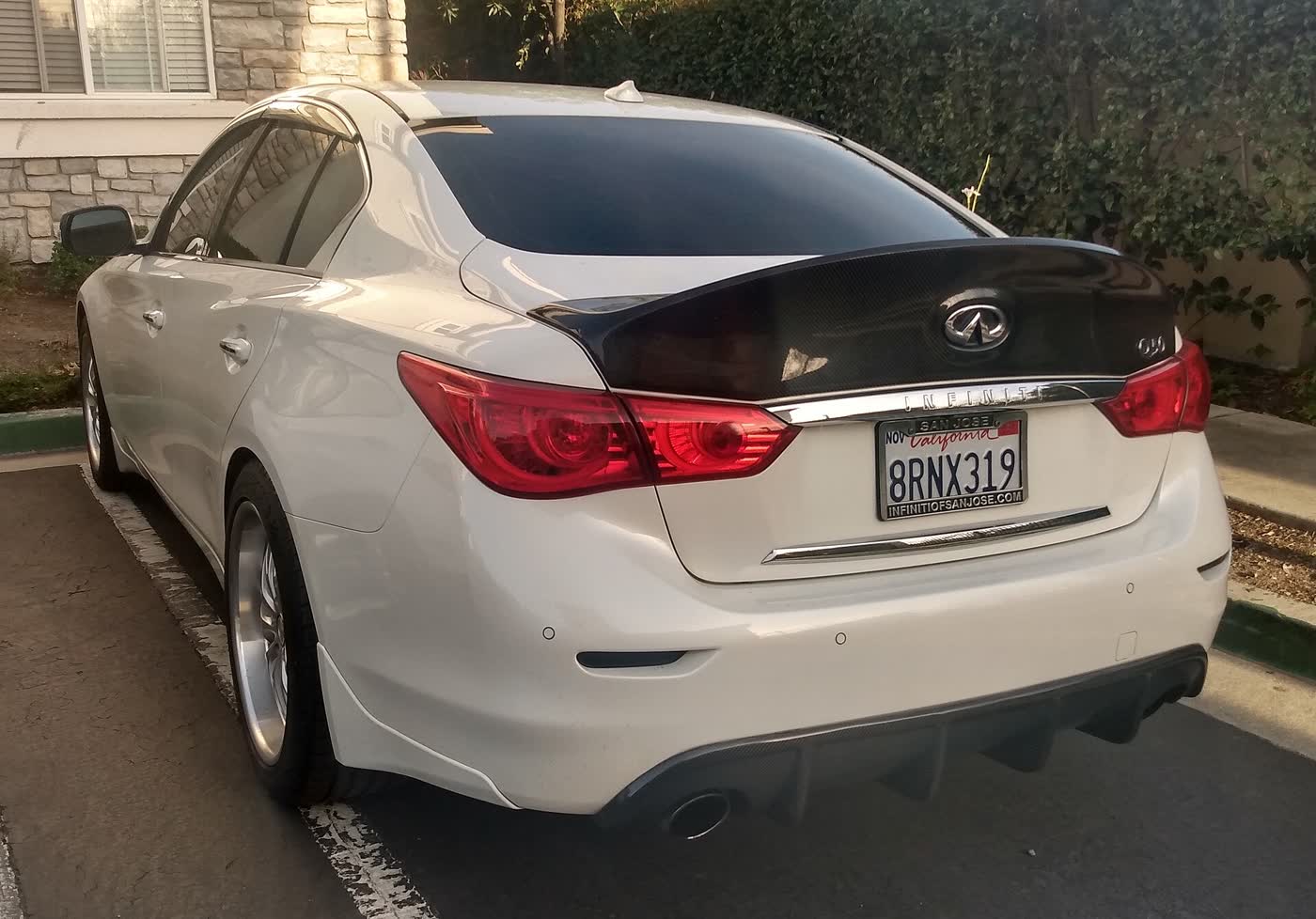
| Path | Cost | Risk |
|---|---|---|
| ECU tune (EcuTek-based) | $800 to $1,570 | Moderate: more boost and heat on the stock turbos |
| Billet turbo pair, VQPLUG | $1,238.69 | Engine-out labour on top |
| Billet turbo pair, R/T Tuning, ~30% more flow | $2,500 plus a $1,000 refundable core | The core only comes back if the old pair is reusable |
| First +100 whp, tune plus turbos | ~$2,039 to $4,070, or $5,070 without the core back | Our estimate, summed from the parts above |
The first step is cheap and well supported. An EcuTek-based ECU tune such as AMS Performance's Red Alpha costs $800 to $1,570, depending on whether you already own the dongle. The parts come from the same pool as the Nissan Z and the Q60 Red Sport 400, because all three run the VR30DDTT.
Here is the catch, and it is why this scores an 8 against the Nissan Z's 9. A tune raises boost and heat on the same turbos this car is already known to lose, before anything addresses the oil starvation behind the failure. On this car, more power and The Risk are the same conversation.
If you plan to go past a tune, the turbo swap is a job you may face anyway. Stock-location billet pairs run $1,238.69 from VQPLUG, or $2,500 plus a refundable $1,000 core from R/T Tuning, and that core only comes back if your old turbos are in reusable condition, which a failed pair may not be. Tuner power claims are not a dyno reading, and we have no independent stock dyno figure for this car.
Buy a 2019 with its back-up camera recall done and a turbo history you can read, or budget $4,400 for the day the turbos go. It scores 43 out of 70: an 8 for a car you can live in and an 8 for a cheap, well-supported tune, held down by a Deal of 4, where resale is falling 18.3% a year, and by steering that keeps a 400 hp car's Drive to a 7.
If you are looking at a 2016 to 2018 car instead, run the VIN for all five campaigns and treat the driveshaft recall as the one that may not have been done. A 2016 is $7,115 on book against the 2019's $18,540, and it has three recalls to check instead of one.
This car is for you if you want the Nissan Z's engine with a back seat and a trunk for about $18,540, and you will buy on paperwork rather than on a test drive. It is not for you if steering feel is why you drive, or if a $4,400 bill the year after you buy would be a problem rather than an annoyance.
So you want 400 horsepower and you need the back seat to be a real one. A 2016 to 2019 Q50 Red Sport 400 puts the Nissan Z's twin-turbo V6 in a five-seat sedan for $18,540 on book, steers through a system that tells you very little, and carries one expensive failure that no recall covers.
We scored it as a 2016 to 2019 Red Sport 400 with the 3.0-litre VR30DDTT, the seven-speed automatic and rear-wheel drive, priced on the 2019. The model year matters on this car more than it looks, and the recall section explains why.
Kelley Blue Book values a 2019 Red Sport 400 at $18,540 in Good condition private party, with Fair at $16,240 and Excellent at $20,340. The 8 Red Sport 400 listings we found on Cars.com across 2016 to 2019 asked a median of $25,437, which is 1.37 times book, from $18,496 to $32,998. It is a small sample, because the Red Sport 400 is a minority of Q50 listings, so read it as direction rather than a precise market.
The model year moves the price more than anything else. A 2016 is $7,115 on KBB at a typical 100,931 miles. Most of the spread you will see in listings sits between those two years.
The number to watch is depreciation. KBB's value for a 2019 went from $30,005 in 2023 to $20,043 in 2025, about 18.3% a year. On the $18,540 buy-in that is about $3,387 a year, and it is the main reason the Deal scores a 4 rather than higher. The price itself is fair: $18,540 is about what our Board pays for 9.6 lb per hp.
This is the failure that decides the review. The VR30DDTT's two turbochargers are reported to fail from oil starvation and bearing wear, commonly between 75,000 and 100,000 miles and sometimes before. Engine and turbocharger complaints are one of the two largest categories in NHTSA's file for 2016, 2017, 2018 and 2019 alike, so no year in the scope avoids it.
What makes it expensive is where the turbos are. They sit in the hot-V between the cylinder heads, so the engine comes out to replace them. Parts are $2,026 for the pair, and with an estimated 10 to 15 hours of labour the total lands at $3,200 to $4,400.
You cannot inspect your way out of it. Smoke on a cold start, lazy boost and a history of adding oil are the tells of a turbo on its way out, and nothing predicts one that has not started. That is why the verdict asks for paperwork: a car with documented turbo work is worth more than one without.
All of them, because there are five and no model year in this scope is free of them. They cost nothing once done and every one shows up on a VIN check, which is why they do not drive the Risk score. They do decide which year to buy.
A 2016 carries three: a Direct Adaptive Steering ECU fault at startup (16V430000), a front-passenger airbag occupant sensor that can misclassify who is in the seat (16V244000), and a driveshaft that can fatigue and break on two-wheel-drive cars (24V470000). A 2017 carries three: a driver airbag inflator weld (17V571000), the same occupant sensor and the same driveshaft. A 2018 carries two: the driveshaft and a back-up camera image that can go dark and stay off (19V654000). A 2019 carries one, the camera, which is a software update.
The driveshaft recall deserves the extra step. Infiniti only started mailing owners on August 13, 2024, so a 2016 to 2018 car sold before then may never have had it done. And the occupant sensor recall stops at 2017: owners of 2018 and 2019 cars report paying $6,000 to $8,500 for the same fault outside it.
About $5,802 a year, which is an Upkeep of 4. Fuel is $2,182 at 22 mpg on premium, which this engine requires rather than recommends. Insurance is $2,304, a 2019 figure, because MoneyGeek does not break out 2016 to 2018. Tires are $616 a year on our Board tire rule, and service about $700, our estimate.
The tires are the line to understand. The rear-drive car runs staggered 245/40R19 front and 265/35R19 rear summer run-flats, so you cannot rotate them front to back, and every one is a run-flat.
Fast, and at a distance. Four hundred horsepower and 350 lb-ft from 1,600 rpm in 3,840 lb is 9.6 lb per hp, and the torque is there almost everywhere. The engine is a real reason to want this car.
The steering is the reason it scores a 7 rather than more. The Red Sport 400 uses Direct Adaptive Steering, Infiniti's steer-by-wire system, and it feels numb and artificial: you point it rather than feel it, and mid-corner corrections are guesses. The Nissan Z has the same engine and a Drive of 8.
Yes. Five seats, four doors, a 13.5 cu ft trunk and 100.0 cu ft inside. The one thing that dates it is the dash: no Apple CarPlay or Android Auto in any year from 2016 to 2019, just Infiniti's two-screen InTouch.
It is competent rather than sharp. On the closest reading of the current SCCA Solo rules it runs in F Street, but SCCA lists only a “Q50 Sport (2014-25)” line and has never split out the Red Sport 400, so check with your region before you enter. We have no grip figure we could attribute to a test.
You can, cheaply: an EcuTek-based tune is $800 to $1,570, and the VR30DDTT's aftermarket is shared with the Nissan Z and the Q60 Red Sport 400. Just know what you are tuning. More boost lands on the turbos this car already loses, and the path past a tune is a turbo pair anyway, at $1,238.69 to $2,500 before labour.
Buy a 2019 with its camera recall done and a turbo history you can read, or budget $4,400 for the day the turbos go. On a 2016 to 2018, run every recall by VIN and get proof on the driveshaft.
The Q50 Red Sport 400 finished at 43 out of 70 on our Board. It loses points to resale falling 18.3% a year, a turbo failure no inspection can rule out, and steering that keeps 400 hp at arm's length. It wins them back as a five-seat sedan you can live with every day, on an engine with a deep, cheap tuning path, for $18,540.
Filming reference: cue sheet · for the hosts on set, not part of the review.
The frame that closes our video: the Q50 Red Sport at 43/70, with the Nissan Z and the G37 alongside.