2014-2019 · 1.6 EcoBoost · 6MT
The surprise of the budget tier: 2,742 lb, running on regular unleaded, with a $1,448 fuel bill level with the Miata's. Its one severe failure needs owner neglect to trigger. Get the recall record and the coolant history, and get an insurance quote first.
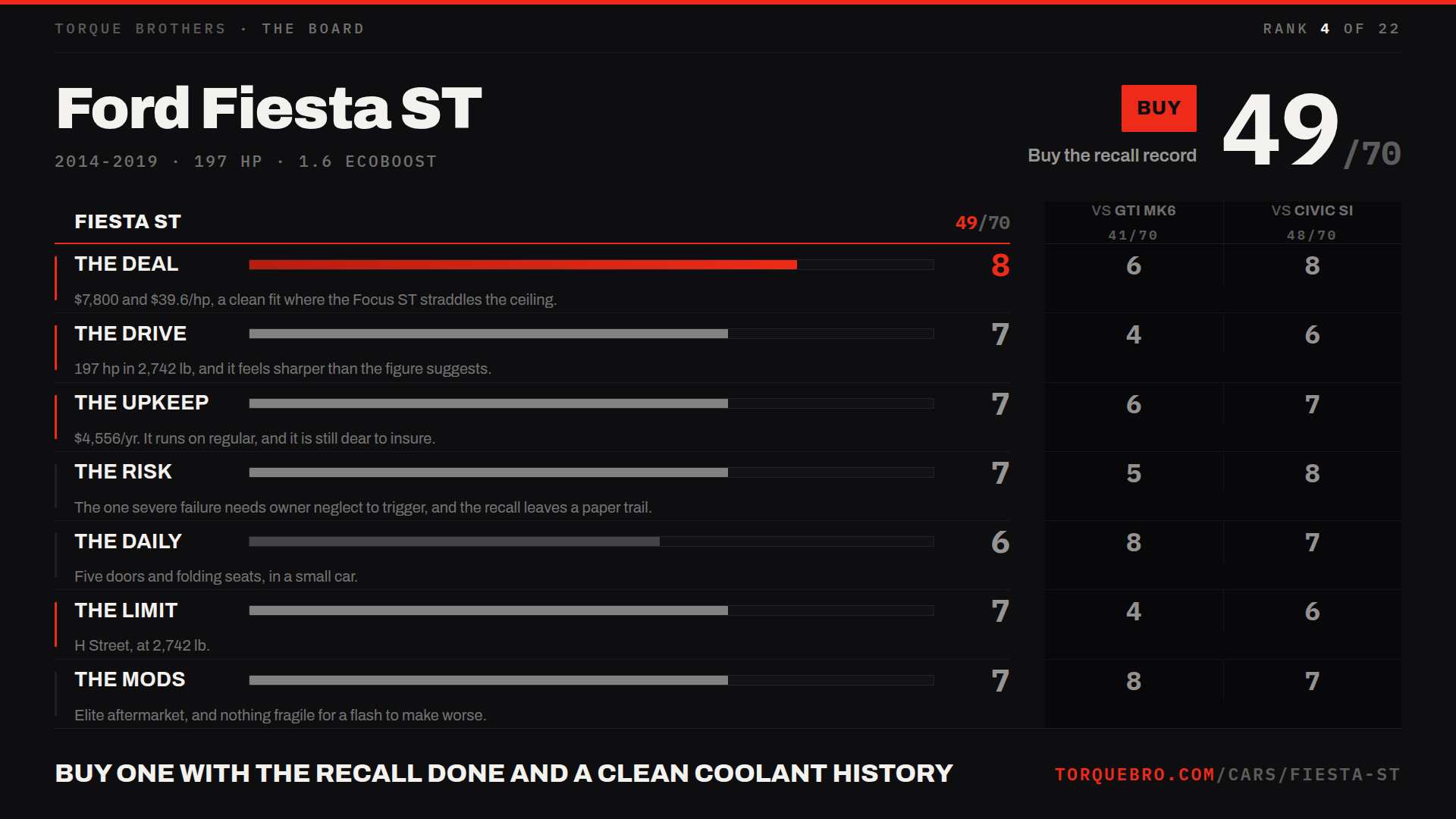
We scored the car as a 2014 to 2019 Fiesta ST with the 1.6 EcoBoost and the six-speed manual, and it landed at 49 out of 70, with a verdict of Buy one with the recall done and a clean coolant history.
This car is for someone who wants a small, light, entertaining car and can live with a small back seat. This is the surprise of the budget tier, and its case is a real one.
All money figures use a fixed set of assumptions so they can be compared to other cars we cover: 12,000 miles a year, fuel at the octane the car actually requires, and full coverage insurance. Prices are Kelley Blue Book private-party at 120,000 miles in Good condition, which is the flat basis this whole budget tier uses. Insurance is MoneyGeek at trim level, the same table and profile that priced the Focus ST, so those two are directly comparable.
| Figure | Fiesta ST (2014-2019, 1.6 EcoBoost, 6MT) | Source |
|---|---|---|
| Used buy-in, private party | $7,800 | KBB |
| Condition basis | 120,000 miles, Good | KBB |
| Full condition range | $6,175 to $8,200 | KBB |
| Dollars per horsepower | $39.6/hp | derived: $7,800 divided by 197 hp |
~ our estimate, not a measured or quoted figure · * there is a caveat, and the note under the table explains it. Why we mark figures
The Deal scores an 8. Seven thousand eight hundred dollars puts this comfortably inside the $5,000 to $10,000 band this tier is built around, which is worth noting because its own Focus ST sibling sits $230 over the ceiling.
At $39.6 per horsepower it lands almost exactly where the Civic Si does, which is $7,760 and $39.4. Those two cars are within forty dollars of each other on price and within two-tenths on value per horsepower, and they are completely different propositions to drive.
If you are reading the dollars-per-horsepower column as the whole story, this car looks ordinary and the 350Z at $18.7 looks like the answer. That column is measuring the wrong thing here. What you are buying at 2,742 lb is not power, and the next section is why.
| Figure | Fiesta ST (2014-2019, 1.6 EcoBoost, 6MT) | Source |
|---|---|---|
| Power-to-weight | 13.9 lb per hp | derived from the figures below |
| Power | 197 hp | CJ Pony Parts |
| Torque | 202 lb-ft at 4,200 rpm | CJ Pony Parts |
| Curb weight | 2,742 lb | Edmunds |
| 0 to 60 mph | ~6.4 sec | Grassroots Motorsports |
| Engine | 1.6 EcoBoost turbo, direct injection | Edmunds |
The Drive scores a 7, and the number that matters is not the horsepower. It is 2,742 lb.
For context inside this tier: the NC Miata is 2,480 lb and the GTI Mk6 starts at 2,906. This is a small, light car, and that is the entire basis of its reputation. It changes direction in a way that heavier, more powerful cars in this group cannot, and people who have driven one tend to talk about it in a particular way for exactly that reason.
Six point four seconds to 60 will not win an argument in a car park. It is also not what you buy this for.
There is a nice coincidence in the arithmetic: at 13.9 lb per horsepower it has identical power-to-weight to the 128i, arrived at from completely opposite directions. One is a light four-cylinder hatch, the other a heavier naturally aspirated six-cylinder coupe.
The Focus ST is quicker and the two cars are the same idea in different sizes. Which one is right for you comes down to space and running cost, and we deal with that at the end.
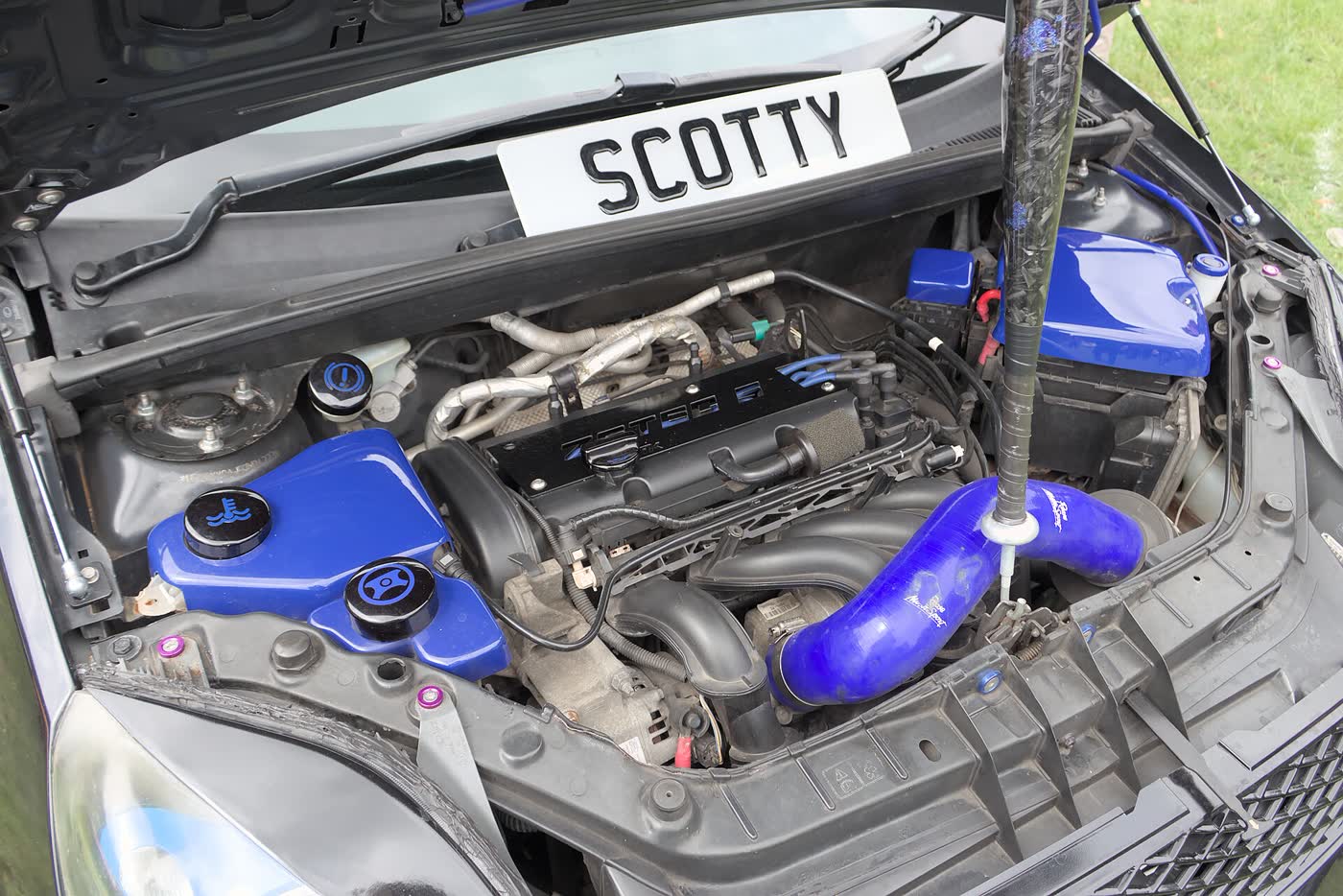
| Figure | Fiesta ST (2014-2019, 1.6 EcoBoost, 6MT) | Source |
|---|---|---|
| Total annual running cost | ~$4,556/yr | sum of the lines below |
| Fuel | ~$1,448/yr | derived from our fixed assumptions |
| Insurance, full coverage | ~$2,508/yr | MoneyGeek, ST trim |
| Tires, amortized | ~$200/yr | our estimate |
| Routine service | ~$400/yr | our estimate |
| Fuel economy | 29 mpg combined (26/35) | fueleconomy.gov |
| Octane | 87, regular, double-verified | fueleconomy.gov and Edmunds |
The Upkeep scores a 7, and it is two extremes cancelling each other out.
The fuel bill is remarkable: $1,448 a year, level with the ND Miata's. Twenty-nine miles per gallon combined, on regular unleaded, from a 197 horsepower turbocharged hot hatch. That is a surprising number and it is double-verified across fueleconomy.gov and Edmunds, which matters because octane claims in this tier have not held up well. The Genesis Coupe's runs-on-regular headline was withdrawn when Edmunds at trim level said premium, and the NC Miata's regular is permitted rather than specified. This one holds.
And then the insurance is $2,508, which cancels most of the advantage. That is 32.2 percent of the car's value per year, against the Focus ST's 34.4 percent and the 350Z's 34.1. MoneyGeek's own page notes the ST is among the pricier Fiesta trims to insure, which is what happens when a small cheap car has a performance badge on it.
We should be straight that this overturns our own research file's headline for this car. It went in as the cheap car to run and it is not. The fuel line is excellent and the insurance line eats it, and the honest total is $4,556 a year, which is mid-pack.
The insurance figure is trim-level and broken out for the ST hatchback specifically, which is better sourcing than most of this tier gets, though it is still not year-specific.
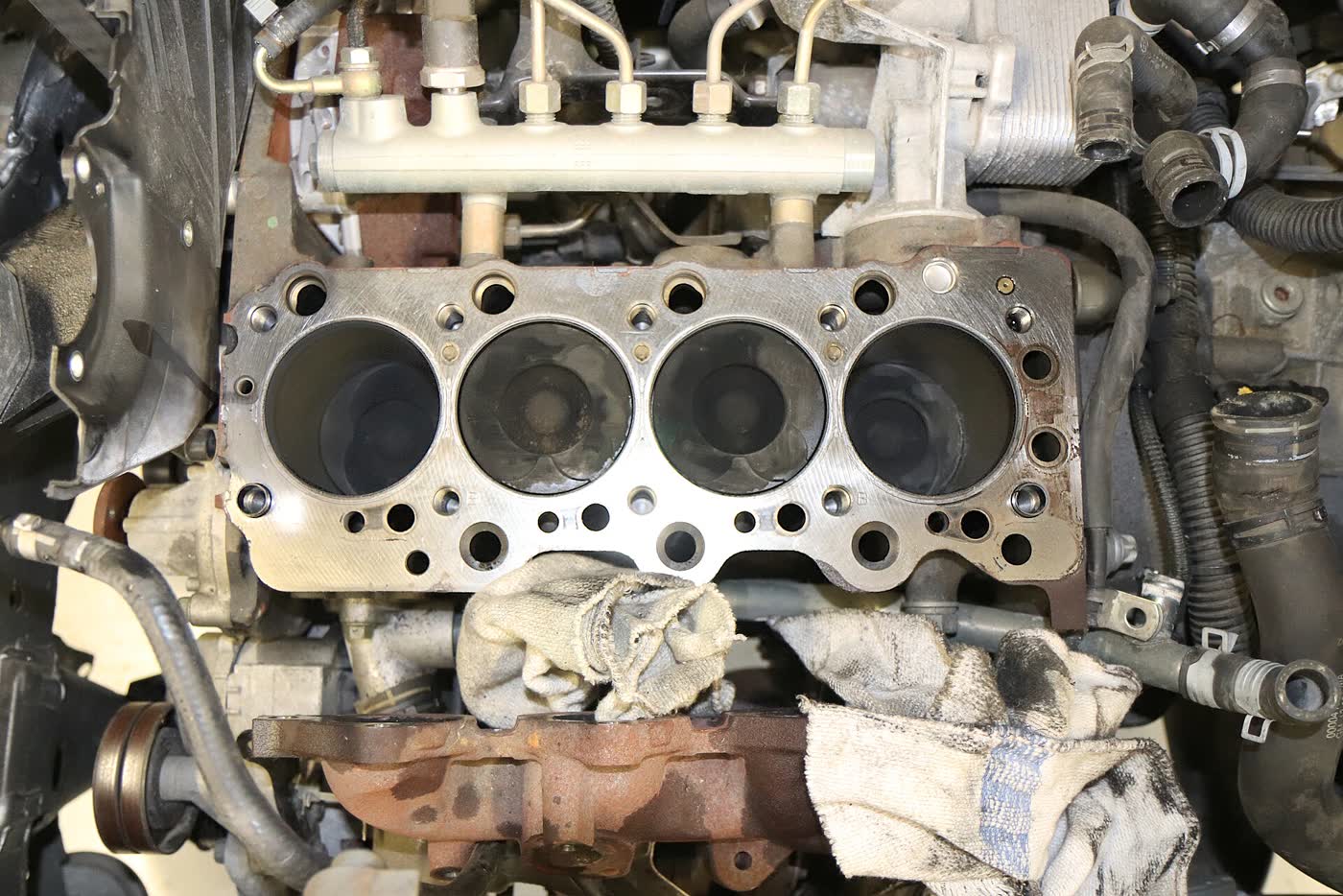
| Figure | Fiesta ST (2014-2019, 1.6 EcoBoost, 6MT) | Source |
|---|---|---|
| Worst realistic repair | ~$1,400 clutch | our estimate |
| The one severe item | 1.6 GTDI cylinder head overheat and crack | NHTSA recall 17V-209, covering the 2014-2015 Fiesta ST |
| Trigger | Running with insufficient coolant, not spontaneous | see below |
| Detection | Recall completion records plus coolant history | see below |
The Risk scores a 7, and the shape of the one serious item is what earns it.
There is a recall on 2014 to 2015 cars for the 1.6 GTDI cylinder head. Read the mechanism carefully, because it is the whole nuance: if the car is driven with insufficient coolant, the head may overheat and crack. That is a consequence of neglect rather than a defect that arrives on its own.
Which puts this in the Genesis Coupe's category rather than the G37's. On the G37, every car is exposed regardless of how it was treated. Here, a maintained car is fine, and the thing you are inspecting is what the previous owner did. That is a much easier problem to solve as a buyer.
And unusually for this tier, there is a paper trail. Recall completion records exist, so you can check rather than guess. Ask for them, then ask about coolant history and look at the level yourself.
One warning about researching this car, because it caught us. The top search results are dominated by UK sites describing UK-market cars, UK recalls and UK engine variants including the 1.0 EcoBoost, which was never fitted to either ST sold here. Check what market your source is describing before you take anything from it. That is a fourth way we have now found for research to get contaminated, after generation blending, model-wide cost averaging and body-style blending, and it is the reason to be suspicious of a forum thread that does not say where it is from.
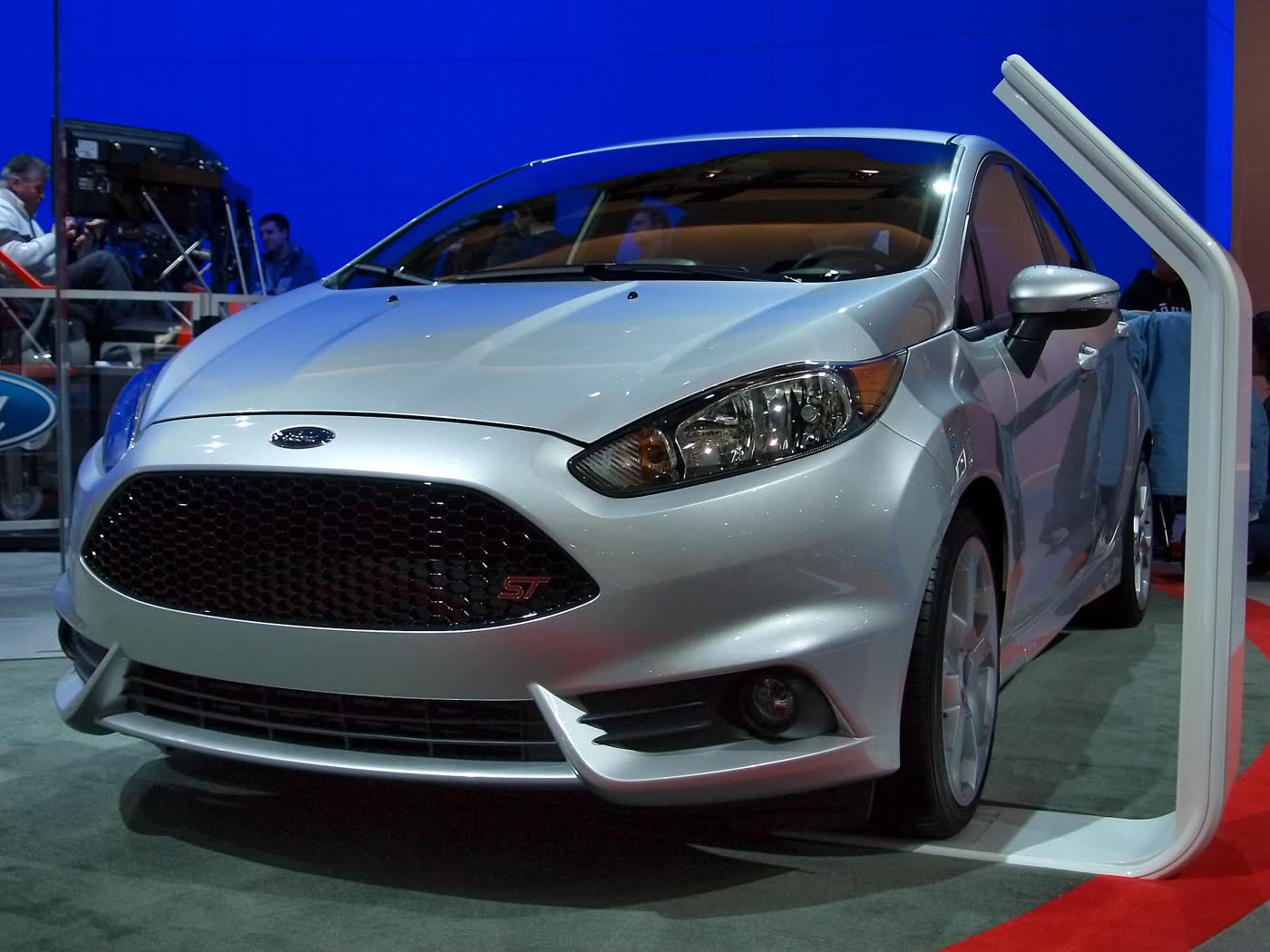
| Figure | Fiesta ST (2014-2019, 1.6 EcoBoost, 6MT) | Source |
|---|---|---|
| Seats / doors | 5 / 4, five-door hatchback | Edmunds |
| Cargo | Not captured | no figure sourced |
| Infotainment | No CarPlay in these years | our estimate |
The Daily scores a 6, and it is the right shape in the smallest possible size.
Five doors and folding seats is a practical format, and on paper that puts it in the WRX and Mazdaspeed3 bracket rather than the coupe bracket. In practice it is a very small car, and the back seat is a compromise rather than a space. That is what pulls it back level with the coupes instead of up with the bigger hatches.
If you are one or two people with things to carry, this works completely. If you regularly have adults in the back, sit in the back before you buy, and then look at the Focus ST.
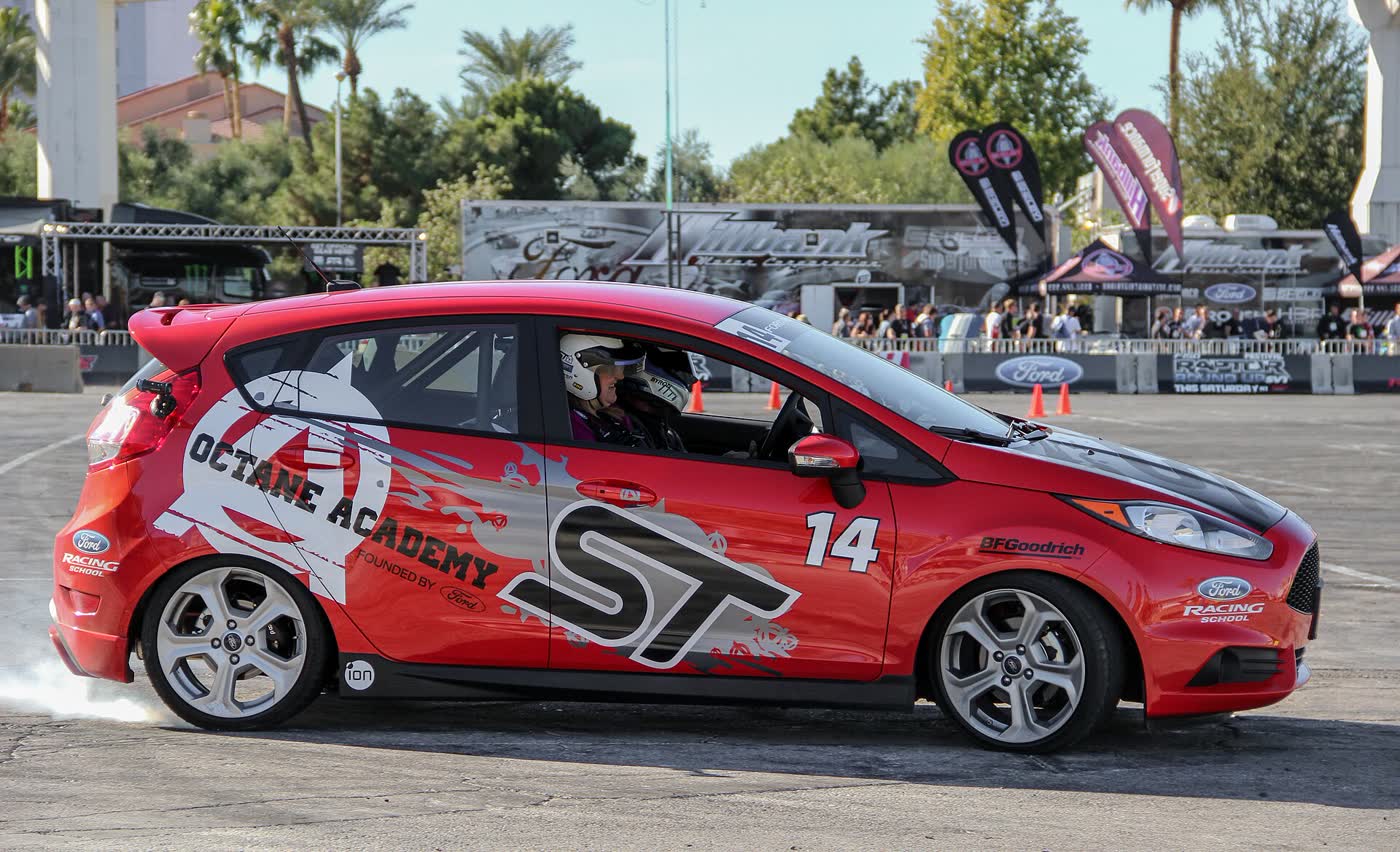
| Figure | Fiesta ST (2014-2019, 1.6 EcoBoost, 6MT) | Source |
|---|---|---|
| SCCA Solo class | H Street (HS) * | 2026 SCCA Solo Rules, Appendix A: Fiesta ST (2014-19) is listed in H Street |
| Lateral grip | Not captured | no instrumented figure sourced |
| Braking | Not captured | no instrumented figure sourced |
SCCA H Street · shared with the Golf GTI, the Civic Si, the Focus ST, the GTI Mk6 and the Mazdaspeed3 on this Board.
The Limit scores a 7, and we scored it on weight and reputation rather than figures, because no instrumented grip or braking number for this car was found.
2,742 lb is the case. The chassis is this car's entire reputation, and on a car this light that matters more than the numbers we do not have. It is the reason people who have driven one talk about it the way they do.
The class carries an asterisk and it is a soft read. The 2026 Appendix A extraction groups the Fiesta ST and Focus ST with the 500 Abarth, Civic Si, Veloster Turbo, Mazda3 Turbo, Mazdaspeed3, Lancer Ralliart and Juke, with no running header visible in context. Our own research file guessed G Street and that guess was inference stacked on inference, so we withdrew it and carry the tier brief's H Street instead. It needs the manual Appendix A pass that is pending across several cars here.
| Figure | Fiesta ST (2014-2019, 1.6 EcoBoost, 6MT) | Source |
|---|---|---|
| Cost per +100 whp | Not captured | no installed figure sourced |
| Aftermarket | Elite, deep and mature | derived |
The Mods scores a 7. The aftermarket is excellent and the 1.6 EcoBoost takes a flash well, so the easy power is there if you want it.
What is unusual is where the money should go first: suspension and bushings, not power. That is the opposite of its Focus ST sibling, where the rear motor mount comes first because the chassis hardware cannot cope with the torque. This car has 202 lb-ft rather than 270, and it is 481 lb lighter, so the hardware is not the constraint.
It is also the rare turbocharged car in this tier where modifying does not make anything worse. There is no pressure-fed failure chain here to accelerate, unlike the Mazdaspeed3, the WRX or the Focus ST. That is our estimate rather than a sourced finding, but it follows from the absence of a documented chain rather than from optimism.
We publish no cost per 100 wheel horsepower, because no installed price for a flash plus supporting modifications was sourced.
49 out of 70. Buy one with the recall done and a clean coolant history.
This is the surprise of the budget tier and a real claim to being the sensible answer at seven thousand eight hundred dollars. It weighs 2,742 lb, it runs on regular, and the one severe thing that can happen to it needs an owner to have neglected it first.
The catch is not a mechanical one. It is that the $1,448 fuel bill, which is excellent, gets cancelled almost exactly by $2,508 of insurance. So it is a mid-pack car to run rather than a cheap one, and if you came here expecting the frugal option, that is the correction.
What to do when you go and see one: get the recall completion records for the 1.6 GTDI cylinder head, then ask about coolant history and check the level yourself. The failure is triggered by running low on coolant, so the service record is the inspection.
And be honest with yourself about the back seat. If it works for you, very little else in this tier is this entertaining for the money.
We scored the Fiesta ST as a 2014 to 2019 car with the 1.6 EcoBoost and the six-speed manual, and it landed at 49 out of 70, with a verdict of Buy one with the recall done and a clean coolant history.
This is the surprise of our budget tier: 2,742 lb, running on regular unleaded, with a single severe failure that only bites a car somebody neglected. It scores 49 out of 70, and it deserves it.
The catch is one nobody expects, and it is not mechanical.
Seven thousand eight hundred dollars, for a 2015 ST hatchback in Good condition at 120,000 miles, private party, from Kelley Blue Book. The range runs $6,175 to $8,200.
That sits comfortably inside our $5,000 to $10,000 band, which is worth saying because the Focus ST sibling does not: that one is $10,230.
At $39.6 per horsepower it lands almost exactly on the Civic Si, which is $7,760 and $39.4. Two cars within forty dollars of each other, and about as different as two cars can be to drive.
If you are shopping on dollars per horsepower, this looks unexceptional and the 350Z at $18.7 looks like the win. That column is measuring the wrong thing on this car, and the next answer explains why.
Light. That is the whole answer and everything else follows from it.
2,742 lb, from Edmunds at trim level. For scale, the NC Miata is 2,480 lb and the GTI Mk6 starts at 2,906. It changes direction in a way the heavier and more powerful cars in this tier simply cannot, and that is why people who have driven one talk about it the way they do.
The numbers are modest: 197 horsepower, 202 lb-ft at 4,200 rpm, about 6.4 seconds to 60. Nobody buys this to win a traffic light. You buy it because a small light car on a good road is a different kind of fun from a fast one, and this is one of the cheapest ways left to have it.
A nice coincidence, since we noticed it: at 13.9 lb per horsepower this has identical power-to-weight to the 128i, arrived at from completely opposite directions.
About $4,556 a year, and this is where we have to correct our own research.
The fuel line is excellent. $1,448 a year, which is level with the ND Miata, from 29 mpg combined on regular unleaded. A 197 horsepower turbocharged hot hatch matching a Miata on fuel cost is a surprising result and we checked it twice: both fueleconomy.gov and Edmunds give regular and 29 combined.
That double-check matters, because octane claims in this tier have not held up. The Genesis Coupe's runs-on-regular headline was withdrawn when Edmunds at trim level said premium recommended, and the NC Miata's regular is permitted rather than specified. This one holds.
And then the insurance is $2,508, and it cancels the advantage almost exactly. That is 32.2 percent of the car's value per year, against the Focus ST's 34.4 and the 350Z's 34.1. MoneyGeek's own page notes the ST is among the pricier Fiesta trims to insure, which is what happens when a cheap small car gets a performance badge.
So our research file's headline for this car was that it is the cheap one to run, and that is wrong. It is a mid-pack car to run with an unusual shape: very little going into the tank, quite a lot going to the insurer.
Ordinary, and that is the good news.
There is no catastrophic failure to price in for a maintained car. The worst realistic bill is a clutch at around $1,400, which is our estimate rather than a quote. Everything else is consumables.
The one severe item on the car is conditional rather than scheduled, and the next section is how you check it.
Mostly yes, and the one serious thing has an unusually clear shape.
There is a recall on 2014 to 2015 cars for the 1.6 GTDI cylinder head, and the mechanism is the important part: if the car is driven with insufficient coolant, the head can overheat and crack. That is a consequence of neglect, not something that happens on its own.
Which puts it in the Genesis Coupe's category rather than the G37's. On the G37, every single car carries the risk regardless of how it was treated, and there is nothing an owner could have done. Here, a car that was looked after is fine, and what you are inspecting is the previous owner rather than the design.
And there is a paper trail, which is rare down here. Recall completion records exist. Ask for them. Then ask about coolant history and look at the level yourself.
One warning about your own research on this car. If you go searching, the top results are dominated by UK sites describing UK-market cars, UK recalls and engine variants including the 1.0 EcoBoost that were never fitted to either ST sold here. We nearly took a UK panic at face value. Check what market your source is describing before you take a word of it, and be suspicious of any forum thread that does not say where it is from.
For one or two people, comfortably. For a household, look at the Focus ST instead.
Five doors and folding seats is a properly practical format, and on paper that puts this in the WRX and Mazdaspeed3 bracket. In reality it is a very small car and the back seat is a compromise rather than a place, which is what pulls it back level with the tier's coupes rather than up with the bigger hatches.
Sit in the back before you buy if anyone else is going to.
It classes as H Street, with an asterisk, and our Limit score of 7 is based on weight and reputation rather than on figures, because no instrumented grip or braking number for this car was found.
2,742 lb is the case, and on a car this light that is worth more than a lateral g figure would be. The chassis is the entire reputation.
On the class: the 2026 Appendix A extraction groups both STs with the 500 Abarth, Civic Si, Veloster Turbo, Mazda3 Turbo, Mazdaspeed3, Lancer Ralliart and Juke, without a visible running header. Our research file guessed G Street and that guess was inference on top of inference, so we withdrew it and carry the tier brief's H Street. Check the current rulebook before you enter anything.
Yes, and the priority is unusual for a turbocharged car.
Suspension and bushings first, not power. That is the opposite of the Focus ST, where the rear motor mount has to come first because the chassis hardware cannot handle 270 lb-ft. This car makes 202 lb-ft and weighs 481 lb less, so the hardware is not the constraint and the chassis is what rewards spending.
The aftermarket is deep and mature, and the 1.6 EcoBoost responds well to a flash if you want more later.
There is also no pressure-fed failure chain here to accelerate, unlike the Mazdaspeed3, the WRX or the Focus ST, so modifying this car does not bring a known failure forward. That is our estimate rather than a sourced finding, and it follows from the absence of a documented chain rather than from optimism.
Same brand, same era, same idea in two sizes, and five points apart on our Board. Every one of those points is money rather than driving.
The Focus ST is $10,230, makes 252 hp, and is a properly roomy five-door. The Fiesta ST is $7,800, makes 197 hp, and is small.
Then the running costs land: $4,556 a year here, $6,092 there, and the insurance line alone is $2,508 against $3,516.
So this is the default answer, and the Focus ST is what you buy when you need the space, or when your own insurance quote comes back nothing like the published figure. Both of those are good reasons. Neither of them is about how the cars drive.
Buy one with the recall done and a clean coolant history. Forty-nine out of seventy.
This is the surprise of the tier and one of its higher scores. Two thousand seven hundred and forty-two pounds, regular unleaded, an aftermarket that rewards suspension money, and a severe failure that only reaches cars whose owners neglected them.
The correction to make is on running cost. The excellent $1,448 fuel bill is almost exactly cancelled by $2,508 of insurance, so this is a mid-pack car to run rather than the cheap one. Get your own quote, the same as you would for its bigger sibling.
When you go to look at one: recall completion records for the cylinder head, then coolant history, then check the level yourself. The failure is triggered by running low on coolant, which makes the service record the inspection.
And be honest about the back seat. If it suits you, there is not much else down here this entertaining for the money.
Filming reference: cue sheet · for the hosts on set, not part of the review.
The frame that closes our video: the Fiesta ST at 49/70, with the GTI Mk6 and the Civic Si alongside.