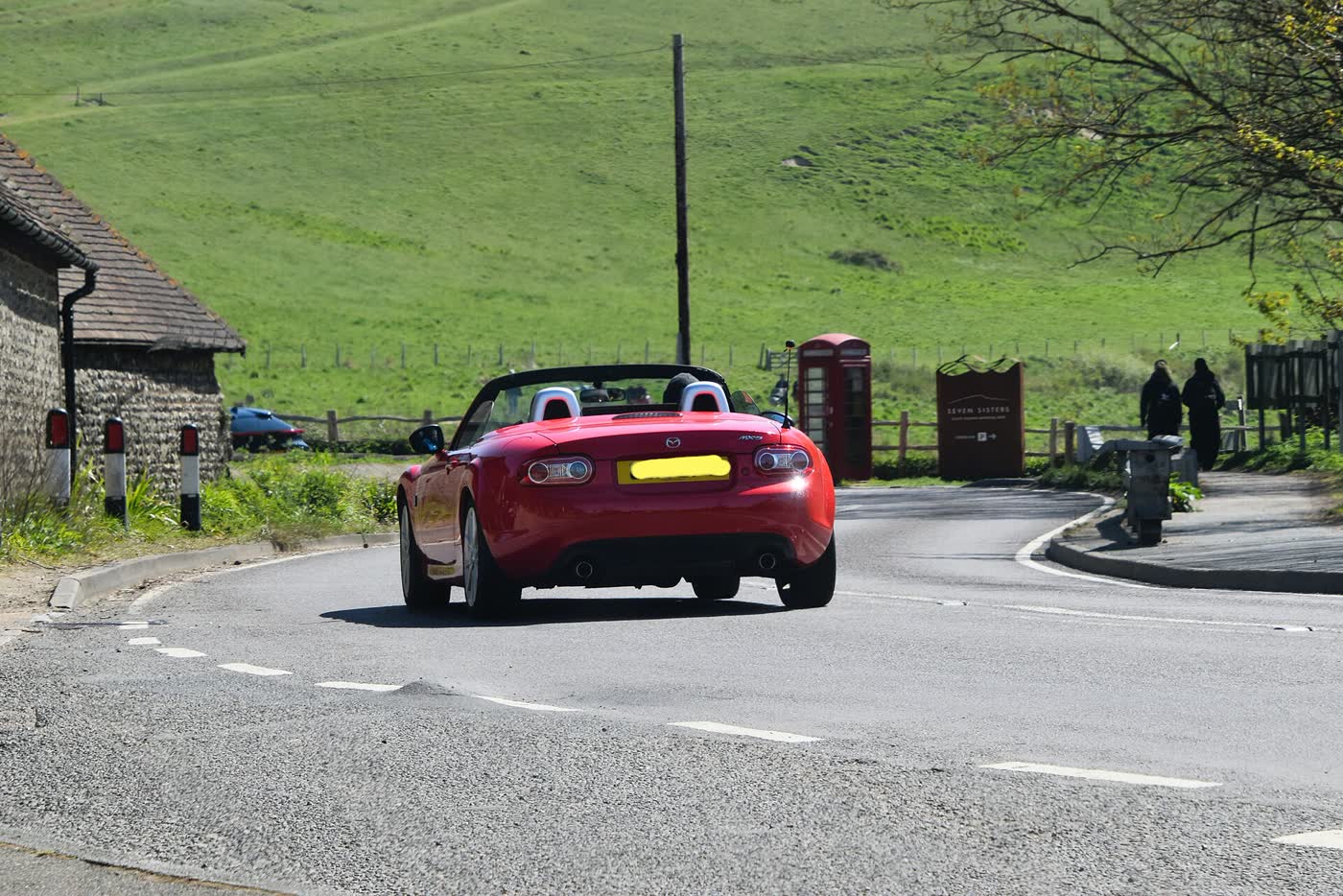
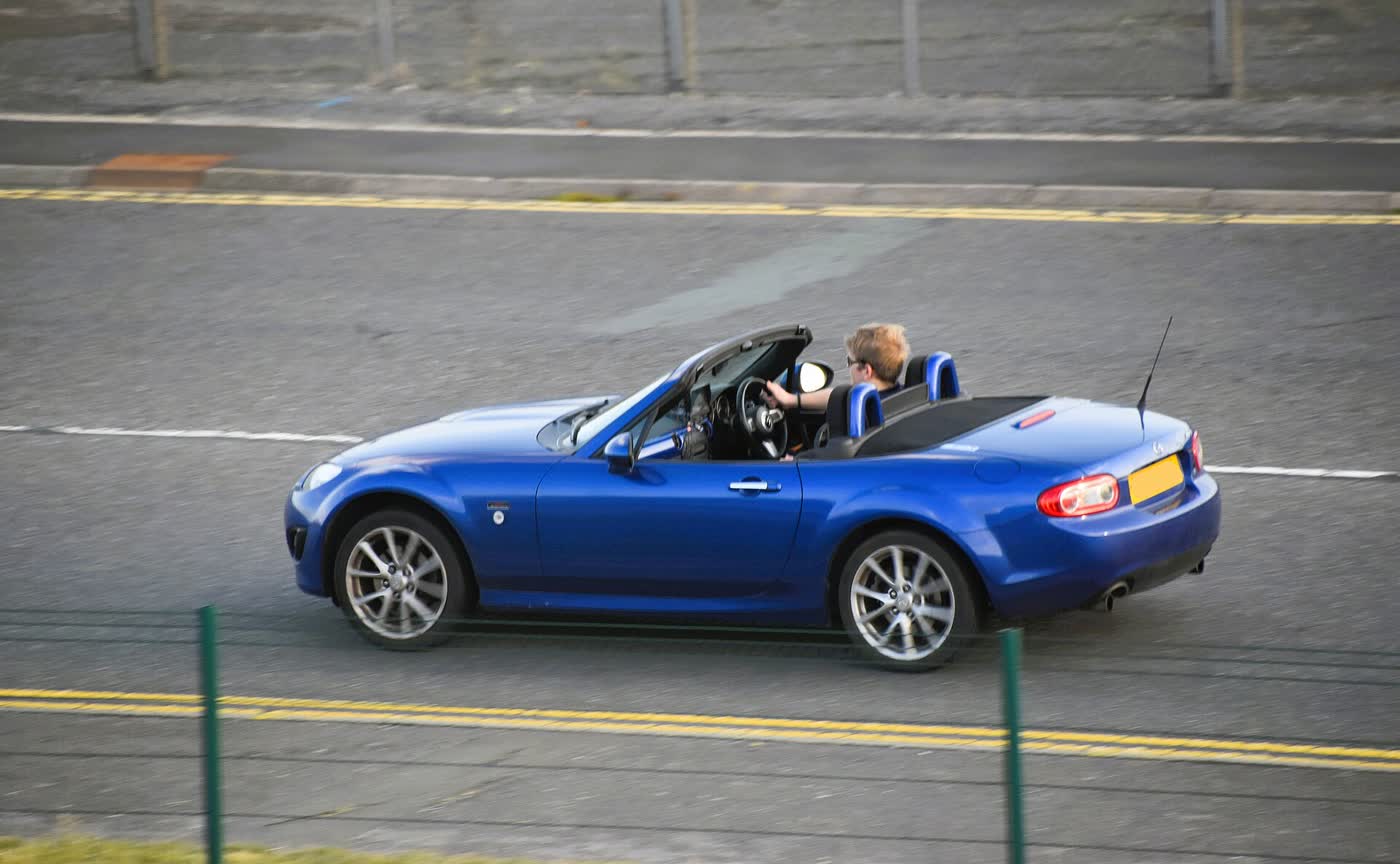
2009-2012 NC2 · 2.0 6MT · Soft-top
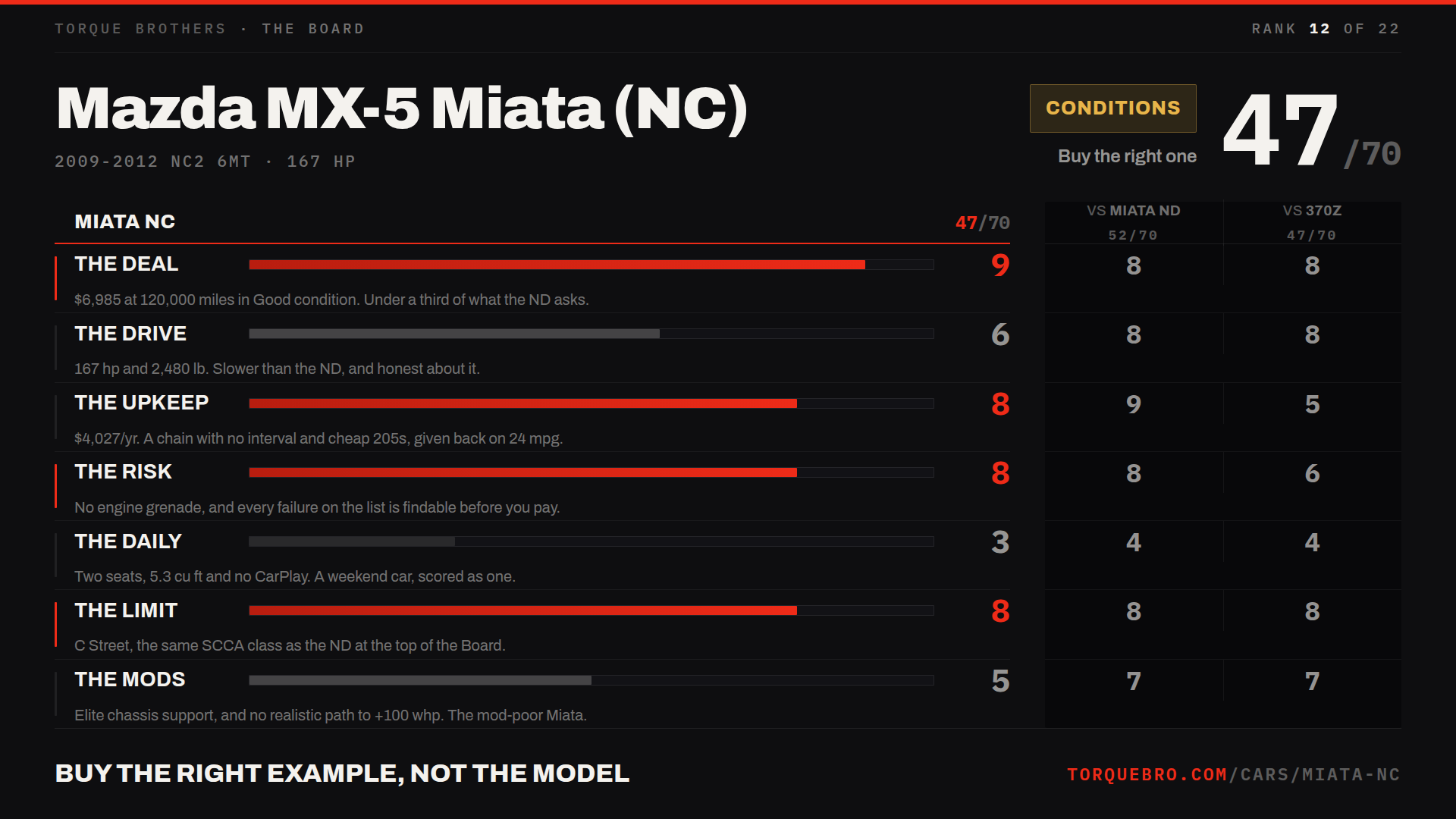
Under $7,000, and it races in the same SCCA class as the car ranked first. Buy the right example rather than the right model: lift the carpet, bounce the corners, check the arches, and feel where the clutch bites. The skip case is wanting to be fast.
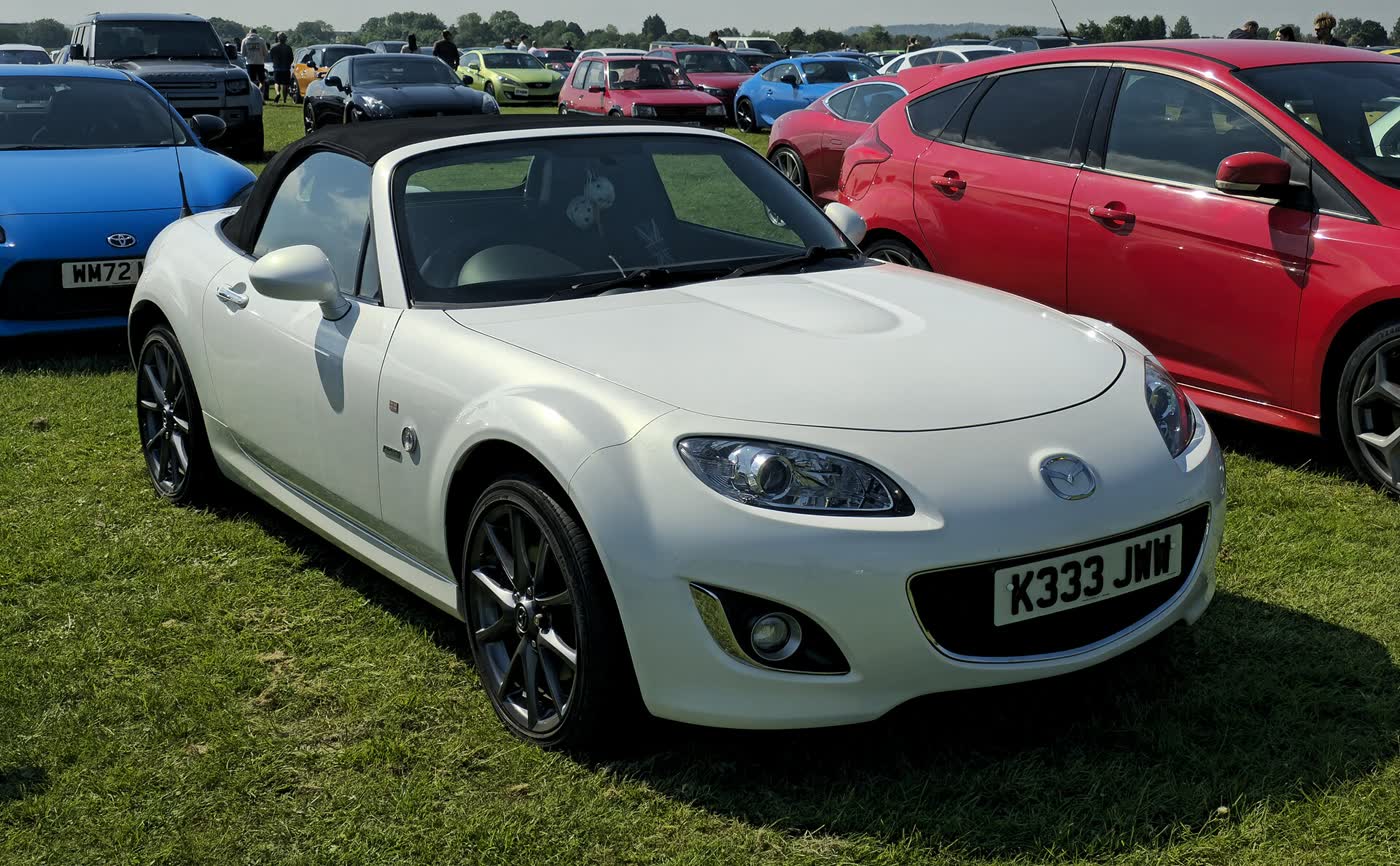
We scored the car as a 2009 to 2012 NC2 with the 2.0 engine, the six-speed manual, and the soft top, and it landed at 47 out of 70, with a verdict of Buy the right example, not the model.
This car is for someone who wants a cheap, honest way into a rear-drive sports car, is willing to inspect a fifteen-year-old car properly, and has somewhere else to put the groceries. If you want to buy a car rather than inspect one, skip to The Risk first, because on this car the inspection is the purchase.
All money figures use a fixed set of assumptions so they can be compared to other cars we cover: 12,000 miles a year, premium fuel at $4.00 a gallon, and full coverage insurance. Prices are Kelley Blue Book private-party at 120,000 miles in Good condition, which is the flat basis this whole budget tier uses. Insurance is MoneyGeek, the same source and profile as the ND, so the two are directly comparable. Insurance figures are published averages, not personal quotes.
| Figure | Miata NC (2009-2012 NC2 6MT) | Source |
|---|---|---|
| Used buy-in, private party | $6,985 | KBB |
| Condition basis | 120,000 miles, Good | KBB |
| Full condition range | $5,685 to $7,960 | KBB |
| Asking spread, 2009 cars | $5,725 to $10,250 | KBB |
| Enthusiast-market average | $15,592 across 92 sales | classic.com |
| Price trend | Not established | see below |
| Trims | Sport, Touring, Grand Touring | Cars.com |
~ our estimate, not a measured or quoted figure · * there is a caveat, and the note under the table explains it. Why we mark figures
The Deal scores a 9, and it is the reason this car is on the Board at all. Just under seven thousand dollars buys a rear-wheel-drive sports car with a proper manual gearbox, and it does it for less than a third of what the car at the top of our ranking costs. If your decision starts from a budget rather than from a shortlist, this is where the shortlist begins.
The spread is the real story, and it is the thing to understand before you shop. Kelley Blue Book puts a Good-condition car at 120,000 miles at $6,985, with the full condition range running from $5,685 to $7,960. Meanwhile classic.com records an average of $15,592 across 92 enthusiast and auction sales in a year. Those are not the same market and you must not treat them as one: the auction population skews hard toward low-mileage collector cars and its own dataset contains a $42,000 outlier. What the gap tells you is that clean examples command a large premium. It does not tell you that your car is secretly worth fifteen grand.
One thing we will not tell you, because we cannot source it: whether prices have bottomed. We had a year-on-year trend figure and we withdrew it, because it came from a search snippet and the underlying trend data turned out to sit behind a paywall. No second source exists that we could find. So there is no "wait a year and save money" advice on this page, and if you hear that line elsewhere, ask where the number came from.
A note on mileage that matters for this car specifically. Our whole budget tier prices cars at 120,000 miles so they stay comparable to each other, but Miatas are weekend cars and a 120,000-mile NC sits well above what the market actually offers. That flat basis is fair to the tier and slightly unfair to this car. In practice you will find these with far less mileage, and the numbers below get better when you do.
| Figure | Miata NC (2009-2012 NC2 6MT) | Source |
|---|---|---|
| Power-to-weight | 14.9 lb per hp | derived from the figures below |
| Power | 167 hp at 7,200 rpm | Cars.com |
| Torque | 140 lb-ft at 5,000 rpm | Cars.com |
| Curb weight | 2,480 lb | Edmunds |
| 0 to 60 mph | 6.8 sec | MotorWeek |
| Redline | 7,200 rpm | Cars.com |
| Engine | 2.0 MZR, timing chain | mx5life |
The Drive scores a 6, and we want to be straight about why rather than hide behind the badge. This is a Miata, so the steering, the balance and the way it changes direction are all still here, and they are still the reason anyone buys one. But it is 148 pounds heavier than the ND and down 14 horsepower on it, the shifter is good rather than great, and the whole car feels a half-step softer than the one that replaced it. A Miata is not automatically a Miata.
The number that frames it is 14.9 pounds per horsepower against the ND's 12.9. That is a real gap and it shows up everywhere: getting out of a junction, holding a gear up a hill, closing a gap on a back road. Six point eight seconds to 60 miles per hour is respectable for the money and slow in absolute terms. If what you actually want is the feeling of a light rear-drive car working with you at sane speeds, this delivers most of it for a third of the price. If you want to keep up with anything, it will not.
Two honest asterisks. First, all of these are as-new figures, and a car with 120,000 miles on it makes less than a car with 12; we are not going to pretend to model how much less. Second, the 0 to 60 time is the one figure here we would not bet the house on. Published times range from 6.4 to 7.0 seconds, though a good part of that spread turns out to be people quoting the earlier 158-horsepower car or the automatic rather than the manual we are scoring. We use MotorWeek's 6.8 because it is an instrumented test of the right car.
| Figure | Miata NC (2009-2012 NC2 6MT) | Source |
|---|---|---|
| Total annual running cost | ~$4,027/yr | sum of the lines below |
| Fuel | ~$2,000/yr | derived from our fixed assumptions |
| Insurance, full coverage | ~$1,512/yr | MoneyGeek |
| Tires, amortized | ~$165/yr | our estimate |
| Routine service | ~$350/yr | our estimate |
| Fuel economy | 24 mpg combined | fueleconomy.gov |
| Octane | 91 recommended, 87 permitted | Mazda owner's manual |
| Timing service | None, it is a chain | mx5life |
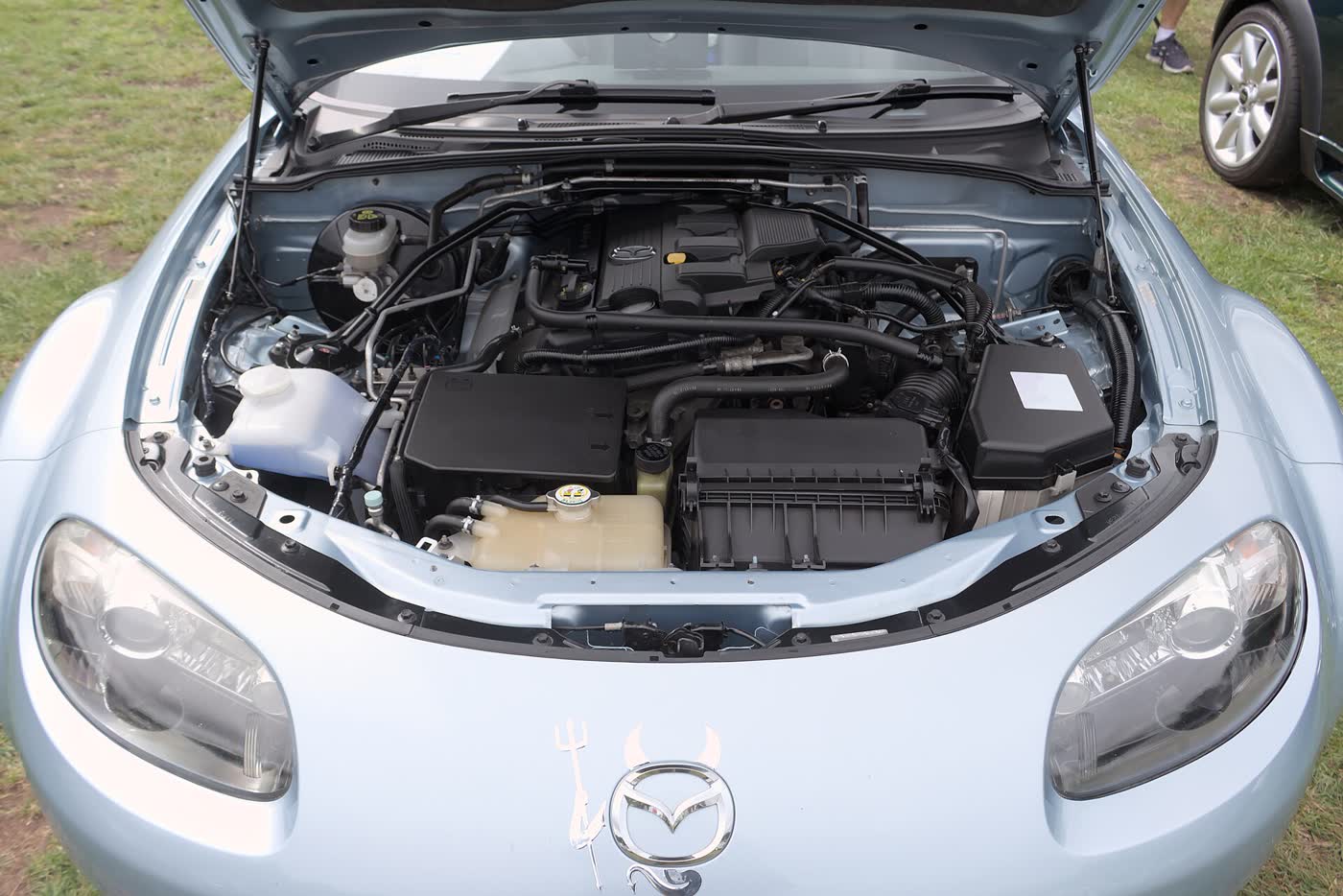
The Upkeep scores an 8, and the shape of that number is worth understanding. Almost every line is cheap. There is no timing belt, because the 2.0 MZR runs a chain with no scheduled replacement interval, which quietly removes a bill that a lot of fifteen-year-old cars carry. The tires are small 205s that cost very little and last well on a light car. Insurance at $1,512 is low for anything with two seats and rear-wheel drive.
What holds it back is fuel. Twenty-four miles per gallon is not a good number in 2026, and it is five behind the ND. That single line is most of the reason this car sits a point below the newer one here. On the octane question, the truth is more forgiving than the label: premium is recommended rather than required, and Mazda's own manual permits 87 with reduced output, which drops the fuel line to about $1,750. We score on 91 because the 167 horsepower figure in The Drive is the premium number, and it would be dishonest to claim the power and the cheap fuel at once.
Here is the correction we owe you, because we got this wrong in an earlier pass and reported it. The NC costs more to run than the ND, not less, by roughly $164 to $414 a year depending on which fuel you put in it. The earlier finding compared an insurance figure with an undisclosed profile against our MoneyGeek-derived ND number, which is exactly the kind of cross-source comparison that produces a confident wrong answer. Redone on one source, the insurance saving is $138 a year and the fuel penalty swamps it.
One more thing that changes how you should think about the cost. Full coverage at $1,512 a year is 21.6 percent of what the car is worth. Past about 10 percent, full coverage stops making sense to most people, and in the real world most owners of cars like this carry liability only. Our Board assumes full coverage for everything so the cars stay comparable, which means we are almost certainly overstating what this one costs you.
This is the most useful table on the page, and nobody publishes it, so we built it from parts pricing plus an independent labor rate. It is the difference between a cheap car and an expensive one.
| Scenario | Year-one cost | As a share of a $6,985 buy-in |
|---|---|---|
| Maintained, with service history, clutch and cooling done | ~$800 to $1,200 | 11 to 17 percent |
| Typical, certain items plus bushings | ~$1,973 to $2,415 | 28 to 35 percent |
| Neglected, everything due including the clutch | ~$4,060 to $4,882 | 58 to 70 percent |
Certain at 120,000 miles: shocks and upper mounts at $773 to $865, from a RepairPal estimate specific to 2009 to 2015 cars rather than the model-wide average; brakes around $400; fluids, plugs, filters and oxygen sensors around $400; a drain-tube service at $0 to ~$150. Likely: suspension bushings at $400 to ~$600. Possible but not certain: a cooling refresh around $500 and the clutch at $1,587 to $1,967, again from RepairPal.
Read that last column again, because it is the whole tier in one line. You are not choosing a model here, you are choosing an example, and the difference between a good one and a bad one is most of a second car. The clutch alone swings the bill by about $1,900, which is why the single most valuable thing you can do on a test drive is feel where it bites.
| Item | Shows up at | Cost | How often | Can a PPI catch it? |
|---|---|---|---|---|
| Soft-top drains block, water into the cabin | Any mileage | $0 if caught | Very common | Yes, lift the carpet |
| Top hats and shock mounts collapse | 80,000 to 120,000 | $773 to $865 | Common | Yes, bounce test |
| Rust, rear arches and rockers | Salt states | $500 to structural | Common in salt | Yes, and it is the key check |
| A/C compressor | 100,000+ | ~$800 to $1,200 | Moderate | Yes, run it cold |
| Premature pad and rotor wear | Ongoing | ~$400 | Common | Yes |
| Retractable hardtop motor | 80,000+ | ~$800 to $1,500 | PRHT cars only | Yes, cycle it three times |
| Engine, the 2.0 MZR | n/a | n/a | Rare, no catastrophic mode | n/a |
The Risk scores an 8, level with the Miata ND, the Civic Si and the Genesis Coupe. That will look strange next to a fifteen-year-old convertible, so here is the reasoning. Our Risk score is about what can blindside you after you have paid. On this car, nothing can. There is no rod bearing, no ringland, no head gasket, no chain tensioner that grenades an engine. The worst realistic repair is a clutch at up to $1,967, sourced from RepairPal, and the most characteristic failure is a blocked drain tube that lets water into the cabin.
Every single item in that table can be found before you hand over money. That is not true of most cars at any price, and it is emphatically not true of most cars at this price. A fifteen-year-old car with no hidden catastrophic failure mode and a fully inspectable fault list is a de-riskable purchase, and de-riskable is what this score rewards.
Two things to be careful of. The first is rust, which is the one item on the list that can write the car off rather than cost you a repair, so if you are shopping in a salt state, get underneath it and look at the rear arches and the rockers properly. The second is a piece of internet advice you will certainly meet: that you need to replace the timing belt every 60,000 miles. This car does not have a timing belt. The 2.0 MZR uses a chain with no replacement interval, and the belt belongs to the older NA and NB cars. A generic "Miata problems" article had blended three generations of the car together, and taking it at face value would add about $700 to your budget for a job that does not exist.
There is one genuine engine caveat, and it belongs to a car we are not scoring. The MZR is an interference design, and on 2007 cars in particular the crank and cam sprockets are keyless and can slip, which on an interference engine is a write-off rather than a repair. That is confined to the earlier NC1. It is a good reason to hold out for the 2009 or newer car beyond just the extra nine horsepower.
| Figure | Miata NC | Source |
|---|---|---|
| Cargo volume | 5.3 cu ft, soft top | Edmunds |
| Seats | 2 | Edmunds |
| Doors | 2 | Edmunds |
| Infotainment | No CarPlay, Bluetooth trim-dependent | Edmunds |
| Head-unit retrofit | ~$300 to $500 | our estimate |
The Daily scores a 3, and it deserves the explanation more than any other score on this page, because on one measure the NC actually beats the car that tops our ranking. It carries 5.3 cubic feet of luggage against the ND's 4.6. The older, cheaper car has the bigger boot. That is surprising and it is a real point in its favour.
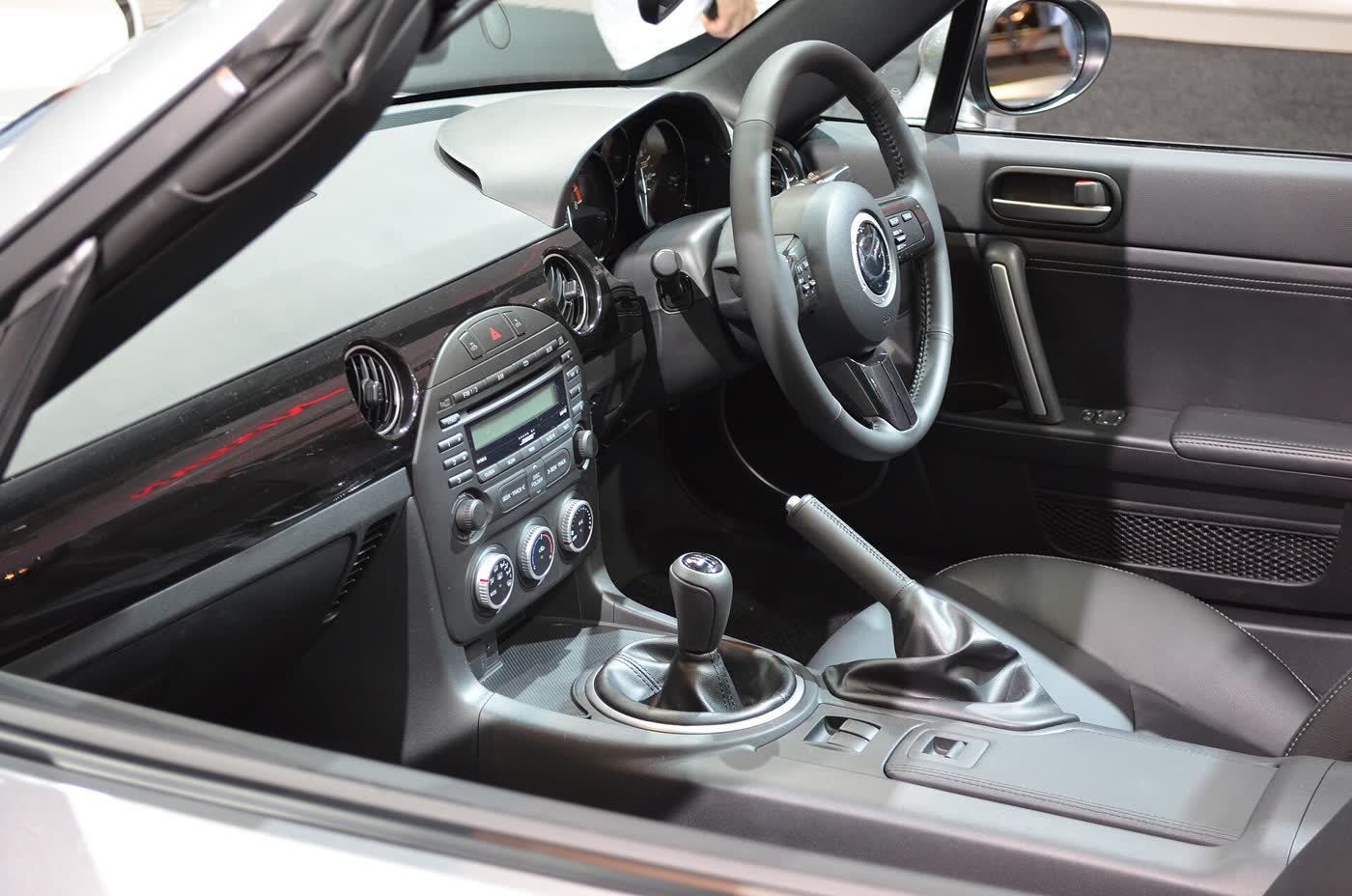
It loses anyway, because we score this category on livability rather than on cubic feet alone. Two seats, two doors, a fifteen-year-old cabin, no CarPlay, and Bluetooth that depends on which trim you found. Budget $300 to $500 for a head unit if you want your phone to work properly, and treat that as a line item rather than a surprise. Add a soft top that is the single most common source of water in the cabin, and you have a car that is harder to live with than the one it lost to on space.
We are not going to pretend this is a flaw. The NC is a weekend car and it was always a weekend car, and scoring it as a failed daily driver would miss the point entirely. The question that matters is whether you have somewhere else to put the stuff of ordinary life. If you do, this score should not move you at all. If this has to be your only car, believe the 3.
| Figure | Miata NC (2009-2012) | Source |
|---|---|---|
| SCCA Solo class | C Street | 2026 Solo Rulebook, Appendix A |
| The ND's class, for comparison | C Street | Grassroots Motorsports |
| Max grip | 0.87 g, 2010 car on OE tires | Edmunds track test |
| Braking | 113 ft, measured 60-0 | Edmunds track test |
| Limited-slip differential | Trim and option dependent | Cars.com |
SCCA C Street · shared with the Miata ND and the RX-8 on this Board.
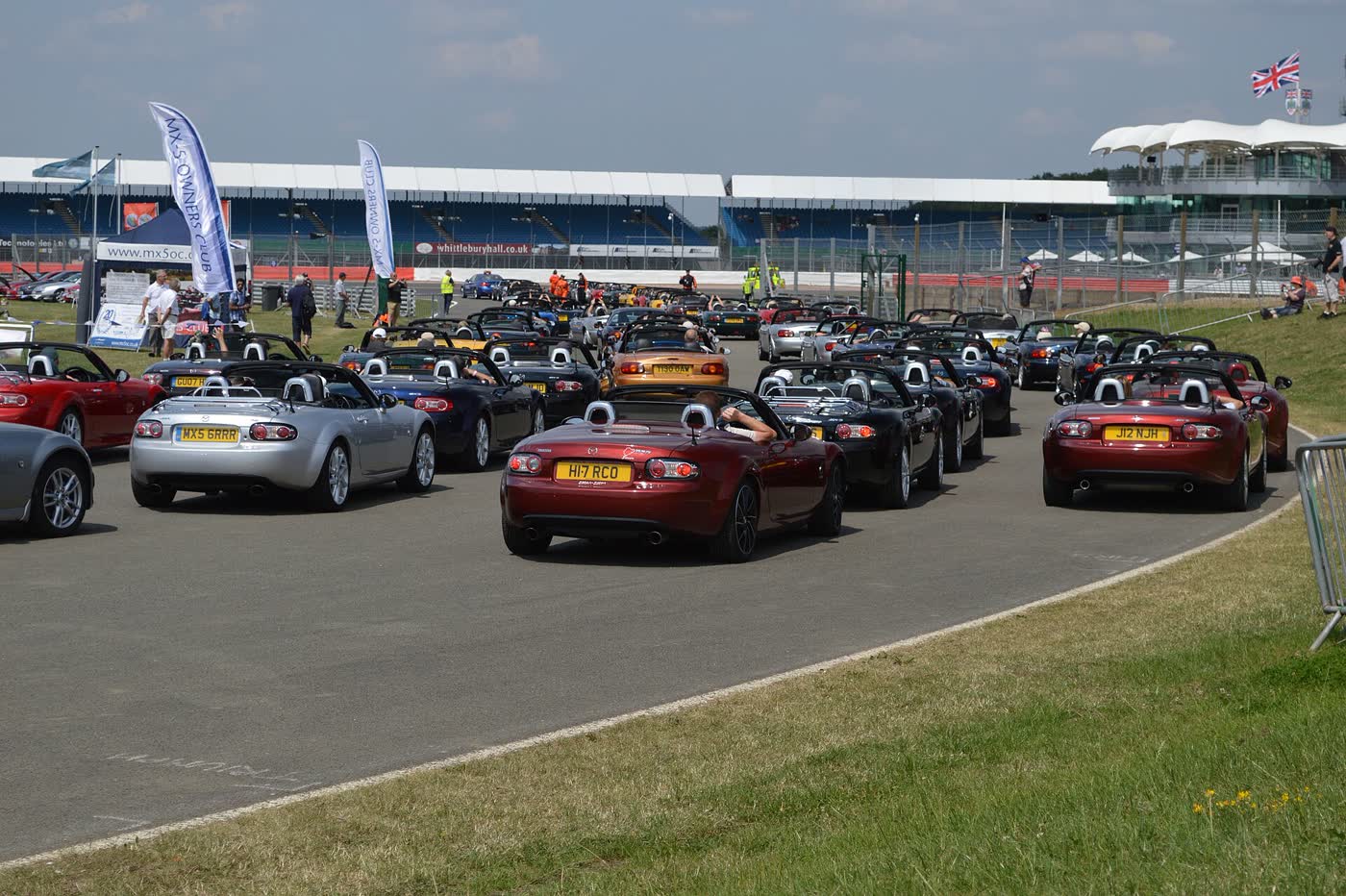
The Limit is an 8, and the headline is not a lap time or a skidpad number. It is the class. In SCCA Solo the NC runs C Street, which is the same class as the ND that sits at the top of our Board. A car you can buy for $6,985 and a car that costs $19,500 line up against each other on the same course under the same rules. That is the single most useful fact in this review, and it is current: it is confirmed in the 2026 Appendix A, effective January of this year, rather than in the eight-year-old classing document we were originally working from.
We lead on the class rather than the instrumented numbers on purpose. The grip and braking figures for a car of this age were measured in 2010 on tires that are no longer sold, which makes them a description of a car that no longer exists in that form. So quote them qualified or not at all: 0.87 g and 113 feet, on a 2010 test car on its factory rubber. And note that the 113 feet is a 60 to 0 measurement, so it cannot be lined up against the 70 to 0 figures we quote for the ND, the GR86 and the Supra. Those are different tests and we will not convert between them.
What the score is actually rewarding is how the car behaves when you push it, and there the NC does what Miatas do. It is light, it is balanced, it tells you what the rear axle is doing, and it flatters a developing driver rather than punishing one. One practical warning for shoppers: the limited-slip differential is not standard across the range on these, so if you intend to compete, confirm the car in front of you actually has one rather than assuming it.
| Path | Cost | What you get | Risk |
|---|---|---|---|
| Chassis: coilovers, bars, bushings | ~$1,000 to $3,000 | The best money you can spend on this car | Low |
| Bolt-ons and a Stage 1 tune | ~$800 to $1,500 | 8 to 12 whp | Low |
| Header and tune | ~$1,500 to $2,500 | Still short of 200 whp | Low |
| Supercharger | ~$4,000 to $5,000 | Real power, and still not +100 whp | Moderate |
The Mods scores a 5, and this is the category where the NC is weakest. We normalise this score to what it costs to add 100 horsepower at the wheels, and the honest answer for this car is that there is no path to it at any sensible price. A Stage 1 tune returns 8 to 12 horsepower. A header and a tune together still will not see 200 at the wheels. A supercharger at four to five thousand dollars is the only real route and it still does not get you 100 more.
There is a nice source note buried in that first figure. The 8 to 12 horsepower claim comes from the tuner selling the tune. We normally treat vendor power numbers as marketing, but a vendor understating what their own product does is a bias running the wrong way for them, which makes this one more credible than usual rather than less.
The other half of this is good news, and it is where your money should go. The chassis aftermarket for the NC is elite. Coilovers, bars, bushings and a decent set of tires will transform how this car drives for a fraction of what a power build costs, and none of it hurts reliability. There is also an unusual footnote here: modifying this car does not accelerate a failure. The MZR is robust enough that the risk you are running is wasted money rather than a destroyed engine, which is the exact opposite of the trade you make modifying a WRX. Spend it on the corners, not on the engine.
Buy the right example, not the model. It scores 47 out of 70 on our Board, and it gets there on a $6,985 buy-in, a reliability score of 8, and an SCCA class it shares with the car ranked first, then giving it all back on pace, practicality and any hope of cheap power.
The condition is the whole review. Lift the carpet behind both seats, bounce-test all four corners, check the rear arches and the rockers from underneath, and feel where the clutch bites. Do those four things and you know which side of a three-thousand-dollar line the car in front of you sits on.
This car is for you if you want a cheap, honest way into a rear-drive sports car, you will actually inspect one properly, and you have another vehicle for real life. It is not for you if you want speed, if you want to modify your way to power, or if this has to be the only car you own.
So you wanna buy a cheap Miata. Here is the short version before we get into it: the NC costs under $7,000, it competes in the same SCCA class as the car ranked first, and the difference between a good one and a bad one is about three thousand dollars you will spend in your first year of ownership. Whether you should buy one comes down almost entirely to whether you are willing to inspect it properly.
We scored it as a 2009 to 2012 NC2 with the 2.0 engine, the six-speed manual and the soft top, and it landed at 47 out of 70. Every part of that scope is doing work, and we will explain why as we go.
Six thousand nine hundred and eighty-five dollars. That is a Good-condition car at 120,000 miles, private party, which is the flat basis we price this whole budget tier on. The full condition range runs $5,685 to $7,960, and asking prices on 2009 cars spread from about $5,725 to $10,250 depending on trim and body style. Whatever else is true about this car, very little else gets you into rear-wheel drive for the money.
Now the part that confuses people. If you search for NC Miata values you will find an enthusiast-market average of $15,592 across 92 sales, and you might conclude the Blue Book number is nonsense. It is not. Those are two different markets. The higher figure comes from auction and enthusiast sales, a population that skews hard toward low-mileage collector cars, and that same dataset contains a car that sold for $42,000. What the gap actually tells you is that clean examples command a large premium over an average one, which is useful. It does not tell you that the tired car with 130,000 miles on it is secretly worth fifteen grand.
One thing we are not going to tell you is whether prices have bottomed out, because we cannot source it. We had a year-on-year trend figure, we checked it, and it turned out to have come from a search snippet with the real trend data sitting behind a paywall. So we pulled it. There is no "wait a year and save" advice here, and you should be suspicious of anyone who gives you that advice without showing you where the number came from.
A word on mileage, because it matters more for this car than for most. We price everything in this tier at 120,000 miles so the cars stay comparable to each other. But Miatas are weekend cars, and a 120,000-mile NC is well above what you will actually find on the market. That standard is fair to the tier and a little unfair to this particular car, and you should expect to do better than these numbers in practice.
Honestly? Slower than you want it to be. It makes 167 horsepower and 140 pound-feet, it weighs 2,480 pounds, and that works out to 14.9 pounds per horsepower against the ND's 12.9. Six point eight seconds to 60. We are not going to dress that up.
What survives is the important half. The steering still talks to you, the balance is still there, and it still changes direction the moment you think about it, because it is still a light rear-drive roadster with a good chassis under it. What you lose against the newer car is the sharpness. It is 148 pounds heavier, it is down 14 horsepower, and the shifter is good rather than great. Do not let anyone tell you a Miata is a Miata. The gap between the NC and the ND is real, and at a third of the price it is also completely fair.
Two asterisks worth knowing before someone puts them in the comments. Every figure above is an as-new number, and a car with 120,000 miles on it makes less than that; we are not going to invent a figure for how much less. And the 0 to 60 time is the softest number on this page. You will see anything from 6.4 to 7.0 seconds quoted, but a lot of that spread is people quoting the earlier 158-horsepower NC1 or the automatic instead of the manual we are scoring. We use 6.8 because it comes from an instrumented test of the right car.
Mostly yes, with one line item that spoils it. Running costs come to about $4,027 a year: roughly $2,000 of fuel, $1,512 of insurance, $165 of tires and $350 of routine service. The tires are small and cheap. The insurance is low. And there is no timing belt to budget for, because the 2.0 MZR runs a chain with no scheduled replacement interval at all.
Fuel is what holds it back. Twenty-four miles per gallon combined is a mediocre number and it is five behind the ND. That gap is most of the reason The Upkeep scores an 8 here against the newer car's 9. On octane, the news is better than the label suggests: premium is recommended rather than required, and Mazda's own manual permits 87 with reduced output, which takes the fuel line down to about $1,750 a year. We score on 91 because the 167 horsepower we quoted in the drive section is the premium figure, and you do not get to claim the power and the cheap fuel in the same breath.
Now a correction we owe you, because we published the opposite of this and it was wrong. The NC costs more to run than the ND, not less. About $164 to $414 a year more, depending on which fuel you use. Our earlier finding compared an insurance quote with an undisclosed profile against our own MoneyGeek-derived figure for the ND, which is the kind of apples-to-oranges comparison that gives you a confident answer in the wrong direction. Redone on one source for both cars, the insurance saving is $138 a year and the fuel penalty is bigger than that.
One last thing about the cost, and it cuts the other way. Full coverage insurance at $1,512 is 21.6 percent of what this car is worth. Once a premium passes roughly ten percent of a car's value, full coverage stops making sense for most people, and in the real world most owners of cars like this run liability only. Our Board assumes full coverage on everything so cars stay comparable, which means the number above is almost certainly higher than what you will actually pay.
This is the number nobody publishes and it is the most useful thing on this page, so we built it from parts pricing and an independent labor rate rather than from a forum post.
A maintained car, one with service history where the clutch and cooling have been done, needs about $800 to $1,200 in year one. A typical car, where the certain items are due plus bushings, runs about $1,973 to $2,415. A neglected car, where everything is due including the clutch, runs $4,060 to $4,882.
Sit with that last one for a second. On a $6,985 purchase, the neglected example costs 58 to 70 percent of the purchase price to put right. The maintained one costs 11 to 17 percent. Same model, same year, same mileage, and one of them costs you most of a second car. This is the whole thesis of shopping at this price: you are not choosing a model, you are choosing an example.
The single item that swings it most is the clutch, at $1,587 to $1,967. It is not certain at 120,000 miles, which is exactly why it matters, because it means feeling where the clutch bites on the test drive is worth about $1,900 to you.
Here is the finding that surprised us, and it is the reason this car scores as well as it does. There is no engine grenade. No rod bearing, no ringland, no head gasket, no tensioner that turns a fifteen-year-old car into scrap. The worst realistic repair on the list is a clutch at up to $1,967, and the most characteristic failure of the whole generation is a blocked drain tube that lets water into the cabin.
The list runs roughly like this. Soft-top drains block and water gets in, at any mileage, very commonly, and you find it by lifting the carpet behind the seats. Top hats and shock mounts collapse between 80,000 and 120,000 miles, at $773 to $865, and you find them by bouncing the corners and driving a broken surface. Rust appears at the rear fender arches and the rockers in salt states. The air conditioning compressor gets tired past 100,000 miles. Pads and rotors wear faster than you would like. And if you are looking at a retractable hardtop car rather than a soft top, the roof motor is its own $800 to $1,500 question, which is one of the reasons we scoped this review to the soft top.
Now read that list again and notice what it has in common. Every single item on it can be found before you hand over money. That is the argument for this car and it is why The Risk scores an 8 on a fifteen-year-old convertible. A car with no hidden catastrophic failure mode and a fully inspectable fault list is a car you can de-risk, and de-risking is exactly what our Risk score is meant to reward.
Two warnings. Rust is the one item that can write the car off rather than cost you a repair, so if you are shopping anywhere they salt the roads, get underneath it properly. And you will absolutely run into advice telling you to replace the timing belt every 60,000 miles. This car has no timing belt. It has a chain, with no replacement interval. That advice belongs to the older NA and NB Miatas, and it comes from generic articles that blend three generations of the car into one. Believe it and you have added about $700 to your budget for a job that does not exist.
There is one real engine caveat, and it belongs to a car we deliberately did not score. The MZR is an interference engine, and on 2007 cars in particular the crank and cam sprockets are keyless and can slip, which on an interference design means a destroyed engine rather than a repair bill. That is an NC1 problem and our scope starts at 2009. It is a better reason to hold out for the newer car than the extra nine horsepower is.
No, and it scores a 3 on The Daily. But there is a surprising detail in here first. The NC carries 5.3 cubic feet of luggage and the ND carries 4.6. The older, cheaper car has the bigger boot. That is a real point in its favour and it cuts against everything you would assume.
It loses the category anyway, because we score livability rather than cubic feet. Two seats, two doors, a cabin designed before smartphones existed, no CarPlay, and Bluetooth that depends entirely on which trim you found. Budget three to five hundred dollars for a head unit if you want your phone to work like it does in a modern car, and treat that as a known cost rather than a nasty surprise. Then add a soft top that is the most common way water gets into this car, and you have something that is harder to live with day to day than the newer car that it beat on space.
None of that is a criticism. It is a weekend car and it always was, and judging it as a failed family car would be missing the point completely. The only question that matters is whether something else in your life handles the boring jobs. If it does, this score should not move you at all.
Yes, and this is the best single fact in the entire review. In SCCA Solo, the NC runs C Street. So does the ND that sits at the top of our Board. A car you can buy for $6,985 and a car that costs $19,500 line up on the same course, in the same class, under the same rules. If you have ever wanted a cheap way to find out whether you are actually any good, that is it.
That classing is current, which matters more than it sounds. We originally had it from an eight-year-old club document, and SCCA moves cars between classes, so we went and confirmed it against the 2026 Appendix A that took effect in January. The most quotable claim in this review was resting on a stale source, and now it is not.
We lead on the class rather than on grip and braking numbers for a reason. The instrumented figures for a car this old were measured in 2010 on tires you cannot buy anymore, so they describe a car that no longer exists in that form. For the record they are 0.87 g and 113 feet, and that braking figure is a 60 to 0 measurement, which means it cannot be compared against the 70 to 0 numbers we quote for the ND, the GR86 and the Supra. Different test, and we are not going to convert between them to make a tidier table.
What The Limit is actually scoring is how the car behaves when you lean on it, and there the NC does what Miatas do. Light, balanced, honest about what the rear axle is doing, and forgiving of a driver who is still learning. One practical warning if you plan to compete: the limited-slip differential was not standard across the range, so check that the car in front of you actually has one instead of assuming it does.
Yes, but not the engine. The Mods scores a 5, and for making power this is the weakest platform we have looked at. We measure this category by what it costs to add 100 horsepower at the wheels, and the honest answer here is that there is no route to it at a sane price. A Stage 1 tune gives you 8 to 12 horsepower. A header and a tune together still will not see 200 horsepower at the wheels. A supercharger at four to five thousand dollars is the only real option and even that does not get you 100 more.
There is a nice detail behind that first figure. The 8 to 12 horsepower number comes from the company selling the tune. We normally treat tuner power claims as marketing, but a vendor understating what their own product does is a bias running against their own interest, which makes that number more trustworthy than usual instead of less.
The good news is the other half of the category, and it is where your money should go. The chassis aftermarket for this car is elite. Coilovers, bars, bushings and a proper set of tires will change how this car drives far more than any engine work will, for less money, and none of it hurts reliability. And there is an unusual footnote: modifying this car does not accelerate a failure. The engine is robust enough that what you are risking is wasted money rather than a destroyed motor, which is the exact opposite of the bargain you make when you modify a WRX. Spend it on the corners.
This is the comparison that actually matters, because the NC exists on our Board as the budget rung directly underneath the car ranked first. The ND is better in almost every way that involves moving: quicker, sharper, better shifter, better cabin, and a car you could plausibly live with. It also costs nearly three times as much.
What the NC gives you is most of the character for a third of the money, and the same SCCA class to use it in. What it takes back is honesty about running costs, because it is $164 to $414 a year more expensive to run than the ND, not less. If you can afford the ND, buy the ND; it finished at 52 to the NC's 47 for good reasons. If you cannot, the NC is not a consolation prize, it is the same idea at a price that a lot more people can actually reach.
Buy the right example, not the model. That is the whole review in one line, and it is not a hedge. On this car the inspection is the purchase, because the model is sound and the individual car in front of you might not be.
Four things, and they take twenty minutes. Lift the carpet behind both seats and feel for damp. Bounce all four corners and drive it over something broken. Get underneath and look at the rear arches and the rockers. And feel where the clutch bites. Do those and you know which side of a three-thousand-dollar line you are standing on.
The NC Miata finished at 47 out of 70 on our Board. It lands level with the 350Z on the Deal, posts a reliability score of 8, and shares a race class with the car ranked first, then hands most of it back on pace, on practicality, and on any hope of cheap horsepower. If you want a cheap, honest way into a rear-drive sports car and you are willing to shop like an adult, this is it. If you want to be fast, or you want one car to do everything, this is not your car.
Filming reference: cue sheet · for the hosts on set, not part of the review.
The frame that closes our video: the Miata NC at 47/70, with the Miata ND and the 370Z alongside.