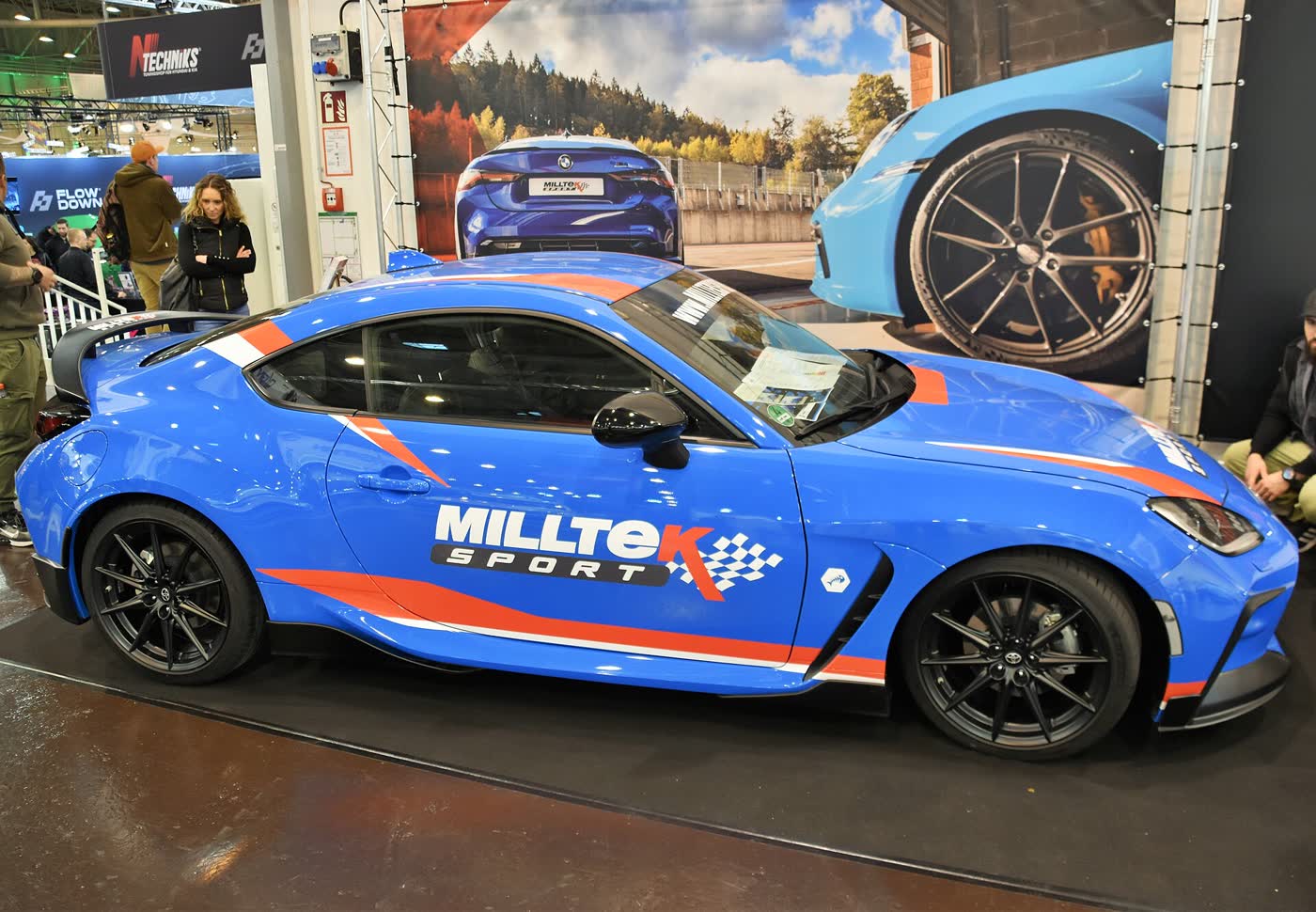
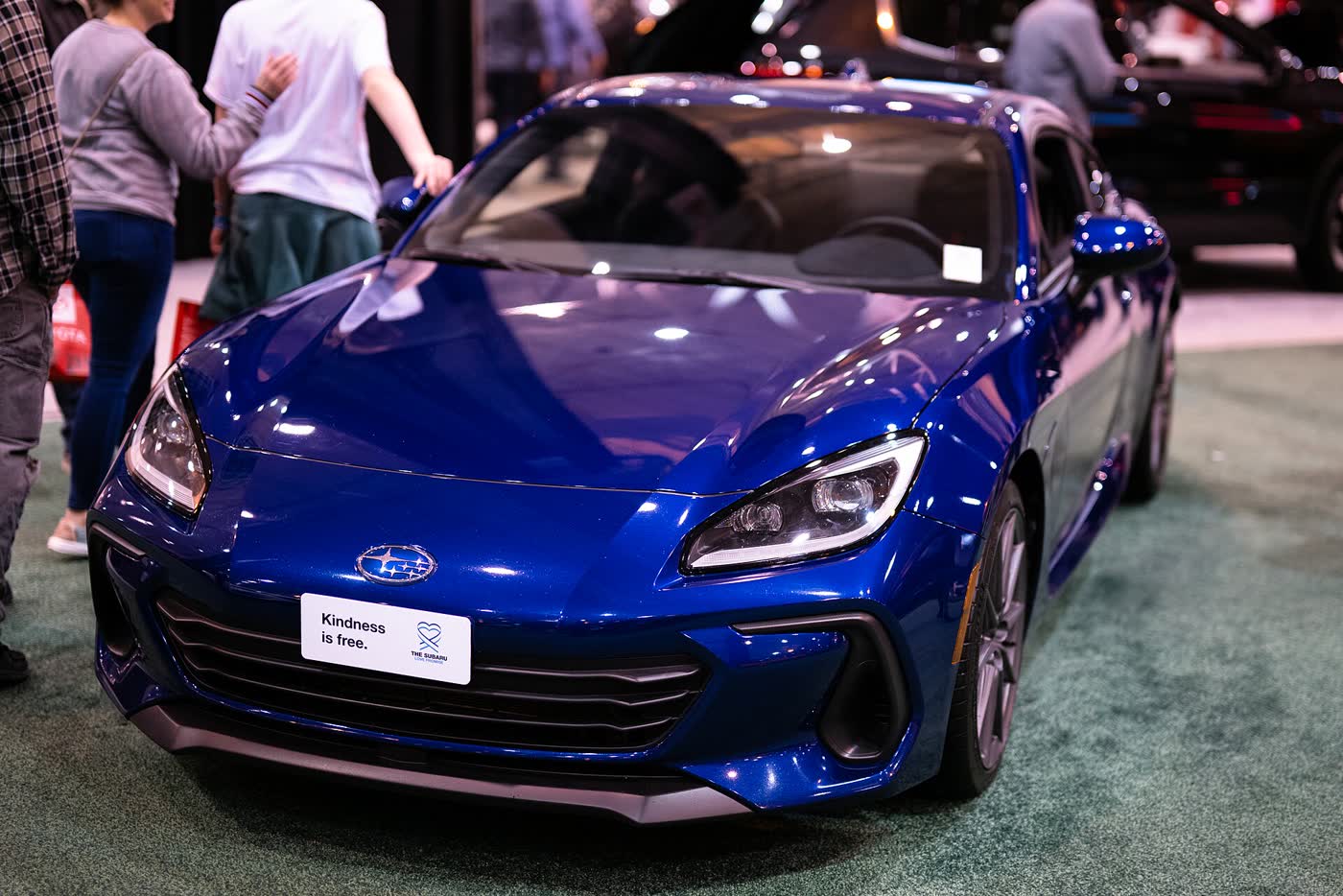
2022+ FA24 · Manual · Subaru BRZ twin
First-hand: we have driven a GR86.
Buy it, but buy it right. Get a 2022 or newer manual with a pre-purchase inspection that confirms the engine's oil-pan and RTV work has been done. That single condition de-risks the one thing that threatens this car.
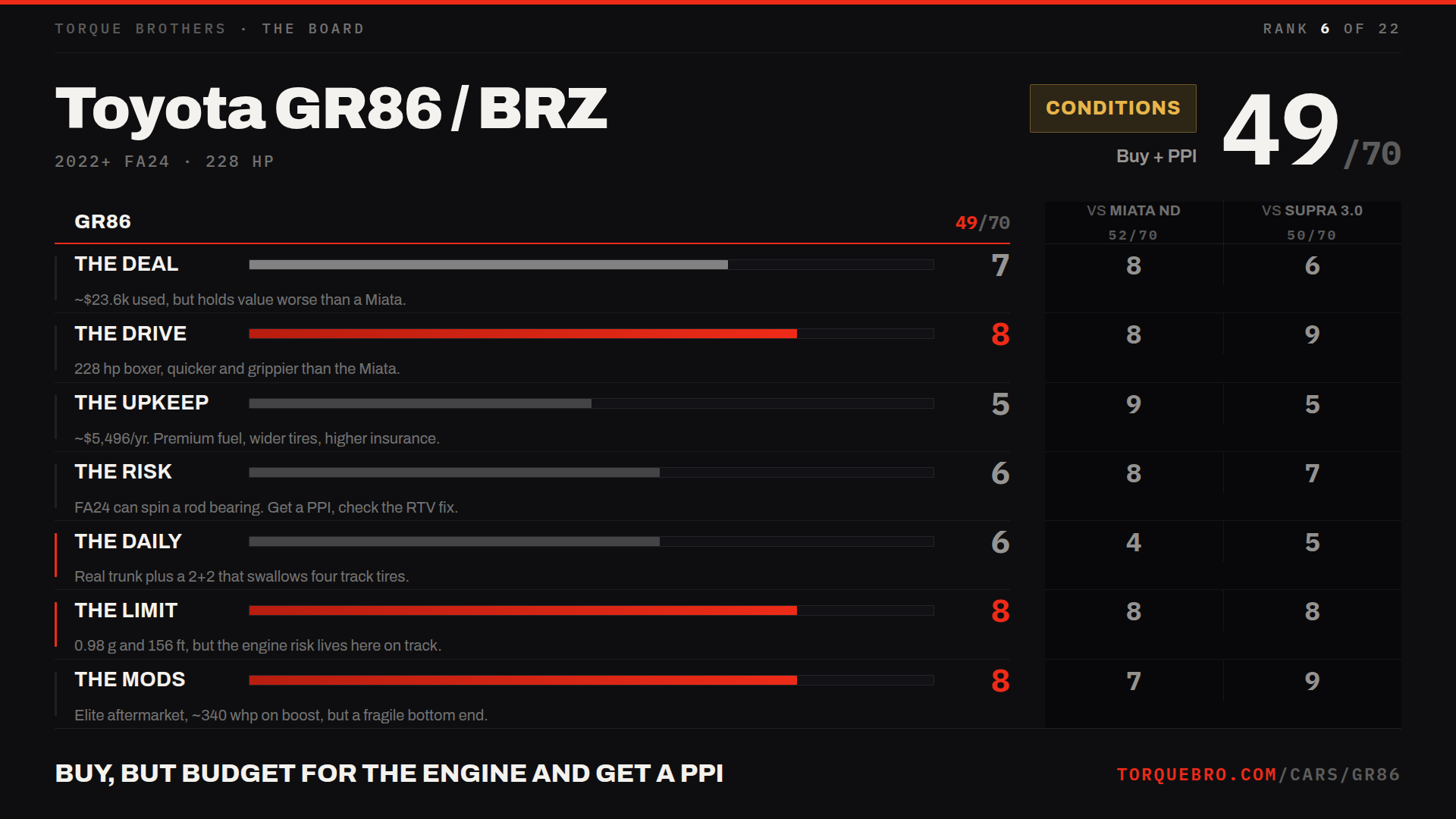
We scored the car as a 2022 or newer GR86 with the manual, and it landed at 49 out of 70, with a verdict of Buy, but budget for the engine and get a pre-purchase inspection.
This car is for someone who wants a genuine driver's car that can also carry a little more than a two-seater, who values grip and pace, and who is willing to do one specific piece of preventive maintenance. If you plan to track it hard and skip the upkeep, skip to The Risk first.
All money figures use a fixed set of assumptions so they can be compared to other cars we cover: 12,000 miles a year, premium fuel at $4.00 a gallon, and insurance for a 35-year-old driver with a clean record and full coverage. Insurance numbers are published averages, not personal quotes. Prices are from Kelley Blue Book.
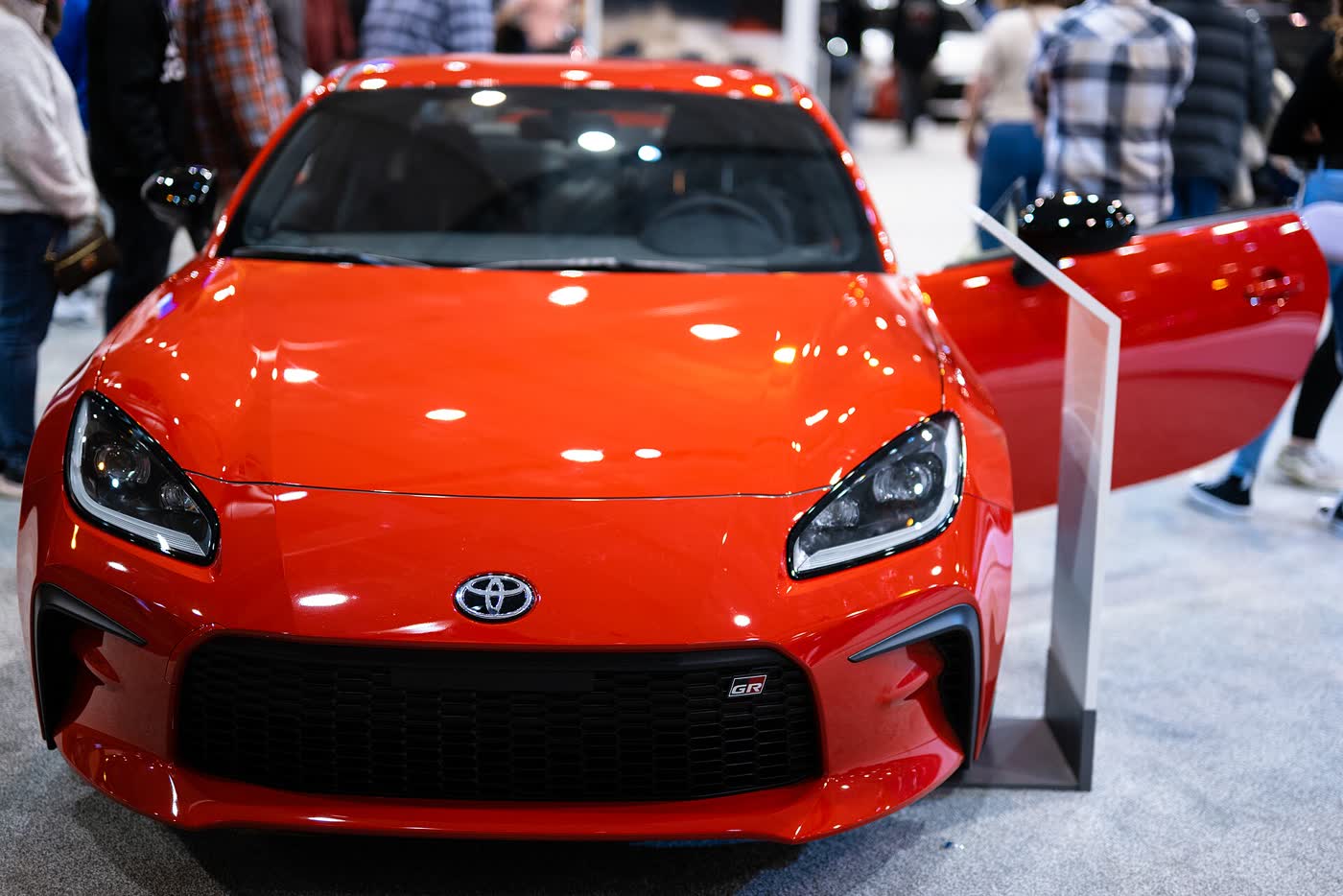
| Figure | GR86 (2022+ manual) | Source |
|---|---|---|
| Used buy-in (KBB private-party) | ~$23,600 | KBB, 2022 Coupe 2D in Good condition |
| Typical retail listing | ~$28,500 | we found no published source for this figure |
| New price today | ~$30,000 | we found no published source for this figure |
| 3-year resale retention | ~78% (range 76 to 82) | derived: KBB private party $23,500 divided by the original $30,225 price (2022 Coupe 2D) is 78%. The 76 to 82 range: we found no published source for this figure |
| Trims | Base (17s), Premium (18s) | KBB: the base car rides on 17-inch wheels, the Premium on 18s |
~ our estimate, not a measured or quoted figure. Why we mark figures
The GR86 is a strong value in absolute terms, but this is a category it loses to the Miata, and it is worth being clear about why. It costs several thousand dollars more to buy, roughly $23,600 against the Miata's $19,500, and it holds its value noticeably worse, shedding 18 to 24 percent over three years where the Miata holds close to 90 percent of its money. So you pay more up front and you get less of it back later.
What you are buying for that premium is more car, which the next few sections make the case for. But if your decision is driven first by budget and by protecting your money, the GR86 is the pricier, higher-depreciation choice, and you should go in knowing that. The trim question is refreshingly simple: there is no must-have package, so buy the cleanest, best-documented car you can find rather than chasing a specific trim.
| Figure | GR86 (2022+) | Source |
|---|---|---|
| Power-to-weight | 12.4 lb per hp | derived: 2,833 lb divided by 228 hp |
| Power | 228 hp, 184 lb-ft | Toyota press release |
| Curb weight | ~2,833 lb | iSeeCars, Premium with the manual |
| 0 to 60 mph | ~5.4 sec | Car and Driver, via Yahoo, as tested |
| Engine | 2.4L flat-four boxer, 7,500 redline | Toyota press release for the 2.4L flat-four. The 7,500 rpm redline: we found no published source for this figure |
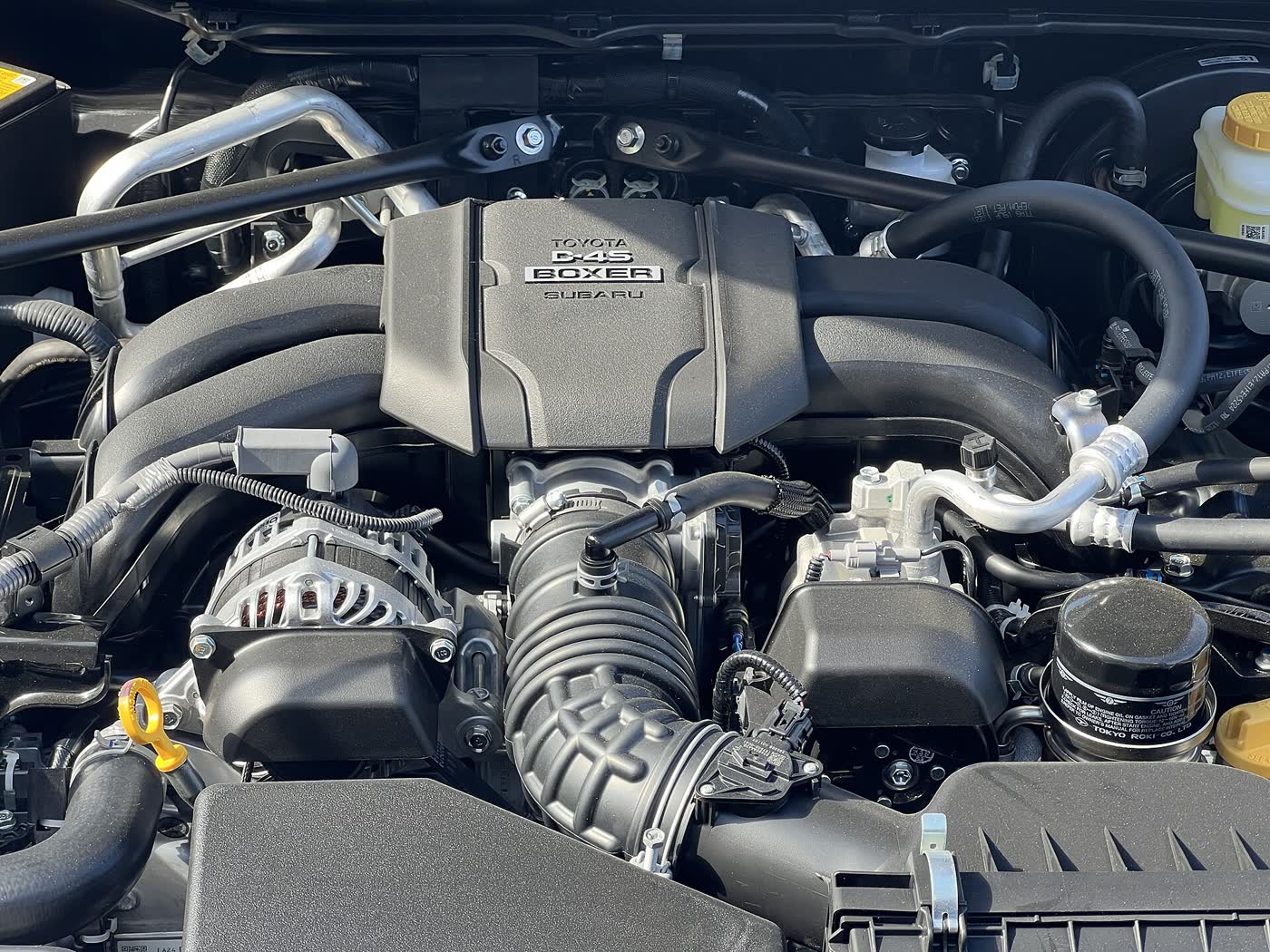
This is where the GR86 earns its place, and where it beats the Miata cleanly. More power, a better power-to-weight ratio, a quicker sprint to 60, and a distinctive boxer engine note you will not find anywhere else at the price. The second-generation 2.4-liter engine matters here specifically, because it fixed the flat midrange that made the original 86 feel gutless in the exact rev range you use most on a back road.
So the buyer question is about flavor. If you want the more muscular, more usable, more modern-feeling driver's car, the GR86 is the pick, and it will feel quicker and grippier than a Miata in every real-world situation. If you want featherweight delicacy and open-top purity, the Miata answers back. Both are engaging, they just engage differently, and the GR86's version comes with the extra pace most people will appreciate.
| Figure | GR86 (2022+) | Source |
|---|---|---|
| Total annual running cost | ~$5,496/yr | derived: fuel $2,087 plus insurance $2,589 plus tires $320 plus service $500 |
| Fuel | ~$2,087/yr (23 mpg, premium) | we found no published source for this figure |
| Insurance | ~$2,589/yr | derived: MoneyGeek full-coverage monthly rates for the 2022 to 2025 model years ($196, $217, $221 and $229) averaged, times 12 |
| Tires (amortized) | ~$320/yr | our estimate |
| Routine service | ~$500/yr | our estimate |
| Insurance class rank | 32nd of 115 sports cars | MoneyGeek |
The GR86 costs meaningfully more to run than the Miata, around $5,496 a year against $3,627, and the difference is worth understanding before you commit. It drinks 91-octane premium, its wider and grippier tires cost more and wear faster, and it sits mid-pack for insurance where the Miata sits first in its class. Add it up and it is roughly $1,870 a year more to keep.
For most buyers that is a perfectly acceptable cost for the extra performance and practicality, and $5,496 a year is not a scary number for a sports car. But if low running cost is near the top of your list, this is a clear second to the Miata, and no amount of the GR86's extra ability changes that math.
| Figure | GR86 (2022+) | Source |
|---|---|---|
| Worst realistic repair | Spun rod bearing / engine failure (~$6,500) | Hagerty for the failure. The ~$6,500 cost: we found no published source for this figure |
| Reliability rating | 4.0 / 5.0 owner rating | KBB consumer reviews, reliability |
| The named concern | FA24 oil starvation (RTV clog + track oil-pressure drop) | Hagerty |
| Mitigation | Proactive RTV/oil-pan clean, oil cooler for track | Hagerty covers the RTV clean. The oil cooler for track use is our advice |
| Buy-check | PPI confirming the oil-pan work was done | our advice |
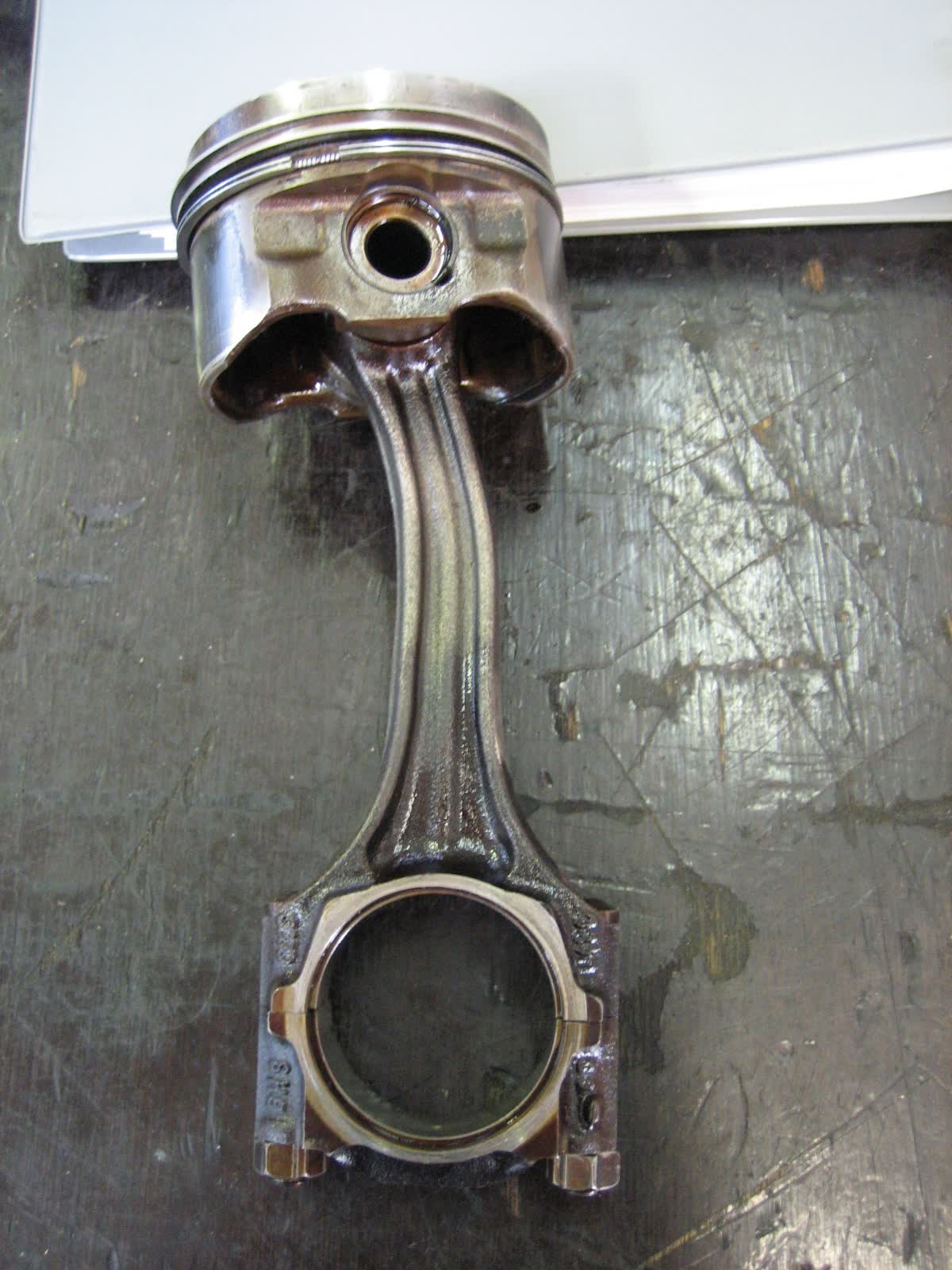
This is the GR86's real weakness and the reason it scores where it does. Multiple independent sources have documented the FA24 engine spinning a connecting-rod bearing and failing, linked to excess factory RTV sealant clogging the oil pickup and to oil-pressure drops in sustained right-hand cornering on track. That is a genuine, catastrophic, well-documented risk, not a forum rumor.
The part that should shape your decision is who is exposed. The failures cluster on tracked cars, which is exactly what a lot of GR86 buyers use them for, so if you are one of those buyers this is a live concern rather than a footnote. The daily-driven risk is lower, and the car is otherwise reliable, but you are buying an engine you have to manage.
The reason this is a Buy and not a Skip is that the risk is mitigable and checkable. A proactive oil-pan drop to clean the RTV, an oil cooler for track use, and a pre-purchase inspection that confirms the work was done will de-risk the whole thing. If you are willing to do that, the Risk becomes manageable. If you are not, this is the car's dealbreaker.
| Figure | GR86 | Source |
|---|---|---|
| Cargo volume | 6.3 cu ft | KBB |
| Seats | 4 (2+2) | Toyota press release |
| Rear legroom | 29.9 in | iSeeCars |
| Front legroom | 41.5 in | KBB |
| Party trick | Fold-flat rear seats fit a full set of track tires | Toyota GR86 features (2024): fold the rear seats to store tires |
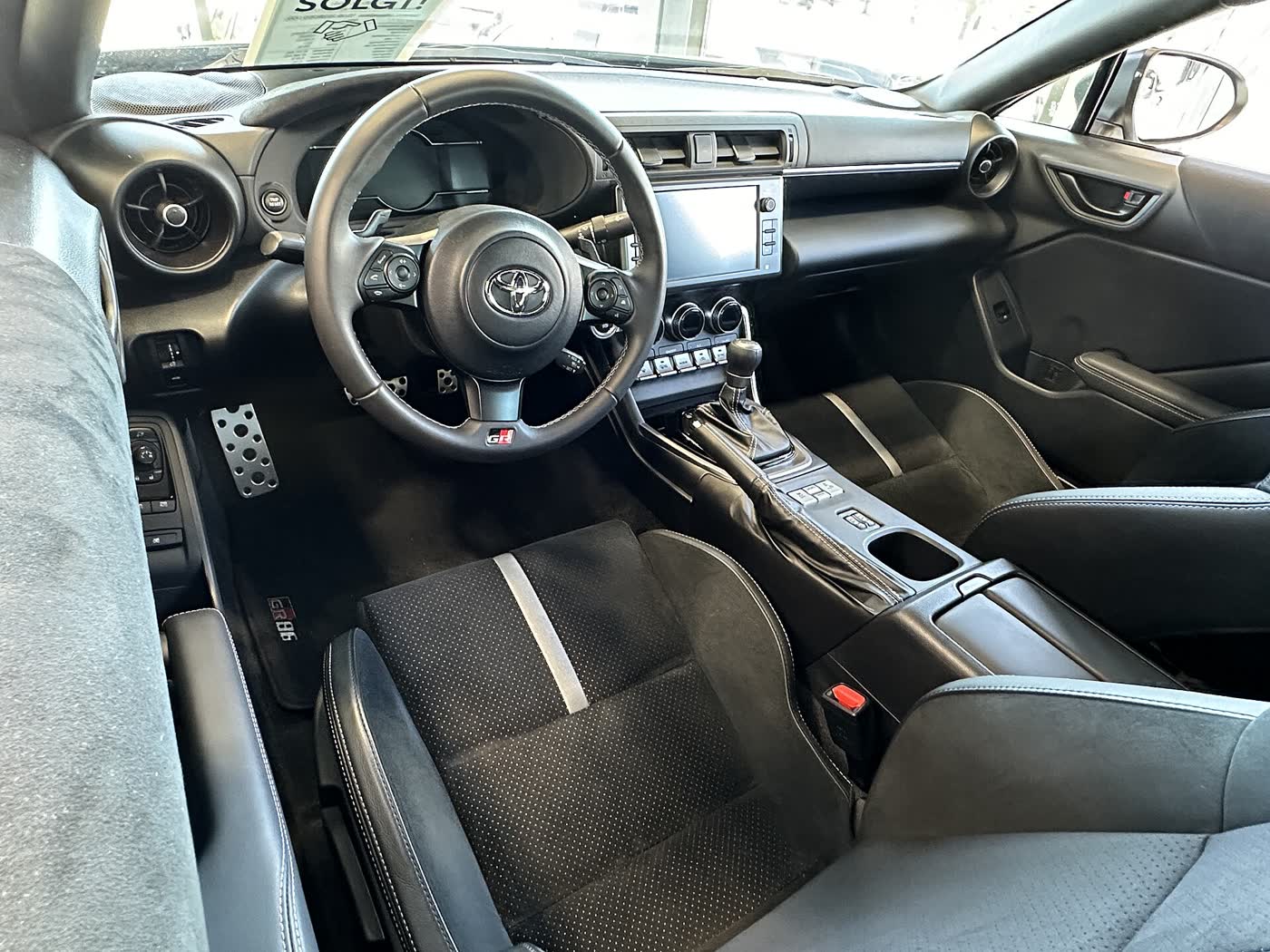
The GR86 is meaningfully more livable than a Miata, and this is its other real win. A proper trunk, a usable 2+2, and the famous ability to fold the rear seats flat and swallow four track wheels make it a flexible car. The back seat is tight, so treat it as space for kids, bags, or the occasional short hop rather than adult passengers, but having it at all changes what the car can do.
For a single person or a couple, this passes the only-car test in a way the two-seat Miata cannot. If you need one car that is fun to drive and can occasionally handle people and gear, the GR86 is the more sensible sports car. If you have a second vehicle and space is a non-issue, this advantage matters less, and the lighter Miata's purity comes back into play.
| Figure | GR86 (2022+) | Source |
|---|---|---|
| Max grip | 0.98 g | Car and Driver, via Yahoo, skidpad |
| 70-0 braking | 156 ft | Car and Driver, via Yahoo |
| Track hardware | Torsen limited-slip standard | Toyota press release: Torsen limited-slip rear differential |
| SCCA class | Street / Street Touring | 2026 SCCA Solo Rules: D Street and C Street Touring |
| Track caveat | The engine oil-starvation risk lives here | Hagerty |
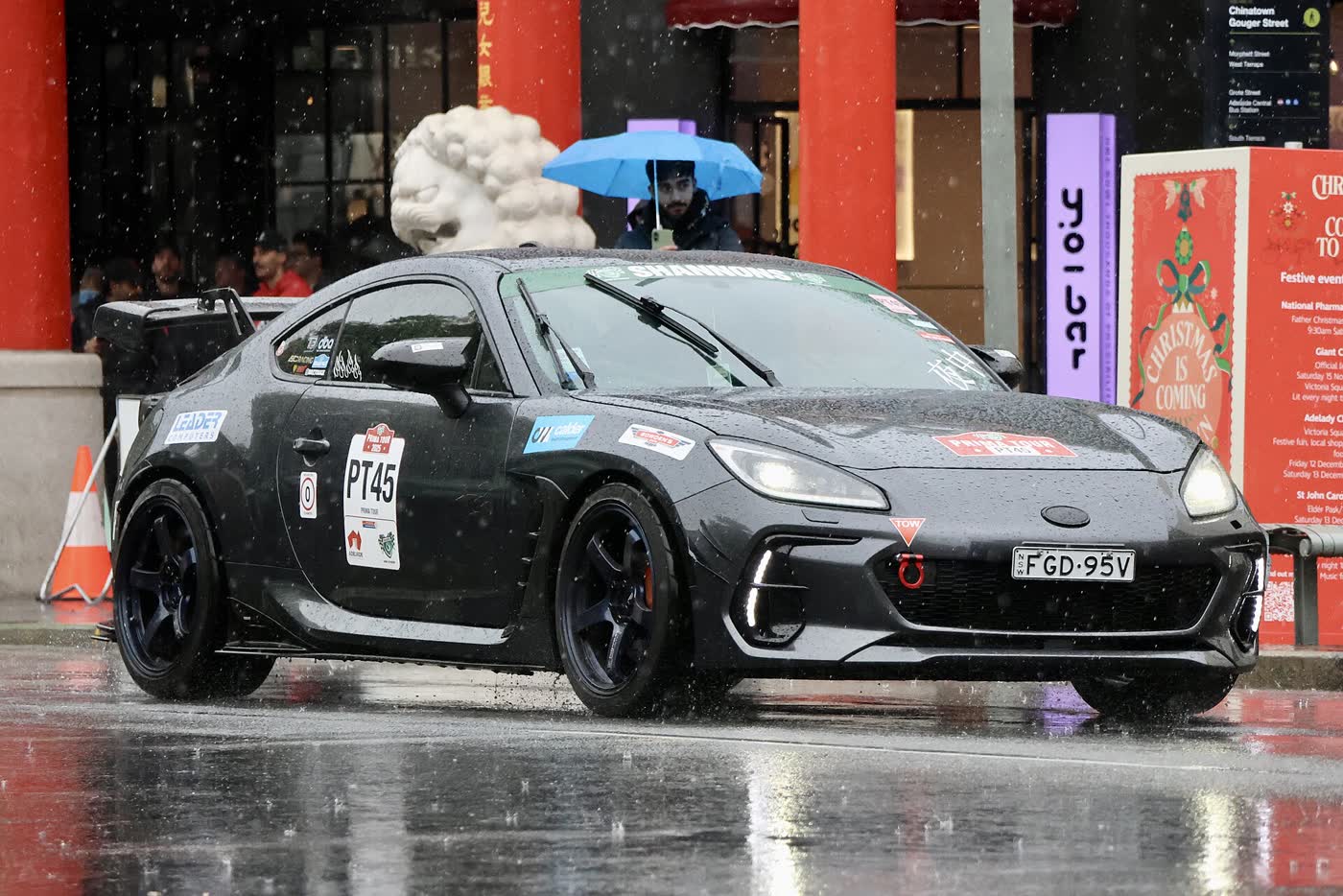
On raw capability the GR86 is excellent: 0.98 g of grip and a 156-foot stop, both clearly better than the Miata, with a standard limited-slip that makes it sharp and adjustable. As a track and canyon tool straight off the lot, it is one of the best in its price range.
The honest catch is that this category and The Risk overlap. The oil-starvation problem shows up precisely in sustained hard cornering, which is what this category measures, so the car's greatest strength and its biggest weakness live in the same place. If you are the kind of buyer this section is written for, someone who will actually push the car, that overlap is exactly why the preventive maintenance in The Risk is not optional. Score the capability high, but respect that using it fully is what raises the stakes.
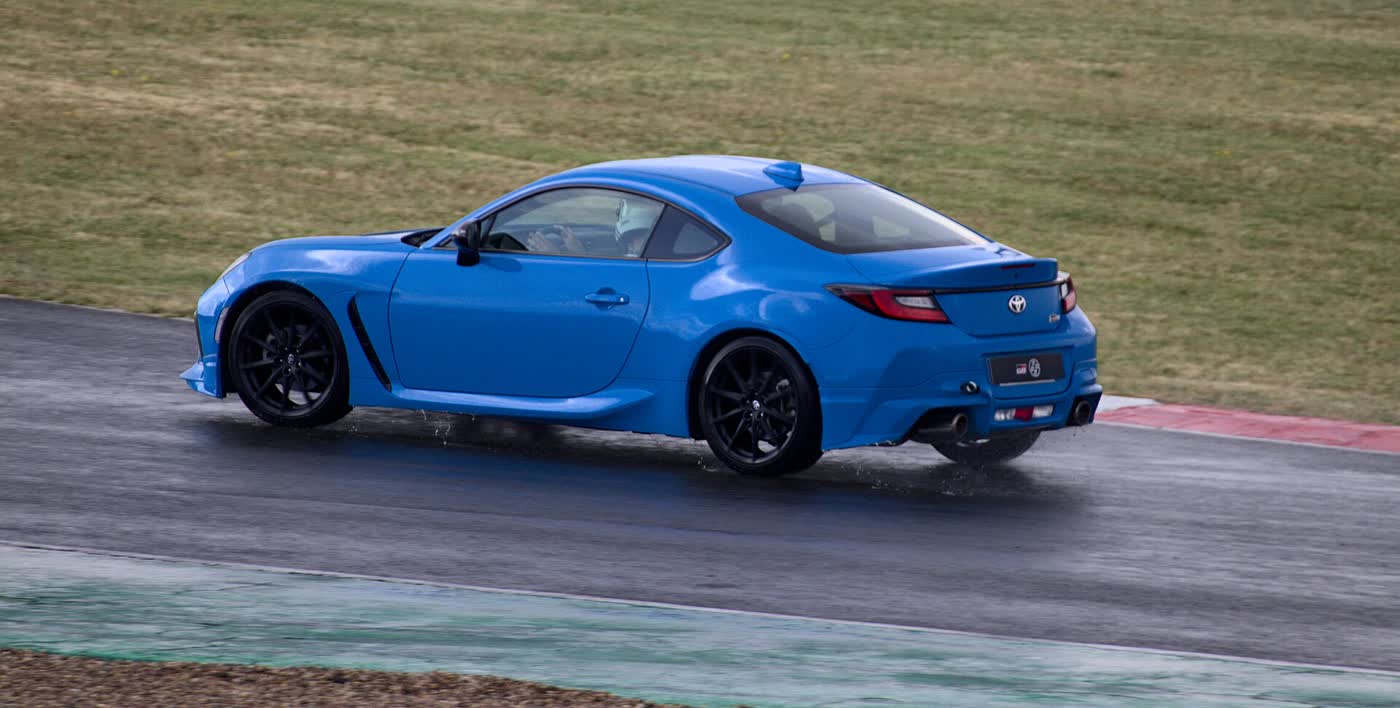
| Path | Cost | Risk |
|---|---|---|
| Handling (coilovers, bars) | ~$800 to $2,900 | Low |
| Bolt-ons (intake, exhaust, tune) | ~$1,000 to $2,000 | Low to moderate |
| Supercharger | ~$6,000 to $8,000 | Moderate to high |
| Turbo | ~$6,000 to $8,000 all-in | High |
| Big power (over 340 whp) | $10,000+ | Severe |
The GR86 has a higher power ceiling than a Miata, around 340 whp on forced induction, and an aftermarket just as deep thanks to the shared Subaru BRZ platform. If your plan is to sharpen the handling, this is a superb and affordable place to do it, with cheap, reliable, well-supported suspension and brake options.
Power is where you need to think harder. The same cast connecting rods that can fail on a stock car are exactly what boost stresses most, so forced induction here carries more risk than on the turbocharged cars in the class. You can absolutely build a fast GR86, but you should budget for a built bottom end sooner than you would on almost anything else, and go in understanding that chasing horsepower trades away some of the car's stock reliability. If you want a razor-sharp handling car, buy with confidence. If you want big power cheaply and safely, this is not the easiest platform for it.
Buy, but buy it right: a 2022-or-newer manual, with a pre-purchase inspection that confirms the engine's oil-pan and RTV work has been done. That single condition addresses the one thing that threatens this car.
This car is for you if you want a modern, grippy, usable driver's car with a real back seat, and you are willing to do one piece of preventive maintenance. It is not for you if you plan to track it hard without that maintenance, or if low purchase price and low running cost are the things you care about most, in which case the Miata is the better buy. Know which of those buyers you are, and the decision makes itself.
So you wanna buy a GR86. Here is the honest short version before we dig in: it out-grips and out-brakes almost everything at this price, it is more usable than a Miata, and its engine can grenade itself on the exact track day it was built for. Stick around, because whether you should buy one comes down entirely to how you handle that last part.
We scored the car as a 2022-or-newer second-generation GR86 with the manual, and it landed at 49 out of 70 on our Board. That is a strong result for a brilliant car, and the three points between it and the Miata tell you exactly what kind of buyer this car is for. Here is the whole story, category by category.
A clean 2022 GR86 runs about $23,600 on the private-party market, with dealer listings closer to $28,500. A new one now stickers around $30,000, so unlike the Miata, the used car is not a dramatic discount off new. That is the first place the GR86 gives ground to the Mazda: it costs more to buy.
It also gives ground on resale. Where a used Miata holds close to 90 percent of its value over three years, the GR86 sheds 18 to 24 percent in the same window. That is not unusual for a car this age, but it matters when you are cross-shopping, because it means the GR86 costs more up front and hands back less of it later. You are paying for more car, and you are paying in both directions.
The trim choice is simple. Base cars ride on 17-inch wheels, Premium adds 18s and a few comfort items, and either one is a perfectly good enthusiast car. There is no must-have performance package the way there is on some rivals, so buy on condition and history rather than trim.
This is where the GR86 beats the Miata, and on paper it is not close. It makes 228 horsepower from its 2.4-liter flat-four, weighs about 2,833 pounds, and runs to 60 mph in around 5.4 seconds. That works out to 12.4 pounds per horsepower, better than the Miata, and the second-generation 2.4-liter engine finally fixed the flat, torque-dead midrange that plagued the original 86.
So it is quicker, grippier, and it actually pulls out of corners. The boxer engine gives it a character all its own, a low, mechanical thrum that sounds like nothing else at the price. It is not a Miata's featherweight delicacy, but it has more muscle and more usable pace, and for a lot of buyers that is the better trade.
Less than the Miata, and this is one of the categories the Mazda wins. The GR86 costs about $5,496 a year to run against the Miata's $3,627. It wants 91-octane premium and returns around 23 mpg combined, so fuel is a real line item. Its wider, grippier tires cost more and wear faster, and it sits 32nd out of 115 sports cars for insurance affordability, where the Miata ranks first.
None of that is punishing for a sports car, and $5,496 a year is entirely reasonable for what you are getting. But if keeping monthly costs low is a priority, know going in that the GR86 asks for roughly $1,870 a year more than the Miata ND's $3,627.
Here is the reason this car scores where it does, and the single most important thing to understand before you buy one. The 2.4-liter FA24 engine can spin a connecting-rod bearing and fail outright. This is not a rumor, it is documented across multiple independent sources, and it has two suspected causes: excess factory RTV sealant clogging the oil pickup and starving the engine of oil, and oil-pressure drops in sustained right-hand corners on track, which instrumented testing has actually reproduced.
The uncomfortable part is who is most exposed. The failures cluster on tracked cars, and the GR86 is a car people buy specifically to track. The daily-driven risk is lower, and nobody knows exactly how widespread the problem is, but you cannot pretend it is not there. Otherwise the car earns a solid 4.0 out of 5 owner reliability rating, so this is one concentrated risk rather than a car that nickels and dimes you.
The good news is the risk is manageable. The mitigation is a proactive oil-pan drop to clean out the RTV, an oil cooler if you track it, and shorter oil-change intervals. And the buy-check writes itself: get a pre-purchase inspection that confirms whether the oil pan has already been dropped and cleaned. Do that, and you have de-risked the single biggest thing that can go wrong with this car.
More easily than a Miata, and this is the GR86's other clear win. You get a real 6.3-cubic-foot trunk plus a 2+2 layout, so there is actual cargo space and occasional-passenger room. The party trick is the one every owner shows off: fold the rear seats flat and a full set of track tires fits inside. The rear seat itself is tight, around 30 inches of legroom, so it is for kids or bags rather than adults, but it exists, and that changes the math.
For a single person or a couple, the GR86 passes the only-car test in a way the two-seat Miata simply cannot. It is not a family car, but it can be your one car if your life is not too demanding on space, and that flexibility is worth real money to the right buyer.
On raw capability, it is superb. It pulls 0.98 g on the skidpad and stops from 70 mph in 156 feet with no fade, both clearly better than the Miata, and the standard Torsen limited-slip differential makes it sharp and adjustable. Out of the box, it is a genuine track-day and canyon weapon.
But here is the asterisk, and it is a big one. The engine oil-starvation risk we covered lives exactly here, in sustained hard cornering. So the car's greatest strength and its most serious weakness occupy the same territory. That is why we score it where we do rather than higher, and it is the honest tension every GR86 buyer has to sit with: the thing it is best at is also the thing that stresses the part most likely to fail.
The GR86 has a higher power ceiling than a Miata and an aftermarket just as deep, shared with the Subaru BRZ, so on paper it is the better build platform. A supercharger gets you to roughly 280 to 303 whp, or a turbo to 300 to 325 on pump gas, both for somewhere around $6,000 to $8,000 all in. Handling and suspension mods are cheap, plentiful, and reliable.
The catch is the same bottom end from the reliability section. The cast connecting rods that can fail even on a stock car are exactly what boost stresses most, so chasing big power carries more risk here than on almost anything else in the class. Build it for handling and you have a dream platform. Chase horsepower, and you should budget for a built engine sooner than you would elsewhere.
This is the comparison most GR86 shoppers are actually running, so let us settle it. The GR86 is the more car: more power, more grip, a back seat, and a real trunk. The Miata is the more sports car: lighter, cheaper to buy and run, and free of the engine worry.
On our Board, the Miata edges ahead, 52 to 49, and the reason is instructive. The GR86 wins the driving categories, but the Miata wins the ones that cost you money and the one that can cost you an engine. If you need the practicality and want the extra pace, buy the GR86. If you want the cheapest, safest, purest driver's car and can live with two seats, the Miata is still the answer.
Buy, but buy it right. Get a 2022-or-newer manual, and get a pre-purchase inspection that confirms the engine's oil-pan and RTV work has been addressed. That single condition de-risks the one thing that threatens this car.
The GR86 finished at 49 out of 70 by being brilliant almost everywhere and carrying one real liability. The only person who should skip it is the buyer who plans to track it hard and will not do the preventive maintenance, because that is the exact recipe the failure feeds on. For everyone else, this is a good all-around driver's car at the price.
Filming reference: cue sheet · for the hosts on set, not part of the review.
The frame that closes our video: the GR86 at 49/70, with the Miata ND and the Supra 3.0 alongside.