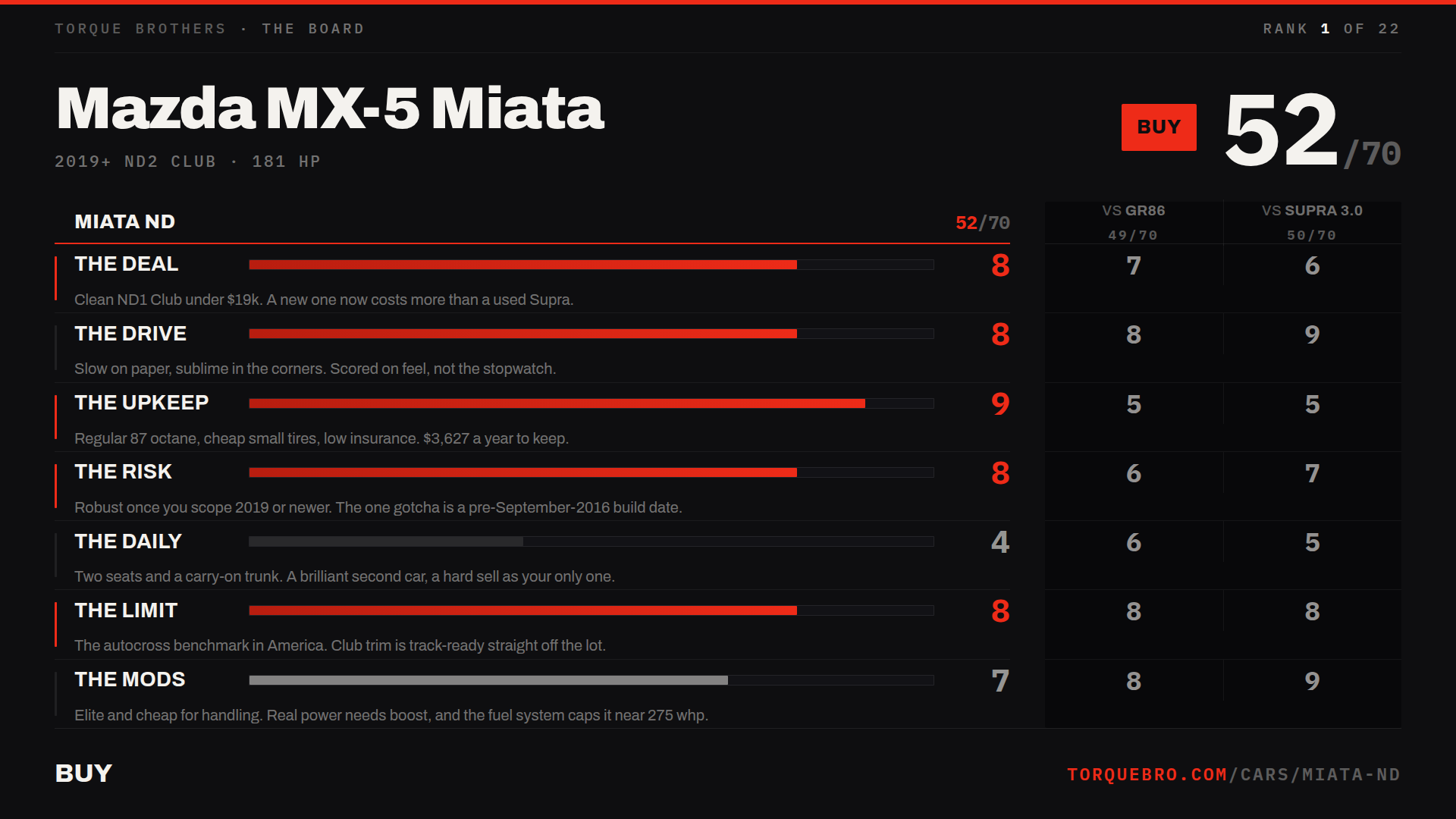
2019+ ND2 · Club · Soft-top
A pure, cheap driver's car. Buy a 2019 or newer Club, and check the build date before you hand over a dollar. The skip case is needing it to be your one and only car.
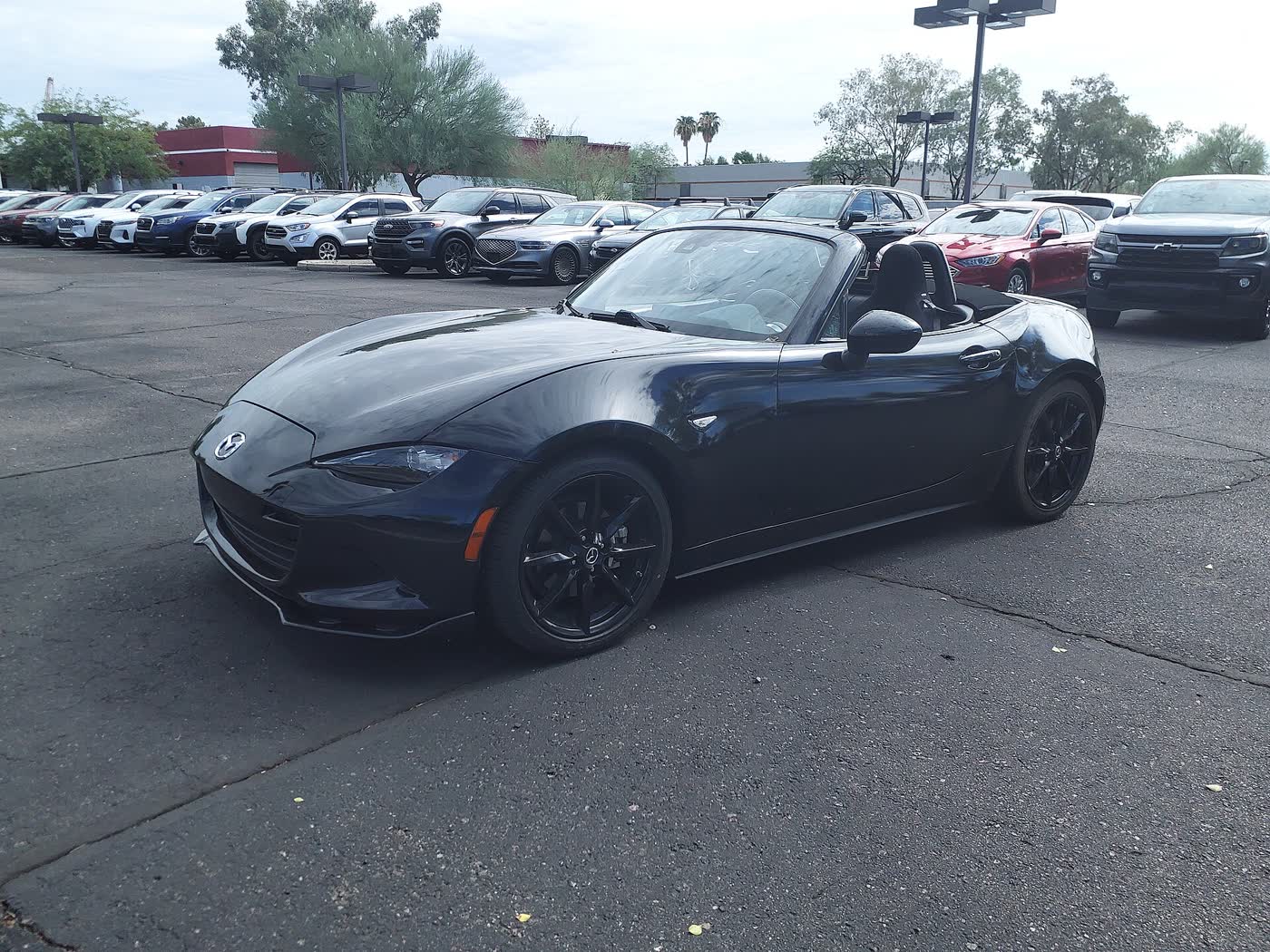
We scored the car as a 2019 or newer ND2 in Club trim, which is the version most enthusiasts should be shopping, and it landed at 52 out of 70 with a verdict of Buy.
This car is for someone who wants a sports car for sports-car money, values how a car feels over how fast it is, and has somewhere else to put the groceries. If you need one car to do everything, skip to The Daily and save yourself the heartbreak.
All money figures use a fixed set of assumptions so they can be compared to other cars we cover: 12,000 miles a year, regular fuel at $3.50 a gallon, and insurance for a 35-year-old driver with a clean record and full coverage. Insurance numbers are published averages, not personal quotes. Prices are from Kelley Blue Book.
| Figure | Miata ND (2019+ Club) | Source |
|---|---|---|
| Used buy-in (KBB private-party) | ~$19,500 | KBB private-party value, 2019 Club: $19,280 in Good condition, $19,980 in Very Good (read October 2026) |
| Typical retail listing | ~$24,460 | we found no published source for this figure |
| New 2026 base price | $31,665 | KBB: 2026 Sport 6-speed manual, starting price including destination |
| Used vs new | About 38% less | derived: ($31,665 minus $19,500) divided by $31,665 |
| Resale held over 3 years | ~88% (range 85 to 90) | we found no published source for this figure |
| Trims | Sport, Club, Grand Touring | Mazda, 2026 MX-5 pricing and packaging |
| Track packages | Brembo/BBS $3,770; add Recaro $4,470 | Carscoops, 2019 launch pricing |
~ our estimate, not a measured or quoted figure. Why we mark figures
The Deal is where the Miata makes its first and strongest case. Around $19,500 buys a modern, rear-wheel-drive sports car with a factory limited-slip differential and Bilstein dampers, which is roughly a third of what a big-power muscle car costs and less than half of a used Supra. If your budget is the main thing standing between you and a proper sports car, this is the shortest path there.
The number that should actually reassure you is resale. Most performance cars lose money the moment you sign, but a well-kept manual Miata holds something like 85 to 90 percent of its value over three years, and one Grand Touring we found had shed only 8 percent. That means the real cost of owning one for a few years is far lower than the sticker suggests, and it protects you if your circumstances change and you need to sell. Buying a Miata is a low-regret financial decision in a category full of high-regret ones.
Two things to know before you shop. First, the trim matters more than the year: the Club is the one with the limited-slip, the Bilsteins, and the track-ready bones, so an enthusiast should hold out for it rather than settle for a Sport or a comfort-focused Grand Touring. Second, new prices have climbed so far that a new base model now costs more than a used Supra used to, which is exactly why the used ND is such a smart buy today.
| Figure | Miata ND (2019+) | Source |
|---|---|---|
| Power-to-weight | 12.9 lb per hp | derived: 2,339 lb curb weight divided by 181 hp |
| Curb weight | ~2,340 lb (RF ~2,460) | Mazda 2019 specifications (2,339 lb, manual soft top) and KBB 2019 RF specs (2,453 lb) |
| Power | 181 hp, 151 lb-ft | Mazda 2019 specifications: 181 hp at 7,000 rpm, 151 lb-ft at 4,000 rpm |
| Measured at the wheels | ~168 whp | Motor Authority, dyno test of a 2019 car |
| 0 to 60 mph | 5.5 to 5.7 sec | we found no published source for this figure |
| Redline | 7,500 rpm (7,200 in top gears) | Mazda 2019 specifications (7,500 rpm); Motor Authority (limiter at 7,200 rpm in 5th and 6th, per Mazda) |
Here is the honest truth that decides whether this car is for you: the Miata is not fast, and it does not care. On paper the 0 to 60 time is merely okay, and if your definition of a fun car is being pinned into the seat, you will be disappointed. This is a car scored on feel, not on the stopwatch, and the single figure that explains it is the weight. At about 2,340 pounds it is one of the lightest new cars sold, and that lightness is why the steering talks to you, why it changes direction the instant you think about it, and why 181 horsepower feels like plenty.
So the buyer question is simple. If you want speed, look elsewhere, because almost anything with a turbo and all-wheel drive will out-accelerate this for the same money. If you want engagement, the sense that you and the car are having a conversation on a good road, very little at any price does it better. The Miata rewards the driver who enjoys the act of driving at legal speeds, not the one chasing numbers.
One insight that will save you money: the celebrated 2019 power bump is mostly a higher rev limiter. Below 6,000 rpm the older and newer engines feel nearly identical, and the extra horsepower lives right at the top of the range. If you mostly short-shift around town, you may never feel the difference and could buy the cheaper older car with a clear conscience. If you love wringing an engine out, the newer one keeps pulling where the old one runs out of breath.
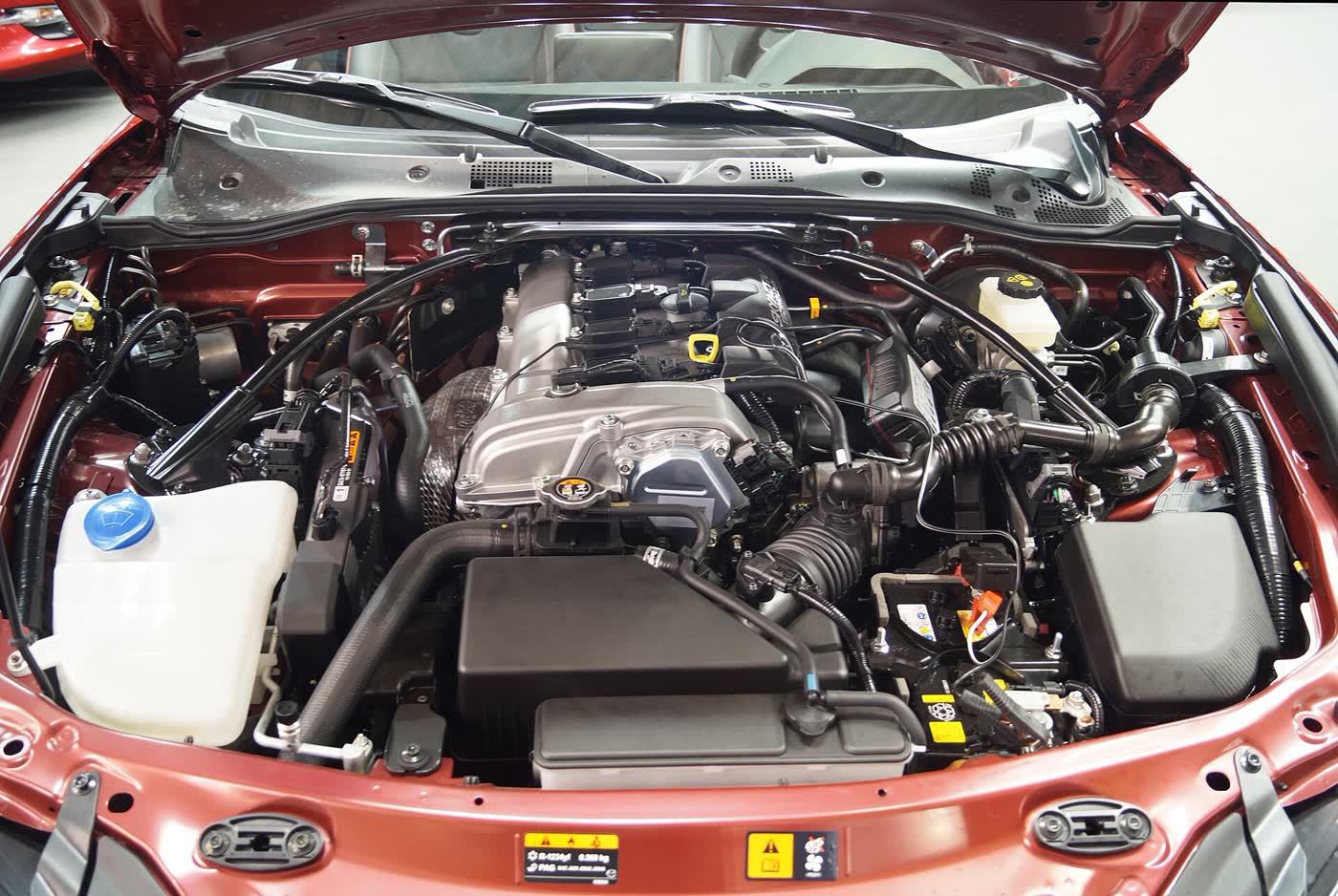
| Figure | Miata ND (2019+ Club) | Source |
|---|---|---|
| Total annual running cost | ~$3,627/yr | derived: $1,448 fuel + $1,569 insurance + $180 tires + $430 service |
| Fuel | ~$1,448/yr (29 mpg, 87 octane) | derived: 12,000 miles a year divided by 29 mpg, times $3.50 a gallon. Mazda lists 87 octane as the minimum and 91 as recommended. |
| Insurance | ~$1,569/yr | MoneyGeek, 2026: average of the 2019 to 2025 model-year full-coverage rates ($152, $146, $120, $112, $101, $115 and $169 a month) times 12. Profile: 40-year-old unmarried male, clean record, good credit, 100/300/100 liability with $1,000 deductibles. Covers all trims. |
| Tires (amortized) | ~$180/yr | we found no published source for this figure |
| Routine service | ~$430/yr | we found no published source for this figure |
| Fuel economy | 29 mpg combined | fueleconomy.gov, 2019 MX-5 with the 6-speed manual: 26 city, 34 highway, 29 combined |
| Service interval | 7,500 miles | Mazda 2021 MX-5 owner's manual: engine oil and filter at least every 12 months or 7,500 miles |
The Upkeep answers the question that catches a lot of first-time sports car buyers off guard: not what does it cost to buy, but what does it cost to keep. For the Miata the answer is around $3,627 a year all in, and every part of that recipe is on the friendly end. It runs on regular 87 octane, not premium. Its small 205-width tires are cheap and the light body wears them slowly. It ranks first out of 115 sports cars for insurance affordability, because insurers see a 181-horsepower two-seater as a commuter rather than a threat.
Why this matters to you: a sports car you cannot afford to run is a sports car that sits in the garage. The Miata is the opposite. It is usable as an everyday driver from a cost standpoint, and the gap between it and a thirsty V8 on premium fuel and wide tires is easily a couple thousand dollars a year. If keeping monthly costs sane is important to you, this is a cheap way to own something fun.
The honest caveat is that "cheap for a sports car" is not the same as "free." Insurance and fuel are still real line items, and the $3,627 figure is the true number rather than a rosy one. But relative to almost anything else that drives this well, the Miata is the sensible choice, and that sensibility is a real part of its appeal.
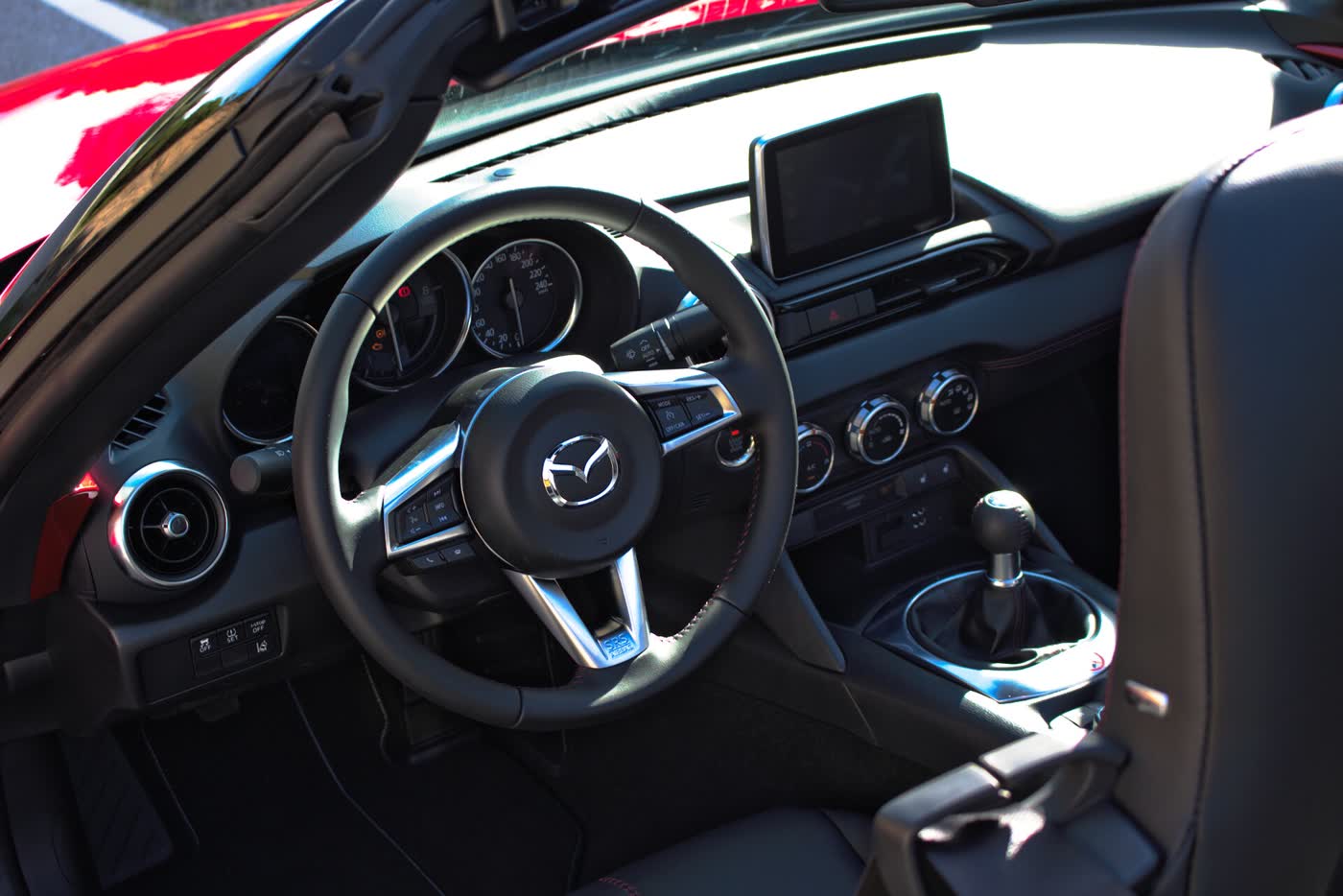
| Figure | Miata ND (2019+) | Source |
|---|---|---|
| Worst realistic repair | ~$1,200 (infotainment screen) | we found no published source for this figure |
| Drivetrain risk | None notable on 2019+ | our assessment. NHTSA lists no engine or transmission recall for the 2019 car. |
| Reliability rating | 4.0 / 5.0 (8th of 21 subcompacts) | RepairPal, 2019 MX-5 Miata |
| Average annual repair cost | ~$429 | RepairPal, 2019 MX-5 Miata |
| NHTSA recalls (2019) | 3, all free fixes | we found no published source for this figure |
The Risk is about what you are gambling on when you hand over the money, and with a 2019 or newer Miata the gamble is small. This is one of the more reliable cars on the road, with an average annual repair cost around $429 and a strong reliability rating. There is no expensive common failure lurking in the drivetrain, which is exactly what you want from a car you plan to enjoy rather than worry about.
The failures that do exist are minor and predictable. An air conditioning line can crack over time from engine vibration and leak, which is cheap to fix if you catch it. The 2016 and 2017 infotainment screens can delaminate, which is the priciest realistic repair at around $1,200, though it is far less common on a 2019. None of these should scare you off. They are the kind of thing you factor into your offer, not reasons to walk away.
One important clarification for shoppers. You may have read about early Miatas with transmission trouble. That problem is real, but it is confined to the very first soft-tops built before September 2016, and it does not touch the 2019 or newer car we are recommending. It only becomes something to check if you decide to save money by dropping down to an older ND, in which case a quick build-date check clears it. For the car in this guide, reliability is a reason to buy, not a reason to hesitate.
| Figure | Miata ND | Source |
|---|---|---|
| Cargo volume | 4.6 cu ft | Mazda 2019 specifications: 4.59 cu ft |
| Seats | 2 | Mazda 2019 specifications: 2-passenger seating |
| Front legroom | ~43.1 in | Mazda 2019 specifications: 43.1 in |
| Headroom, top up | Tight for taller drivers | KBB: 37.4 in front headroom; its review says drivers taller than about 6 ft 3 in do not fit well |
| Cabin storage | Minimal | Mazda 2019 specifications: two cup holders, a locking rear console and covered panel storage |
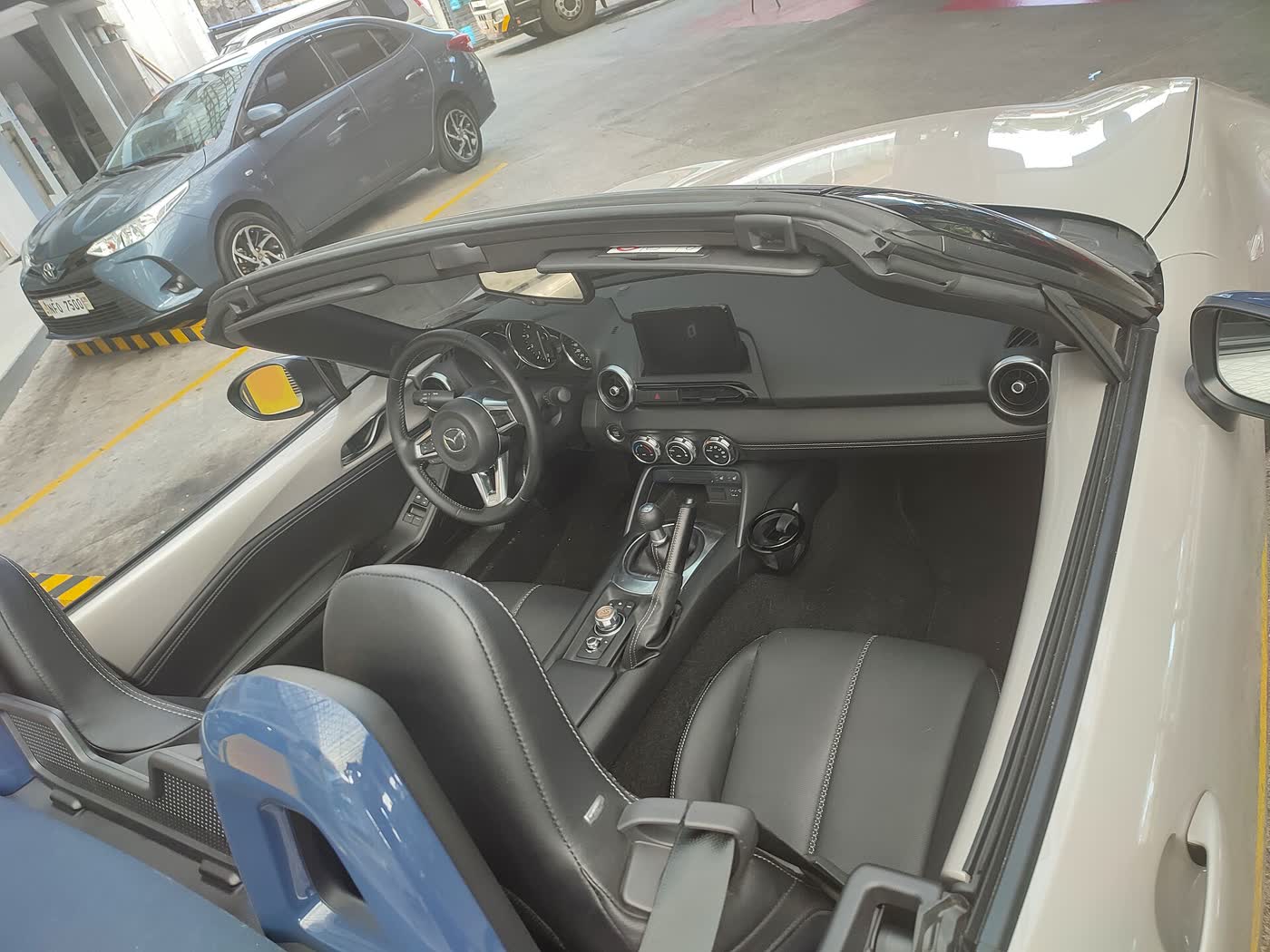
The Daily is where you find out if this car can actually be your car, and for most people the answer is no, so read this part carefully before you fall in love. You get two seats and 4.6 cubic feet of trunk, which in practical terms is a carry-on bag and a soft duffel. There is no back seat to overflow into and almost no cabin storage. A dog, a big grocery run, or a passenger with luggage all end the arrangement quickly.
This is not a flaw so much as a definition. The Miata was never trying to be practical, and judging it as a failed family car misses the point. The real question for you is whether you have somewhere else to put the stuff of daily life. If this would be a second car, a weekend toy alongside something sensible, the tiny trunk is a non-issue and the car is close to perfect. If it has to be your only vehicle, be honest with yourself now, because the space simply is not there.
If you love the idea but need a little more civility, the RF with its folding hard top is the version to look at. It trades a small amount of weight and trunk space for a quieter, more secure cabin, which makes it easier to live with on a cold or wet commute without giving up the essential character.

| Figure | Miata ND (2019+ Club) | Source |
|---|---|---|
| SCCA Solo class | C Street (stock), STR (modified) | we found no published source for this figure |
| Max grip | 0.90 g | we found no published source for this figure |
| 70-0 braking | 170 ft | we found no published source for this figure |
| Track hardware | LSD, Bilstein, DSC-Track, optional Brembo | Mazda 2019 specifications (limited-slip differential, Bilstein dampers, Brembo package); Mazda 2024 pricing (DSC-Track added for 2024) |
| Track-day note | Small brakes fade under sustained laps | our assessment of the stock brakes |
SCCA C Street · shared with the Miata NC and the RX-8 on this Board.
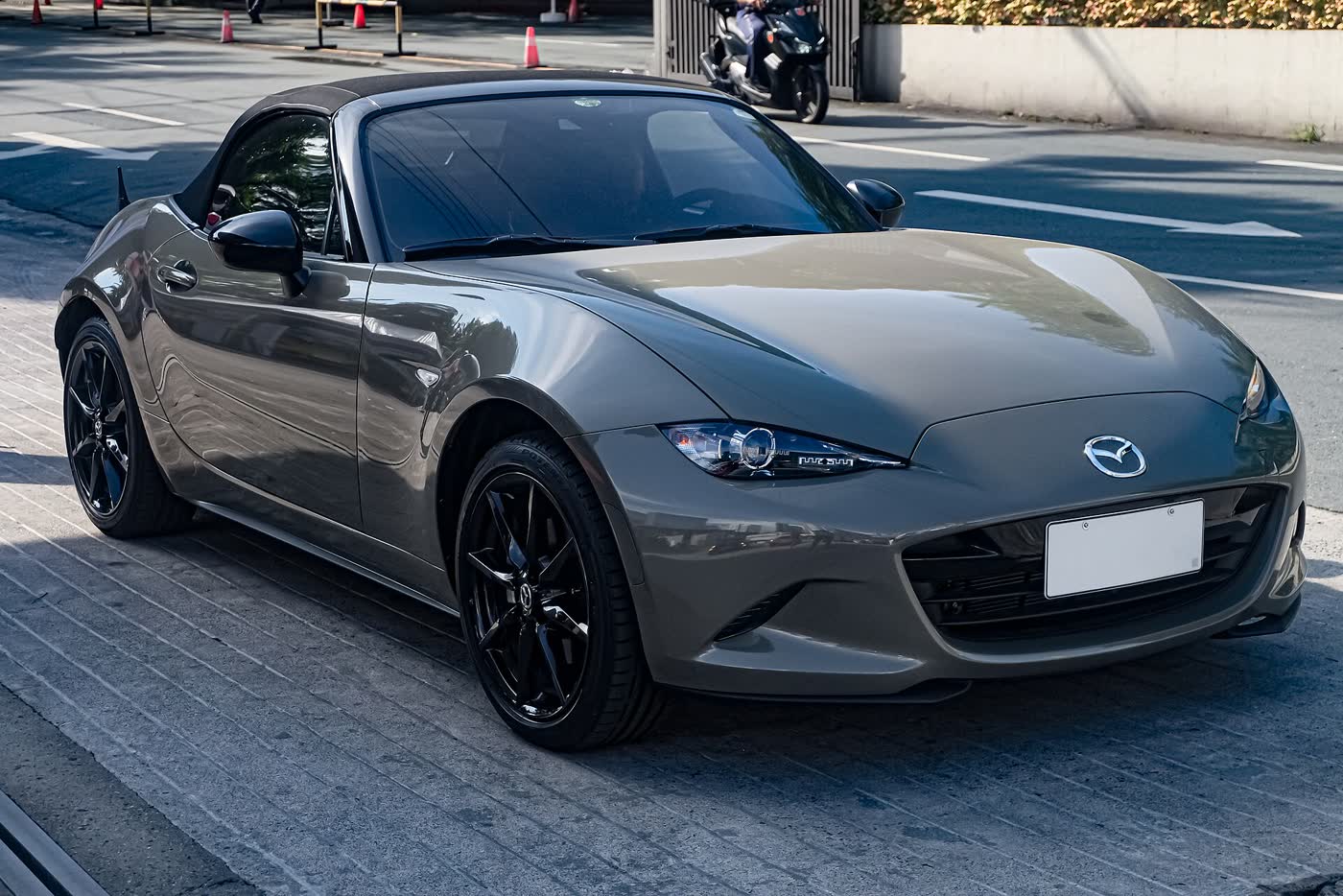
The Limit is about how the car behaves when you actually push it, and this is where the Miata stops being merely charming and becomes great. In autocross it is the benchmark that entire classes are measured against, dominant in SCCA Solo's C Street category and a force in Street Touring. When the 2019 model arrived, competitors seriously wondered whether it would have to be reclassed. If you want a car to learn car control in, to run at an autocross or a track day, there is no better or cheaper teacher.
Whether this section matters to you depends on how you plan to use the car. If you will actually drive it hard, on a course or a great road, the Club's factory limited-slip, Bilstein dampers, and track stability mode make it ready straight off the lot, and the balance means it flatters a developing driver instead of punishing mistakes. Even if you never see a track, the capability is what makes the car feel alive at everyday speeds, so it is not wasted on you.
Two honest notes. The grip ceiling of 0.90 g is not sky-high, but the way the car communicates and adjusts matters more than the raw number. And the brakes are small: they are fine for autocross and spirited road driving but will fade during a sustained track session, so a set of better pads and fresh fluid is on the shopping list if you get serious. As an autocross weapon it is close to flawless. As a track-day car it is very capable with a short list of upgrades.
| Path | Cost | Risk |
|---|---|---|
| Handling (coilovers, bars) | ~$800 to $2,900 | Low |
| Bolt-ons (intake, exhaust, tune) | ~$1,000 to $2,000 | Low to moderate |
| Supercharger | ~$5,000 to $7,000 | Moderate |
| Turbo on the NA engine | ~$8,000 all-in | High |
| Big power (over 275 whp) | $10,000+ | Severe |
The Mods matter if you are the kind of owner who cannot leave a car alone, and the Miata is a rewarding platform for that itch, as long as you understand the split. On handling, it responds to very little money. A modest budget buys coilovers, bars, and bushings that turn an already sharp car into a scalpel, and none of it hurts reliability. If your dream is a razor-sharp back-road or autocross machine, you can get there cheaply and safely.
Power is a different story, and this is the part that should shape your decision. The engine is modest, so real power means forced induction, and that is where reliability starts to erode. A turbo on this naturally aspirated engine is the single riskiest common modification you can make: it adds heat and detonation risk, stresses the transmission and clutch, and makes an oil cooler and careful tuning mandatory. Even then, the factory fuel system walls you off around 275 horsepower at the wheels until you commit to a built engine and a bigger fuel system, which is where costs and fragility climb together.
So the buyer question is what kind of builder you are. If you want to sharpen how the car handles, this is a dream platform with almost no downside. If you are determined to chase big horsepower, it can be done, but know going in that you are trading away the very reliability the Miata is famous for, and budget for the clutch, cooling, and tuning that responsible power requires.
Buy, but buy the right one: a 2019 or newer Club, and if you drop to an older car to save money, check the build date. It scores 52 out of 70 on our Board by winning the categories that cost you money and the one that rewards driving skill, and losing only on practicality.
This car is for you if you want a pure, affordable driver's car and you can live with two seats. It is not for you if you need it to haul people and gear or serve as your only vehicle. There is very little middle ground, and knowing which side you are on is the whole decision.
So you wanna buy a used Miata. Here is the short version before we get into it: the fourth-generation MX-5, the ND, out-scored cars here that make fifty more horsepower, and the single thing that decides whether you get the great one or the one we would tell you to walk away from is a build date. Stick around and we will show you exactly which one to buy.
We scored this car as a 2019 or newer ND2 in Club trim, and by the end you will understand why every part of that sentence matters. It landed at 52 out of 70 on our Board, which is high company, and it got there in a way almost no other car does. Here is the whole story, category by category.
This is where the Miata makes its first argument, and it is a strong one. A clean ND1, meaning a 2016 to 2018 car, in Club or Grand Touring trim with 40,000 to 45,000 miles, sits right around 17,000 to 19,000 dollars right now. The lowest sale we found in the data was a 2016 Club that went for 10,800 dollars, which we mention for context rather than as a target, because a car that cheap usually comes with a story.
What makes the used car look so good is what has happened to the new one. A base 2026 Miata Sport now stickers at 31,665 dollars delivered, and a loaded Club RF with the Brembo, BBS, and Recaro package climbs past 43,000 dollars. That means a brand-new Miata now costs more than a used Supra did not long ago, which flips the math and makes a used ND1 look like a strong used buy.
One thing shoppers overlook is resale. Most performance cars bleed value the second you drive them home. A well-kept manual Miata does the opposite and holds its money, so the true cost of owning one for a few years is lower than the sticker price suggests. The trim you want is the Club, because it is the only one that comes with the limited-slip differential, the Bilstein dampers, and the DSC-Track stability mode. Grand Touring trades all of that for leather and adaptive lights, and Sport is the bare-bones version. For an enthusiast, it is Club or nothing.
Let us get the numbers out of the way, because they are not the point. The 2019 and newer ND2 makes 181 horsepower, the earlier ND1 makes 155, and the car weighs about 2,332 pounds. That works out to roughly 13 pounds per horsepower, which is S2000 territory, and it will run to 60 miles per hour in about 5.7 seconds in ND2 form. On paper, that is not fast.
The reason the Miata scores well on driving has nothing to do with those figures. It is the steering, the balance, and one of the best manual shifters ever bolted into a production car. This is a car you score on feel, not on a stopwatch, and it is exactly the kind of car our Board is built to reward when it deserves it.
Here is the insight that should change how you shop. That famous 2019 power bump, the one Mazda advertised as 17 percent more power, is mostly a raised rev limiter. Below about 6,000 rpm, the ND1 and the ND2 engines behave almost identically. The extra horsepower lives almost entirely in the top 1,500 rpm that the older car simply did not have. What that means in the real world is simple. If you short-shift around town, you will never feel the difference between the two. If you wring the car out on a back road or an autocross course, the ND2 keeps pulling while the ND1 has already gone flat. So the right car for you depends on how you actually drive, not just on what you want to spend. One honest asterisk to know before someone in the comments says it: the advertised 7,500 rpm redline is only the limit in the lower gears under hard driving, and independent testing measured about 168 horsepower at the wheels.
This is the category that quietly wins the car its whole case, and it is the one buyers feel every single month. The Miata returns around 34 miles per gallon on the highway, and it does it on regular 87 octane rather than premium. The tires are small and cheap, and because the car is so light, it wears everything slowly, from rubber to brakes to clutch.
Service comes every 7,500 miles, and the ownership data backs up the reputation. Only about 10 percent of MX-5 repairs rate as serious, against a 12 percent average across all cars. Insurance stays low too, because insurers read a 181 horsepower two-seater as a commuter rather than a muscle car. Put all of that together and it runs to $3,627 a year, less than anything else we have scored. Compared to a V8 pony car chewing through premium fuel and wide staggered tires, you are looking at a four-figure difference every year, and that gap is real money that belongs in the buying decision.
The Miata is a robust car, so this section is short on disasters and long on cheap annoyances, and that is itself the verdict. Everything we flag here is confirmed across multiple independent sources, not a single forum horror story, which is the bar we hold every reliability claim to.
The scariest sounding issue is an early manual transmission failure, and it sounds alarming until you learn how narrow it is. It affects soft-top cars built before September 2016, it is documented in a Mazda service bulletin, and it is a five-minute build-date check on the car you are looking at. Scope your search to 2019 or newer and it stops being your problem at all. That is the whole reason we tell you to check the build date before you buy.
Two more items are worth knowing. The air conditioning line can crack over time from engine vibration and leak refrigerant, a pattern that shows up in both Consumer Reports owner data and the forums, and it is cheap to fix if you catch it early. The infotainment screens on 2016 and 2017 cars can delaminate and develop a spider-web crack, which is covered by a service bulletin but can run near 1,200 dollars out of warranty. Beyond that you are into minor territory, like the soft-top rear window hazing with age and the odd loose exhaust heat shield. None of it should scare you off. All of it should just be factored into the price you pay.
Here we have to be honest, because this is the Miata's ceiling and there is no way to talk around it. The test we run is whether a car could realistically be your only vehicle, and for most people the Miata cannot. You get two seats and about 4.6 cubic feet of trunk, which is a carry-on and a soft duffel and nothing more. A dog, a Costco run, or a friend plus their luggage all end the fantasy quickly.
The point is not that this is a bad car. It is that practicality is simply not the job it was built for, so scoring it as a failed daily driver misses what it is. The Miata is a brilliant second car and a hard sell as your only one. The one lever you can pull toward livability is the RF, the retractable hardtop, which adds real refinement and a quieter cabin on a cold commute in exchange for a little weight and a bit of trunk space. If you need the car to behave a little more like a coupe, that is the version to look at.
This is where the Miata stops being merely likable and becomes elite. In autocross it is not just competitive, it is the benchmark that other people's classes get measured against. In SCCA Solo it dominates C Street and is a force in Street Touring, and when the 2019 ND2 arrived, competitors openly wondered whether the car would have to be reclassed to keep things fair.
The ND2 advantage on course is specific rather than a vibe. Because the usable rev range is taller, second gear now pulls all the way to about 60 miles per hour, which kills the extra upshift the older car forced you into on a typical national course. That is the sort of detail that only matters once you have actually run the car in anger, and it is exactly the kind of thing we care about. In Club trim the limited-slip, Bilstein dampers, and track stability mode make it ready to go straight off the lot.
The honest caveat is the difference between autocross and full track days. The brakes are small and the cooling is modest, so for a real track session you will want proper pads and fresh fluid, and the stock setup will show heat after repeated hard laps. As an autocross weapon it is close to perfect. As a track-day car it is very capable with a short shopping list.
This is the comparison most Miata shoppers are actually running, so let us settle it. The GR86 is the more complete car. It has more power at 228 horsepower, it has a back seat, and it is a usable coupe. The Miata is the more focused sports car. It is lighter, it is cheaper to buy and to run, and it is the autocross reference point.
On our Board, once you account for running cost, the Miata edges ahead of the GR86 despite giving up roughly 47 horsepower. It wins on value, on cost of ownership, and on how it behaves at the limit, and it loses on daily usability. That trade is the entire decision. If you need two more seats and a trunk, buy the GR86. If you want a pure, cheap driver's car and you can live with two seats, the Miata is the answer.
Buy, but buy the right one. Get a 2019 or newer Club, and check the build date before you hand over any money. That single condition falls straight out of the research, because 2019 gives you the better rev range and the sorted early issues, Club gives you the limited-slip and the Bilsteins, and the build-date check keeps you clear of the one transmission problem worth avoiding.
The Miata ND finished at 52 out of 70 on our Board, and it earned it by winning the categories that cost you money and the one category we know better than anyone. The only person who should skip it is the buyer who needs a single car to do everything, because that is the one job this car cannot do. For everyone else, this is a very easy car to recommend.
Filming reference: cue sheet · for the hosts on set, not part of the review.
The frame that closes our video: the Miata ND at 52/70, with the GR86 and the Supra 3.0 alongside.