2010-2013 · Gen 2 (BL) · 2.3 DISI turbo, 6MT
280 lb-ft at 3,000 rpm through the front wheels with no limited-slip differential, and a fuel pump failure a visual inspection cannot see. Buy the one nobody has tuned, and datalog it before you pay. Bring a laptop, not a flashlight.
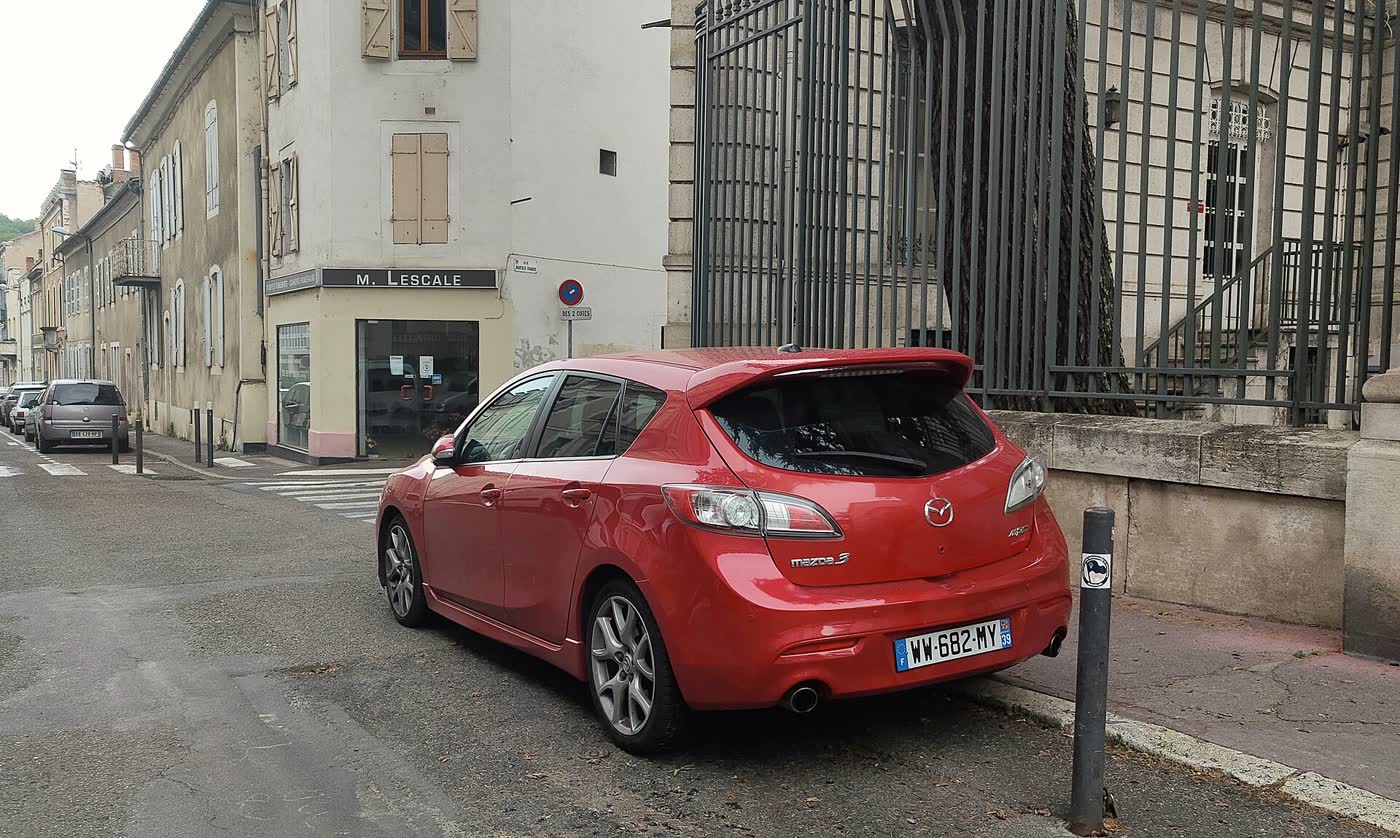
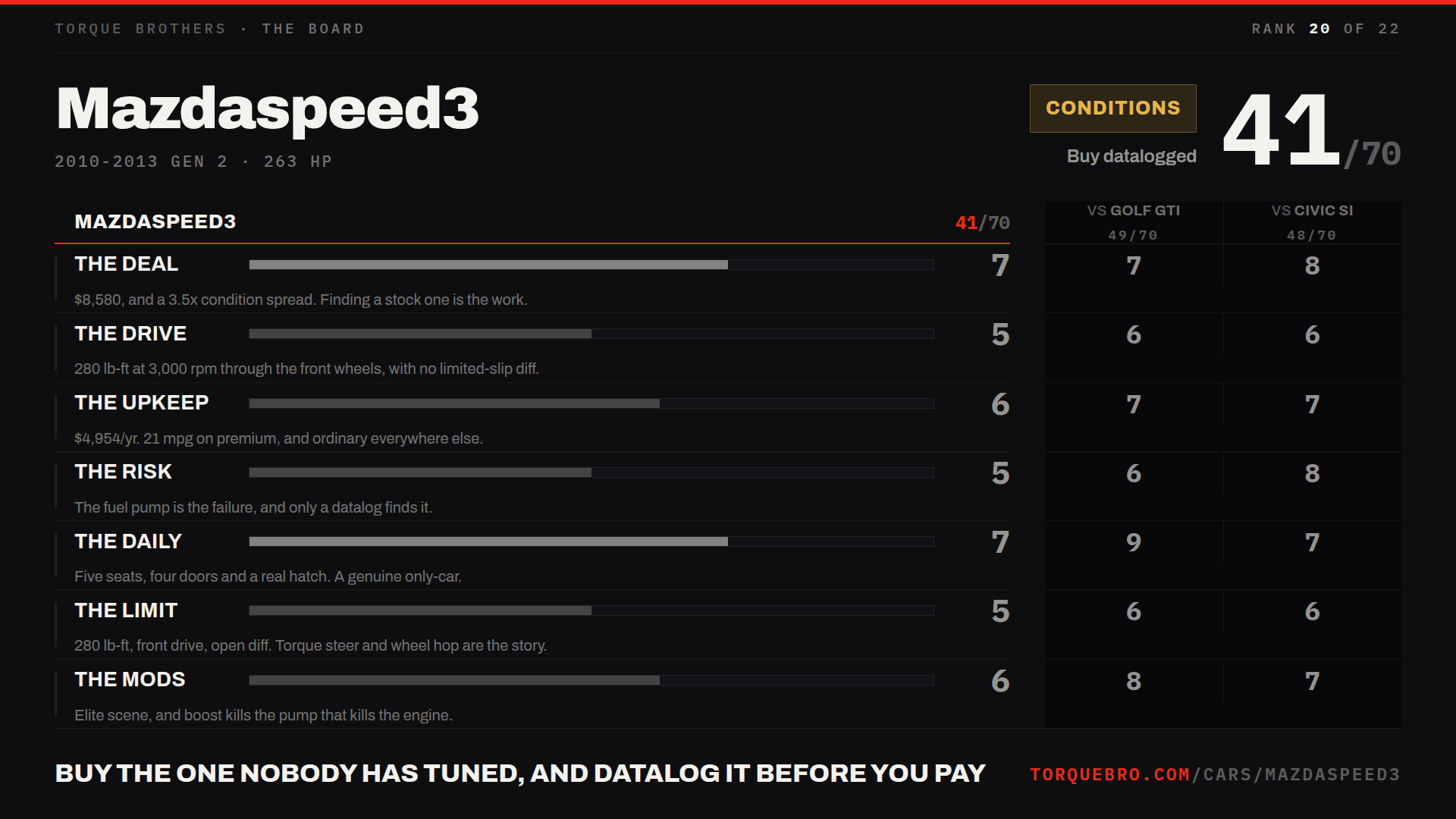
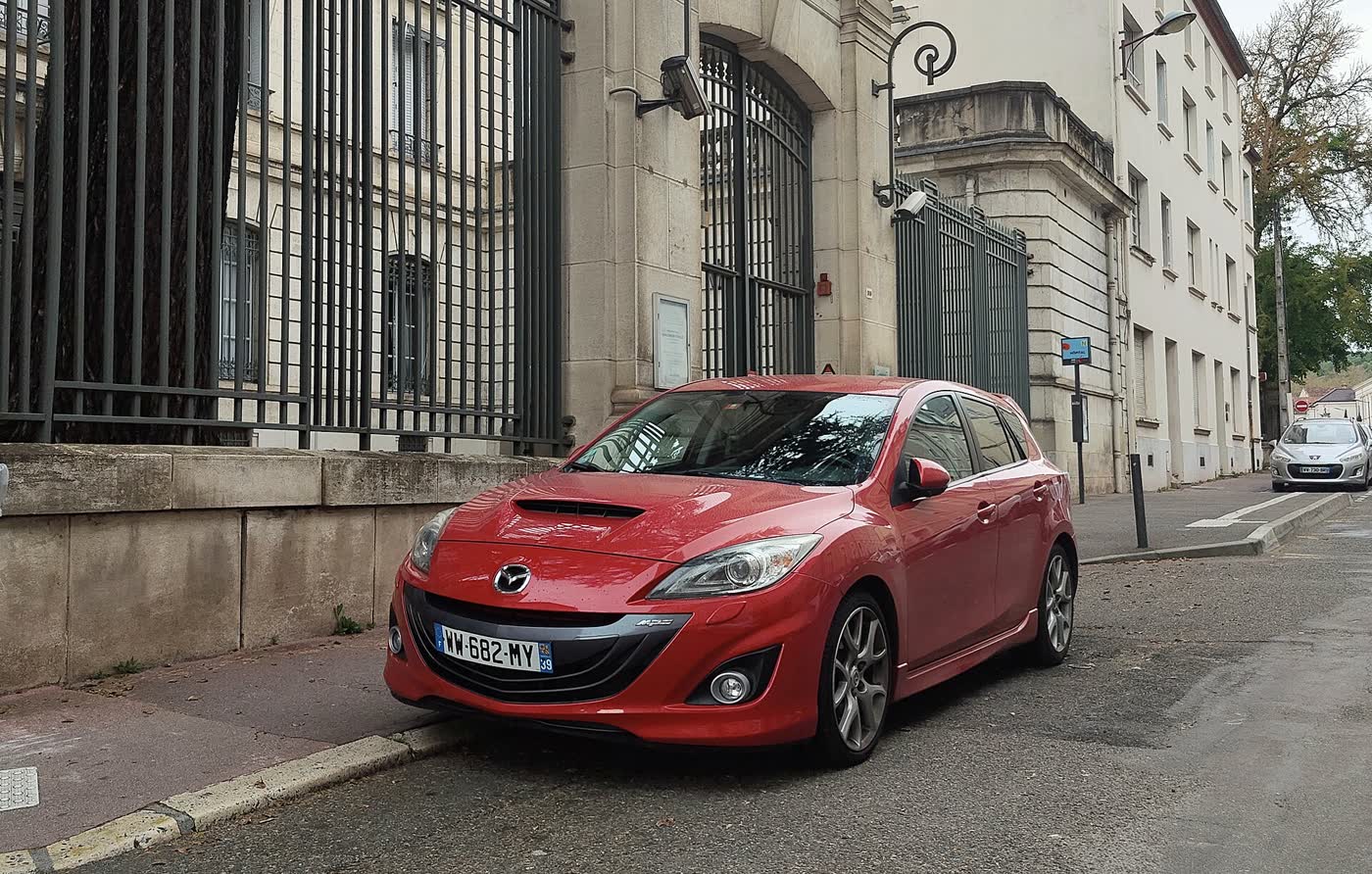
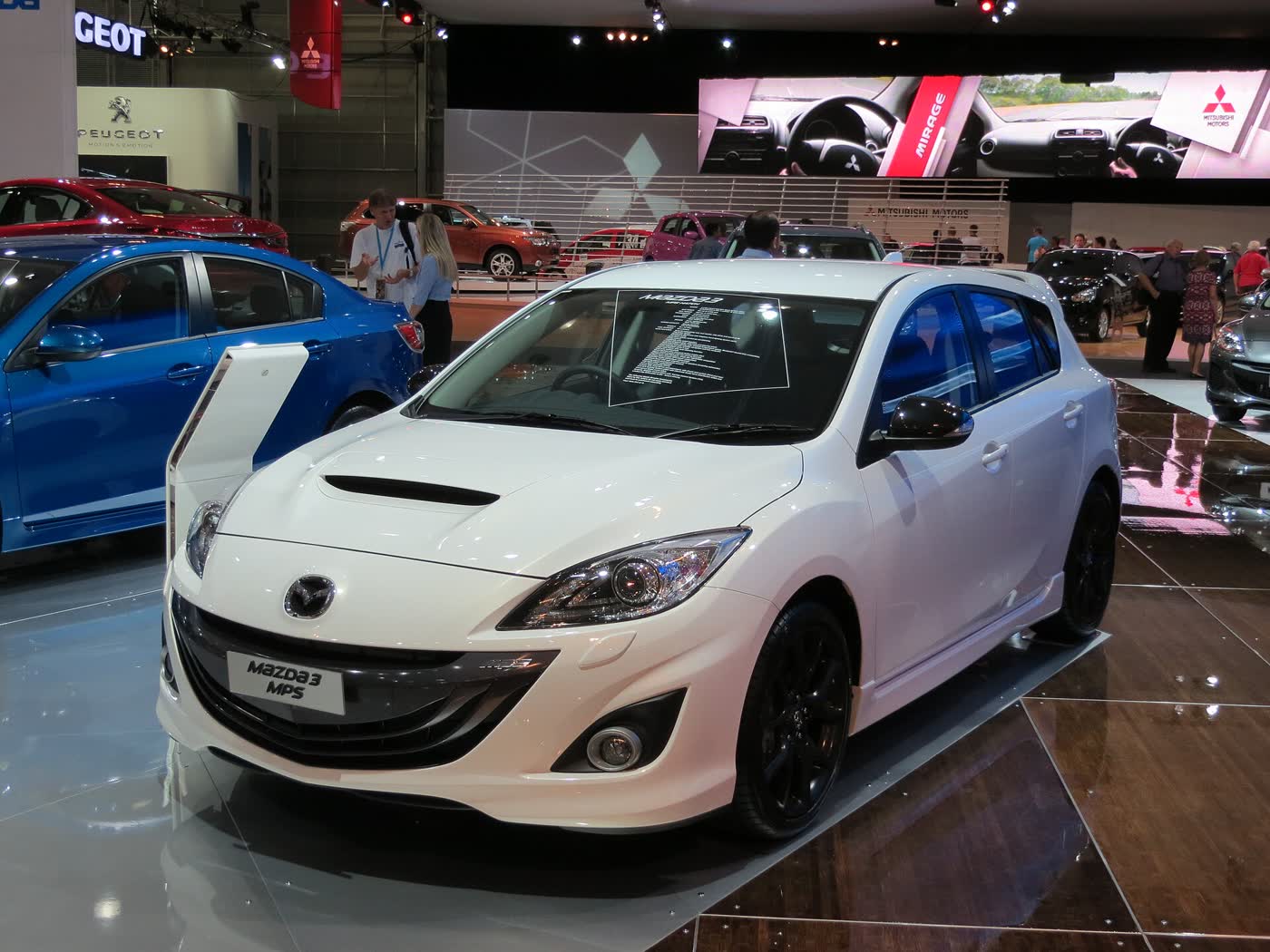
We scored the car as a 2010 to 2013 Gen 2 (BL) with the 2.3 MZR DISI turbo and the six-speed manual, and it landed at 41 out of 70, with a verdict of Buy the one nobody has tuned, and datalog it before you pay.
This car is for someone who wants a fast, practical hatch, and who is willing to turn up to a viewing with a laptop. That last part is not a joke, and The Risk explains why it is the whole purchase.
All money figures use a fixed set of assumptions so they can be compared to other cars we cover: 12,000 miles a year, premium fuel at $4.00 a gallon, and full coverage insurance. Prices are Kelley Blue Book private-party at 120,000 miles in Good condition, which is the flat basis this whole budget tier uses. Insurance is MoneyGeek at trim level, the same source and profile as the Miata, 350Z and Civic Si, so those figures are comparable to each other.
| Figure | Mazdaspeed3 (2010-2013 Gen 2, 6MT) | Source |
|---|---|---|
| Used buy-in, private party | $8,580 | KBB |
| Condition basis | 120,000 miles, Good | KBB |
| Full condition range | $6,980 to $8,980 | KBB |
| Appraisal spread, one model year | $2,565 to $8,860, a 3.5x spread | Edmunds |
| Dollars per horsepower | $32.6/hp | derived: $8,580 divided by 263 hp |
~ our estimate, not a measured or quoted figure · * there is a caveat, and the note under the table explains it. Why we mark figures
The Deal scores a 7. Eight thousand five hundred and eighty dollars for 263 horsepower works out to $32.6 per horsepower, which is better than the Civic Si's $39.4 and the NC Miata's $41.8, and well behind the G37's $21.2 and the 350Z's $18.7. Solid mid-pack.
The number that actually matters is the spread, and it is severe. Edmunds appraises a single model year of this car anywhere from $2,565 to $8,860. That is 3.5 times from bottom to top, on one year, and it is not because some of them have nicer paint. Modified, abused and neglected cars dominate the bottom of that range.
Which means the price on the advert tells you less here than on almost anything else you are looking at. A cheap Mazdaspeed3 is easy to find. A stock, unmolested one is the actual difficulty, and it is worth more than the saving. Read The Risk before you read any listings.
A correction we owe you: an earlier draft of our research put this car at about $25 per horsepower and called it level with the 350Z. That was computed against a placeholder price before we pulled KBB at 120,000 miles, and it was wrong in direction as well as magnitude.
| Figure | Mazdaspeed3 (2010-2013 Gen 2, 6MT) | Source |
|---|---|---|
| Power-to-weight | 12.5 lb per hp | derived from the figures below |
| Power | 263 hp at 5,500 rpm | Cars.com |
| Torque | 280 lb-ft at 3,000 rpm | Cars.com |
| Curb weight | 3,281 lb | Edmunds |
| 0 to 60 mph | 6.2 sec | Go Ahead Take the Wheel |
| Differential | Open. No limited-slip at any trim | Grassroots Motorsports |
The Drive scores a 5, and one line describes the whole car in both directions: 280 lb-ft at 3,000 rpm, through the front wheels, with an open differential.
That is a lot of torque arriving early, and it makes the car feel considerably faster than 6.2 seconds to 60 suggests. It is quicker than the Civic Si and both Miatas, and slower than the two Nissans. On a back road it is rapid.
It also fights you for it. Wheel hop and torque steer are described as two of the largest problems facing this car, and worn rear motor mounts are a main cause of both. There is no limited-slip differential at any trim, so all that torque is being managed by the tyres and your wrists.
Whether that is charm or annoyance is a matter of taste, and you should find out on a test drive rather than from us. Some people love this car precisely because it misbehaves.
| Figure | Mazdaspeed3 (2010-2013 Gen 2, 6MT) | Source |
|---|---|---|
| Total annual running cost | ~$4,954/yr | sum of the lines below |
| Fuel | ~$2,286/yr | derived from our fixed assumptions |
| Insurance, full coverage | ~$1,968/yr | MoneyGeek |
| Tires, amortized | ~$250/yr | our estimate |
| Routine service | ~$450/yr | our estimate |
| Fuel economy | 21 mpg combined | Cars.com |
| Octane | 91, premium | Cars.com |
The Upkeep scores a 6, and there is refreshingly little to say. About $4,954 a year, and every line in it is ordinary for the performance on offer.
The one figure that stands out is fuel, and not in a good way: 21 mpg combined on premium is $2,286 a year, which is what a turbocharged 2.3 litre in a 3,281 lb car costs to feed. The Fiesta ST does the same job for $1,448 on regular, if that comparison is where your head is.
Insurance at $1,968 is 22.9 percent of the car's value a year. That runs against the NC Miata's 21.6 percent and the 128i's 20.8 percent, so it is a touch high but nothing remarkable. It comes from MoneyGeek broken out by trim, which is Group A and directly comparable to the Miata, 350Z, Civic Si and 370Z figures on this Board. It is trim-level rather than trim-and-year, which is the same caveat the Civic Si carries.
A correction: our research draft had this at 30 percent of value and had the comparison the wrong way round. That was computed against a placeholder price.
| Figure | Mazdaspeed3 (2010-2013 Gen 2, 6MT) | Source |
|---|---|---|
| Worst realistic repair | ~$1,600 clutch | our estimate |
| The failure that matters | High-pressure fuel pump losing pressure under load | ThreePiece and CorkSport |
| Detection | Datalog only. No visual check substitutes | derived from the sources below |
The Risk scores a 5, and this car introduced something our Board had not seen before.
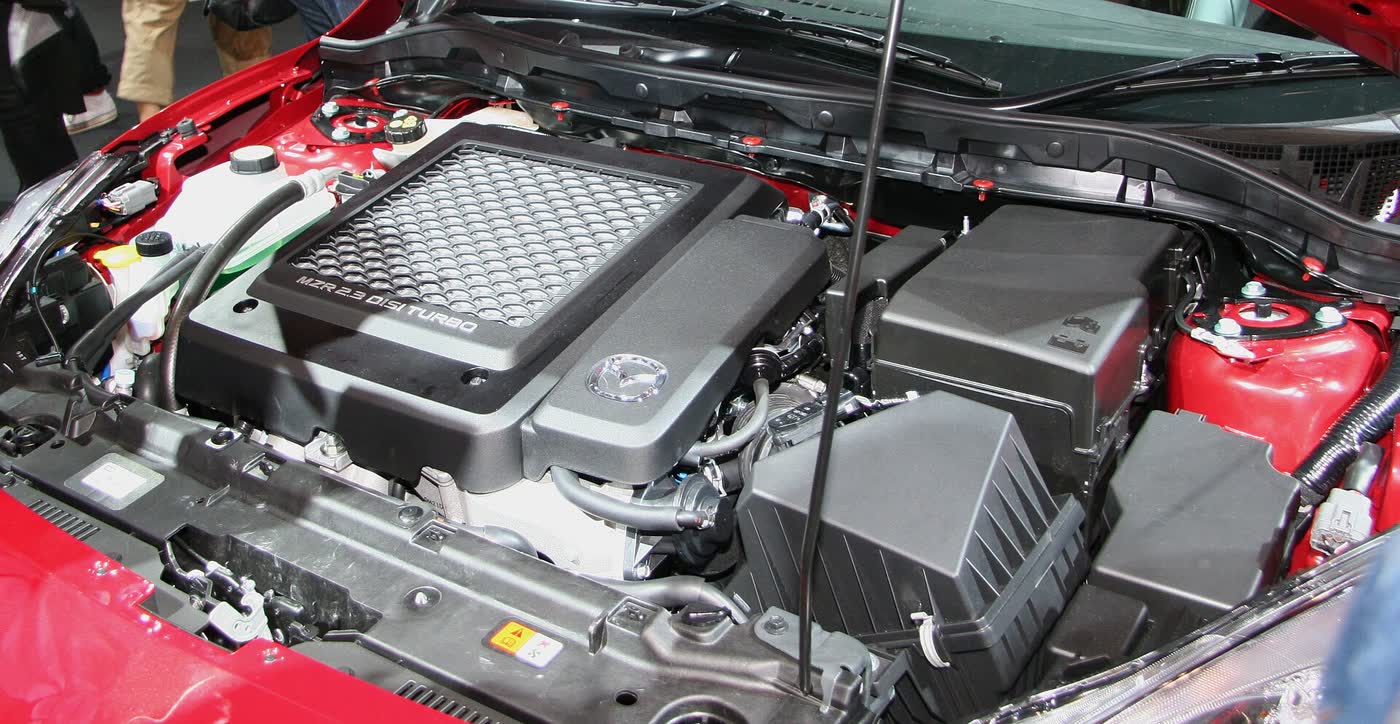
Its defining failure is invisible to a visual inspection and trivial to find with a laptop. The high-pressure fuel pump loses pressure under load. You cannot see that. You cannot hear it at idle. A careful walk-around, a torch, a clean service book and a pleasant test drive tell you nothing at all about it. A logging session at full throttle in third gear tells you everything.
That is different buying advice from anything else in this tier, and it is the reason the verdict says what it says. Bring a laptop, not a flashlight.
Why it matters so much is the chain behind it. A pump that cannot keep up leans the engine out, and leaning out torches pistons. So the cheap failure is the precursor to the expensive one, which is the same architecture the WRX has with oil consumption and ringlands, and the GTI Mk6 has with cold-start rattle and its timing chain. Three cars, three cheap warnings, three expensive endings.
Now the part where we correct something you have probably read elsewhere, including in our own research. There is a widely repeated claim that the pump fails "when, not if, from 50,000 to 60,000 miles on a stock car." We could not corroborate the mileage claim and we have downgraded it. The two original sources were a tuning vendor's build guide and a now-dead parts-shop blog, both of which sell pump internals. A targeted search confirmed the failure is real and common, with spill valve sticking, low rail pressure and no-start symptoms, but found nothing supporting the mileage figure, and owner threads span a wide range including well past 100,000. The failure is real. The schedule is not established, and the difference matters if you were about to walk away from a good car at 70,000 miles.
One more correction, because it looks like it applies and does not: NHTSA bulletin SB-10048339 covers the 2.0 SkyActiv engine, not this 2.3 DISI turbo. It is not your bulletin.
And the item you can check by feel: the rear motor mount. Wheel hop under power is the tell, and it is the same complaint the Focus ST has for the same reason.
| Figure | Mazdaspeed3 (2010-2013 Gen 2, 6MT) | Source |
|---|---|---|
| Seats / doors | 5 / 4, hatchback | Cars.com |
| Cargo | Not captured | no figure sourced |
| Infotainment | No CarPlay | our estimate |
The Daily scores a 7. It is a genuine only-car: five seats, four doors, and a hatchback with folding seats, which carries more than the sedans and coupes in this tier can.
It sits level with the Civic Si here despite having a less pleasant interior, because the hatch beats the sedan's boot on usefulness and that is what this category measures. Where it gives ground is ride quality, which is firm in a way that stops being charming on a long motorway run, and the Gen 2 grille, which people have feelings about.
| Figure | Mazdaspeed3 (2010-2013 Gen 2, 6MT) | Source |
|---|---|---|
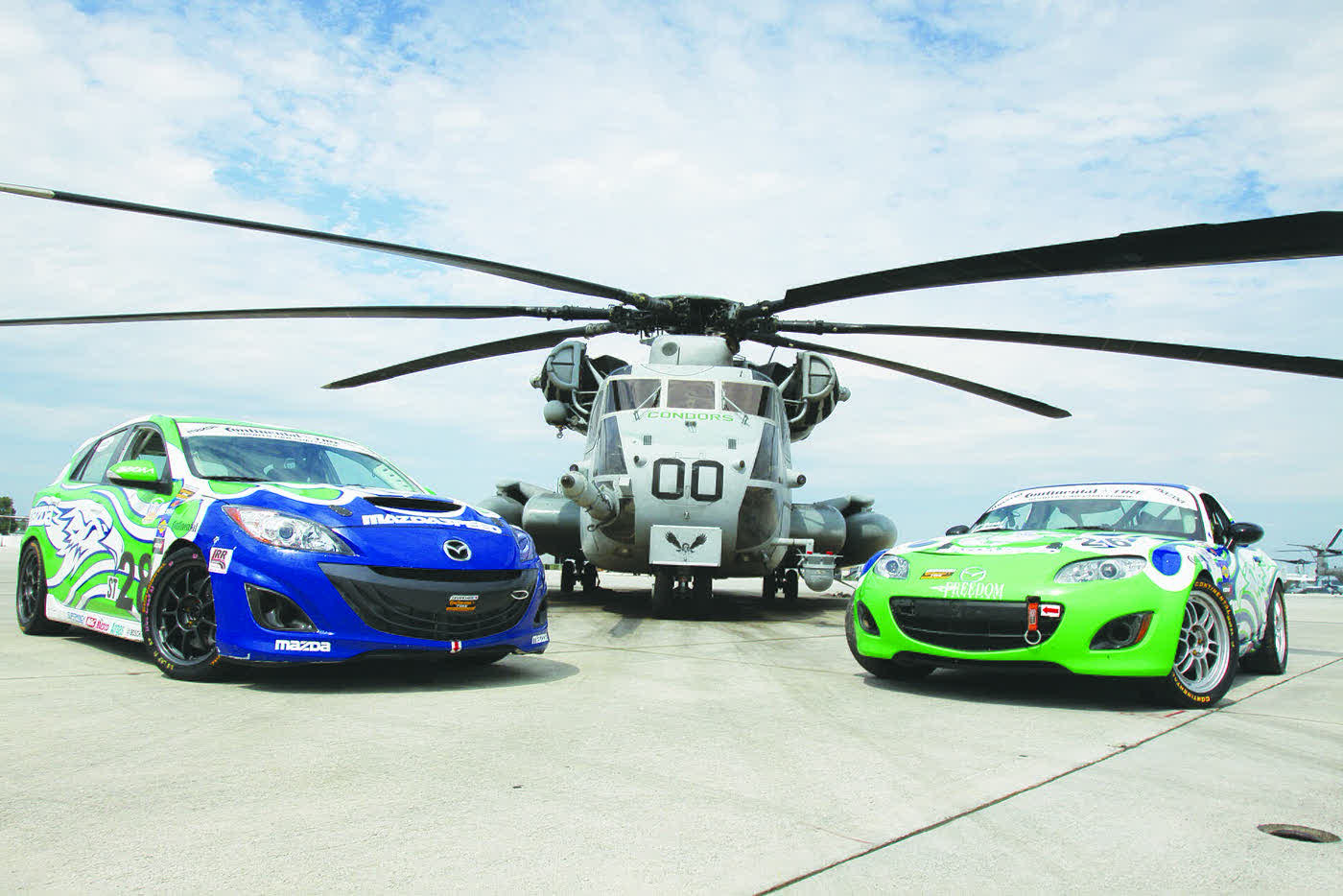
| SCCA Solo class | H Street (HS) * | SCCA Classification Assistant |
| Differential | Open. No limited-slip at any trim | Grassroots Motorsports |
| Lateral grip | Not captured | no instrumented figure sourced |
SCCA H Street · shared with the Fiesta ST, the Golf GTI, the Civic Si, the Focus ST and the GTI Mk6 on this Board.
The Limit scores a 5, and the reason is structural rather than a lack of grip. 280 lb-ft, front wheels, open differential. Put those three facts together and you have a car that runs out of traction before it runs out of ideas, and no amount of tyre fixes the arrangement.
For contrast inside this tier, the Civic Si has a helical limited-slip as standard equipment on a car with half the torque. That is the gap.
The class read needs an asterisk and this one was messy. The 2026 Appendix A extraction returned three separate Mazdaspeed3 groupings, none with a usable running header: one with ordinary Mazda3s, one with the Fiesta ST, Focus ST and Civic Si, and one in a Prepared category. Corroborating sources put it in G Street but date from 2016 to 2019. Our own research file contradicted itself and the author withdrew the G Street reading, so we carry H Street and flag that it needs a manual check.

| Figure | Mazdaspeed3 (2010-2013 Gen 2, 6MT) | Source |
|---|---|---|
| Cost per +100 whp | Not captured | no installed figure sourced |
| Aftermarket | Elite, deep and mature | derived |
The Mods scores a 6, and the order you do things in matters more here than on anything else in this tier.
Defensive first: rear motor mount, then fuelling, then power. The mount is the fix for wheel hop the car left the factory with. The fuelling is the thing that stops the failure in The Risk from becoming the catastrophe behind it.
Because that is the trap. The pump fails especially under any additional boost, and the engine's failure mode is leaning out and torching pistons. Adding power accelerates the primary failure, which is itself the precursor to the terminal one. This is the clearest case of that pattern we have written up.
Which produces an unusual conclusion for a used performance car. An untuned example is worth more than a tuned one here, and that inverts how most of this market works. Anyone selling you a tuned Mazdaspeed3 on a stock high-pressure fuel pump is selling you the failure with the car.
We publish no cost per 100 wheel horsepower, because no installed price for a pump-and-fuelling package was sourced.
41 out of 70. Buy the one nobody has tuned, and datalog it before you pay.
This is a fast, practical, likeable car, and the score is held down by a failure you cannot see and a market full of cars that have been modified into it.
The buying instruction is unlike anything else in this tier, so it is worth repeating plainly. Get a full-throttle fuel-pressure datalog in third gear before money changes hands. Check the rear motor mount for wheel hop. And buy the car nobody has flashed, even if it costs more than the one somebody has, because on this engine the modification and the failure are the same story.
If that sounds like a lot of work, it is, and the reward is 280 lb-ft in a hatchback for under nine thousand dollars. If it sounds like too much, the Civic Si asks almost nothing of you and gives up the pace.
We scored the Mazdaspeed3 as a 2010 to 2013 Gen 2 with the 2.3 MZR DISI turbo and the six-speed manual, and it landed at 41 out of 70, with a verdict of Buy the one nobody has tuned, and datalog it before you pay.
This is 280 lb-ft in a practical hatchback for under nine thousand dollars, and the failure that decides whether you got a good one is completely invisible to a normal inspection. You find it with a laptop, in about ten minutes, and almost nobody does.
Eight thousand five hundred and eighty dollars, for a 2012 Touring hatchback in Good condition at 120,000 miles, private party, from Kelley Blue Book. The range runs $6,980 to $8,980.
That is $32.6 per horsepower for 263 horsepower, which beats the Civic Si's $39.4 and trails the 350Z's $18.7.
But the sticker tells you less on this car than on anything else you are looking at. Edmunds appraises a single model year from $2,565 to $8,860. That is a 3.5 times spread, on one year, and it is not about paint. Modified, thrashed and neglected cars fill the bottom of it.
So the real difficulty with this car is not finding a cheap one. It is finding one nobody has already modified, and that is worth paying for. Budget patience rather than money.
Fast, and busy. Two hundred and eighty lb-ft at 3,000 rpm, going through the front wheels, with no limited-slip differential at any trim.
That one line is the whole car in both directions. The torque arrives early and hard, and the thing feels quicker than its 6.2 seconds to 60 suggests. It is quicker than the Civic Si and both Miatas, and slower than the two Nissans.
And it fights you. Wheel hop and torque steer are two of the most-cited complaints about this car, and worn rear motor mounts are a main cause of both. With an open differential, all that torque is being sorted out by the front tyres and your hands.
Some people love it for exactly that reason. Some people find it exhausting after a month. Drive one before you decide which you are, because this is not a car you can judge from a specification sheet.
Middling, and unremarkable, which is a relief after The Risk.
About $4,954 a year. Insurance is $1,968, which is 22.9 percent of the car's value annually, running against the NC Miata's 21.6 and the 128i's 20.8. A bit high, nothing alarming, and it comes from MoneyGeek broken out by trim on the same basis as the Miata, 350Z and Civic Si, so those comparisons are fair.
The line that stands out is fuel: 21 mpg combined on premium, which is $2,286 a year. That is what a turbocharged 2.3 in a 3,281 lb car costs to feed. The Fiesta ST does 29 mpg on regular for $1,448, if you want the contrast.
Tyres and service are our own estimates and carry no source.
It depends on what the previous owner did, and the range is wide.
| Scenario | Year-one cost | As a share of an $8,580 buy-in |
|---|---|---|
| Documented, stock, records present | ~$1,600 to $2,200 | 19 to 26 percent |
| Typical, catch-up maintenance | ~$2,800 to $3,600 | 33 to 42 percent |
| Neglected, pump and mounts and more | ~$3,800 to $5,100 | 44 to 59 percent |
Those are parts plus independent labour at 120,000 miles. The high-pressure fuel pump sits at roughly $700 to $1,200 as our estimate, and it is conditional rather than certain, for reasons in the next section.
Notice that even the bad row here is not the disaster the WRX or the RX-8 can produce. This car's worst realistic day is expensive rather than terminal, provided you catch the fuelling before it leans out.
This is the section that decides the purchase, and it works differently from every other car in this tier.
The failure that matters is the high-pressure fuel pump losing pressure under load, and you cannot see it. Not on a walk-around, not with a torch, not from the service book, not on a pleasant test drive. It is invisible to everything a normal pre-purchase inspection does.
And it is trivial to find with a datalog. A logging session at full throttle in third gear tells you the whole story. That is the single most useful thing you can do about this car, and it is the reason our verdict says what it says. Bring a laptop, not a flashlight.
Why it matters is the chain behind it: a pump that cannot keep up leans the engine out, and leaning out torches pistons. The cheap failure is the precursor to the expensive one. Our budget tier has three cars built this way. The WRX starts with oil consumption and ends with ringlands, the GTI Mk6 starts with a cold-start rattle and ends with a timing chain through the valves, and this one starts with fuel pressure.
Now a correction, including of our own earlier research. You will read that the pump fails "when, not if, at 50,000 to 60,000 miles on a stock car." We could not corroborate that and we have downgraded it. The two sources behind the claim were a tuning vendor's build guide and a now-dead parts-shop blog, both of which sell pump internals. A targeted search confirmed the failure is real and common, with spill valve sticking, low rail pressure and no-start symptoms. It found nothing supporting the mileage, and owner reports run well past 100,000. The failure is real. The schedule is not, and if you were about to walk away from a well-kept 70,000-mile car on the strength of that number, do not.
One thing that looks relevant and is not: NHTSA bulletin SB-10048339 covers the 2.0 SkyActiv engine rather than this 2.3 DISI turbo. Different engine, not your problem.
The other check is free: drive it hard from a standstill and watch for wheel hop. That is the rear motor mount, it is a known weak point, and it is the same complaint the Focus ST has.
Yes, easily. Five seats, four doors, and a hatchback with folding seats that carries more than any sedan or coupe in this tier.
It scores level with the Civic Si on livability despite a plainer interior, because the hatch is simply more useful than a boot. What it gives up is ride quality, which is firm in a way that gets old on a long motorway journey, and the Gen 2 grille, which you either stopped noticing years ago or never will.
It classes as H Street, and our Limit score of 5 is the lowest thing on the card that is not the RX-8's engine, for a structural reason rather than a lack of grip.
280 lb-ft, front wheels, open differential. No limited-slip at any trim. The car runs out of traction before it runs out of anything else, and tyres do not fix an arrangement. For contrast, the Civic Si has a helical limited-slip as standard on a car with half the torque.
The class read wants a manual check. The 2026 Appendix A extraction returned three separate Mazdaspeed3 groupings, none with a usable running header, and corroborating sources say G Street but date from 2016 to 2019. Our own file contradicted itself and the author withdrew the G Street reading, so we carry H Street with an asterisk.
Only in the right order, and the order is not the fun one.
Rear motor mount first. Then fuelling. Then power. The mount fixes wheel hop the car came with. The fuelling is what keeps the failure from becoming the catastrophe.
Here is why that sequence is not negotiable. The pump fails especially under additional boost, and the engine's failure mode is leaning out and torching pistons. So adding power accelerates the failure that precedes the terminal one. The WRX has a version of this and the Focus ST has a milder one; here the modification and the weak point are the same part.
Which leads somewhere unusual for a used performance car. An untuned example is worth more than a tuned one, which inverts how this market normally works. If somebody is selling you a flashed Mazdaspeed3 on a stock high-pressure fuel pump, they are selling you the failure along with the car, and quite possibly without knowing it.
We publish no cost per 100 wheel horsepower here, because no installed price for a proper pump-and-fuelling package was sourced.
The two front-drive turbo hatches in our budget tier, with almost identical characters and a $1,650 gap.
They share more than they differ: 280 lb-ft and 270 lb-ft through the front wheels, no mechanical limited-slip in either, the same collapsing rear motor mount, the same wheel hop, and the same correct first modification. Treat them as level on pace, because our 6.2 and 5.9 second figures come from different sources and the Mazdaspeed3 has the better power-to-weight.
The differences that decide it are money and risk. The Focus ST is $10,230 and costs $6,092 a year to keep. The Mazdaspeed3 is $8,580 and costs $4,954. That is $1,138 a year, every year, mostly insurance.
Against that, the Focus ST has no catastrophic failure mode at all, and this car has a fuelling chain that ends in pistons. So the Focus ST is the safer car and the Mazdaspeed3 is the cheaper one, and if you are willing to do the datalog, the cheaper one is a lot of car for the money.
Buy the one nobody has tuned, and datalog it before you pay. Forty-three out of seventy.
There is a good car here. It is quick, it is properly practical, the aftermarket is deep, and 280 lb-ft in a hatch for $8,580 is a lot of performance for the money.
What holds the score down is that the market is full of cars that have been modified into their own weak point, and that the weak point is invisible unless you go looking with the right tool.
So do the three things. Get a full-throttle fuel-pressure datalog in third gear. Check for wheel hop, which is the rear motor mount. And buy the car nobody has flashed, even at a premium, because on this engine the modification and the failure are the same story.
Filming reference: cue sheet · for the hosts on set, not part of the review.
The frame that closes our video: the Mazdaspeed3 at 41/70, with the Golf GTI and the Civic Si alongside.