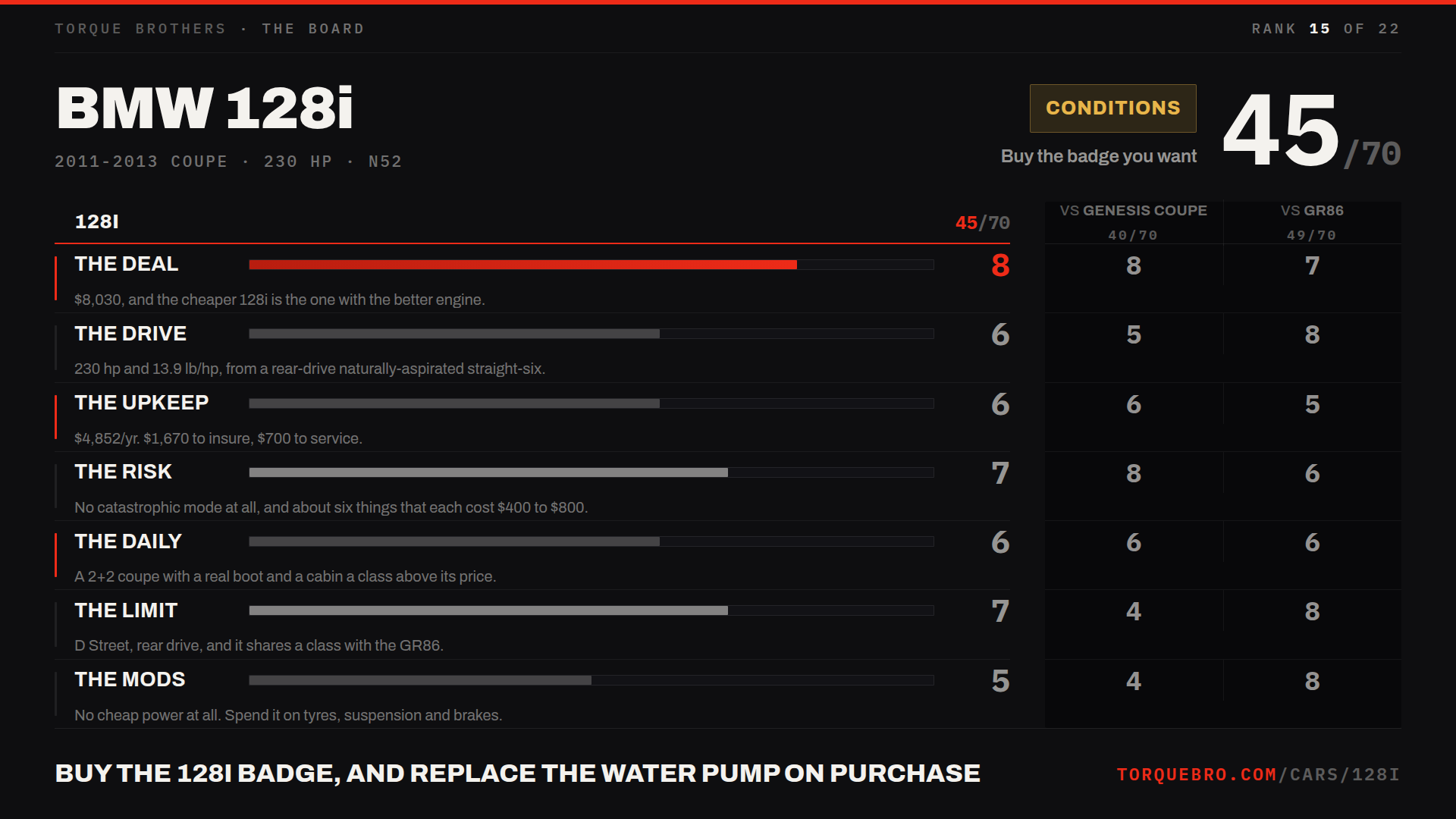
2011-2013 Coupe · N52 · 6MT
The BMW you buy to avoid BMW problems. The 135i got the N54 twin-turbo and its whole reputation; this got the naturally-aspirated N52, with no known catastrophic failure mode. Confirm the badge, replace the water pump on purchase. It will not grenade, and it will not stop asking for money.
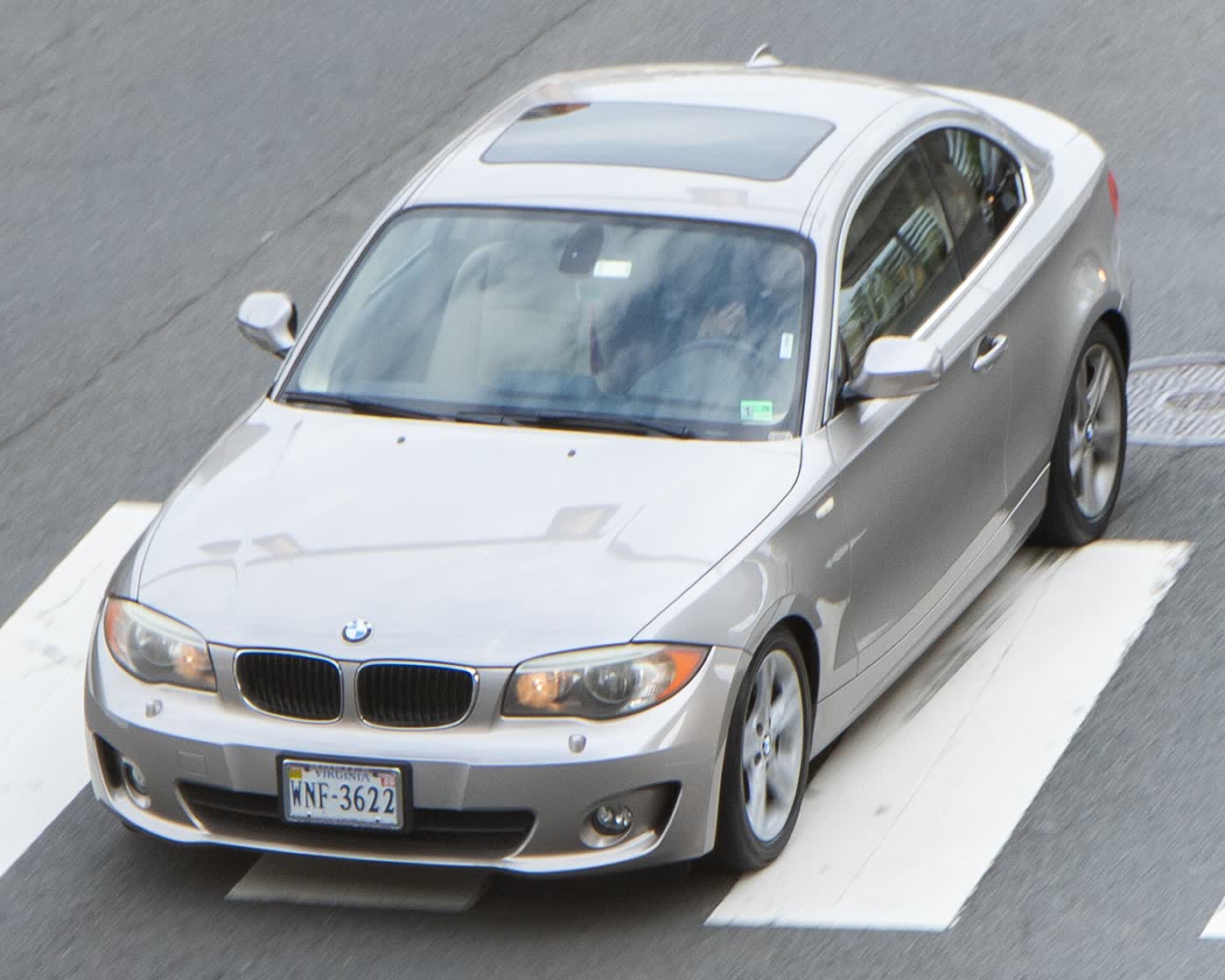
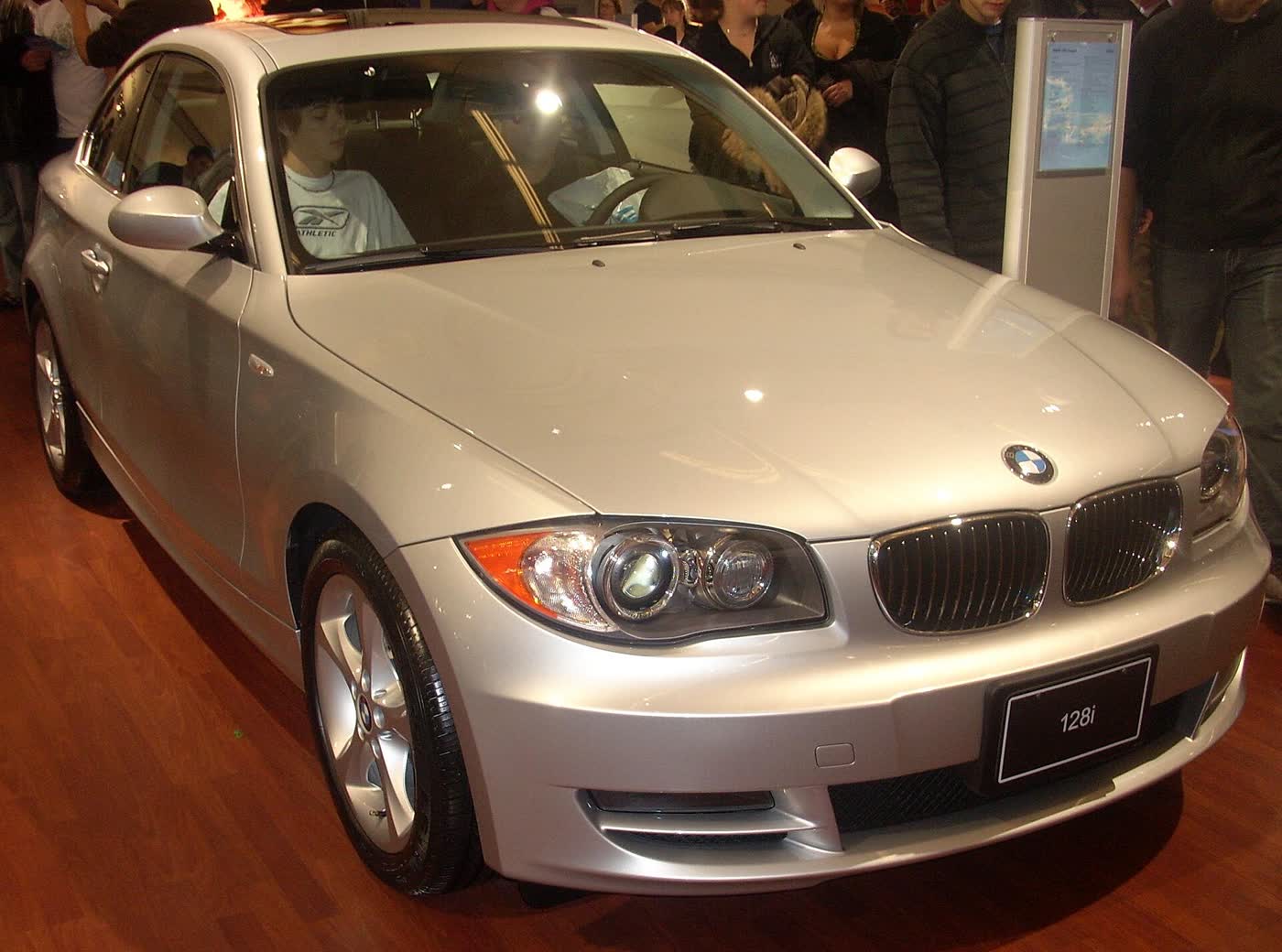
We scored the car as a 2011 to 2013 128i coupe with the N52 and the six-speed manual, and it landed at 45 out of 70, with a verdict of Buy the 128i badge, and replace the water pump on purchase.
This car is for someone who wants a rear-drive naturally aspirated straight-six with proper BMW ergonomics, and who understands that the running costs never quite stop.
This is the contrarian pick of the budget tier, and the argument for it is unusual. It is bought because of what it does not have.
All money figures use a fixed set of assumptions so they can be compared to other cars we cover: 12,000 miles a year, premium fuel at $4.00 a gallon, and full coverage insurance. Prices are Kelley Blue Book private-party at 120,000 miles in Good condition, which is the flat basis this whole budget tier uses. The insurance figure here is coarse, and The Upkeep says why.
| Figure | 128i (2011-2013 Coupe, N52, 6MT) | Source |
|---|---|---|
| Used buy-in, private party | $8,030 | KBB |
| Condition basis | 120,000 miles, Good | KBB |
| Full condition range | $6,355 to $8,455 | KBB |
| Dollars per horsepower | $34.9/hp, against the Civic Si's $39.4 | derived: $8,030 divided by 230 hp |
~ our estimate, not a measured or quoted figure · * there is a caveat, and the note under the table explains it. Why we mark figures
The Deal scores an 8, and the argument runs the opposite way to how used performance cars normally work.
Eight thousand and thirty dollars for 230 horsepower is $34.9 per horsepower, which puts it ahead of the Civic Si's $39.4 and the GTI Mk6's $45.4, and behind the 350Z's $18.7 and the G37's $21.2. Mid-pack, and unremarkable on its own.
The interesting part is the car sitting next to it in the showroom fifteen years ago. The 135i costs more to buy than this, and it comes with the N54 twin-turbo's repair bill on top: high-pressure fuel pumps, injectors, turbos, walnut blasting. Here the cheaper car is also the one with the better engine.
That almost never happens, and it is the entire reason this car is on our Board.
A correction we owe you: our research file compared this against four figures that were all computed against placeholder prices. The conclusion survived; the numbers did not, and the ones above are current.
| Figure | 128i (2011-2013 Coupe, N52, 6MT) | Source |
|---|---|---|
| Power-to-weight | 13.9 lb per hp | derived from the figures below |
| Power | 230 hp | Cars.com |
| Torque | 200 lb-ft | Cars.com |
| Curb weight, coupe 6MT | 3,208 lb | Edmunds |
| 0 to 60 mph | 6.1 sec manual (6.7 automatic) | Cars.com |
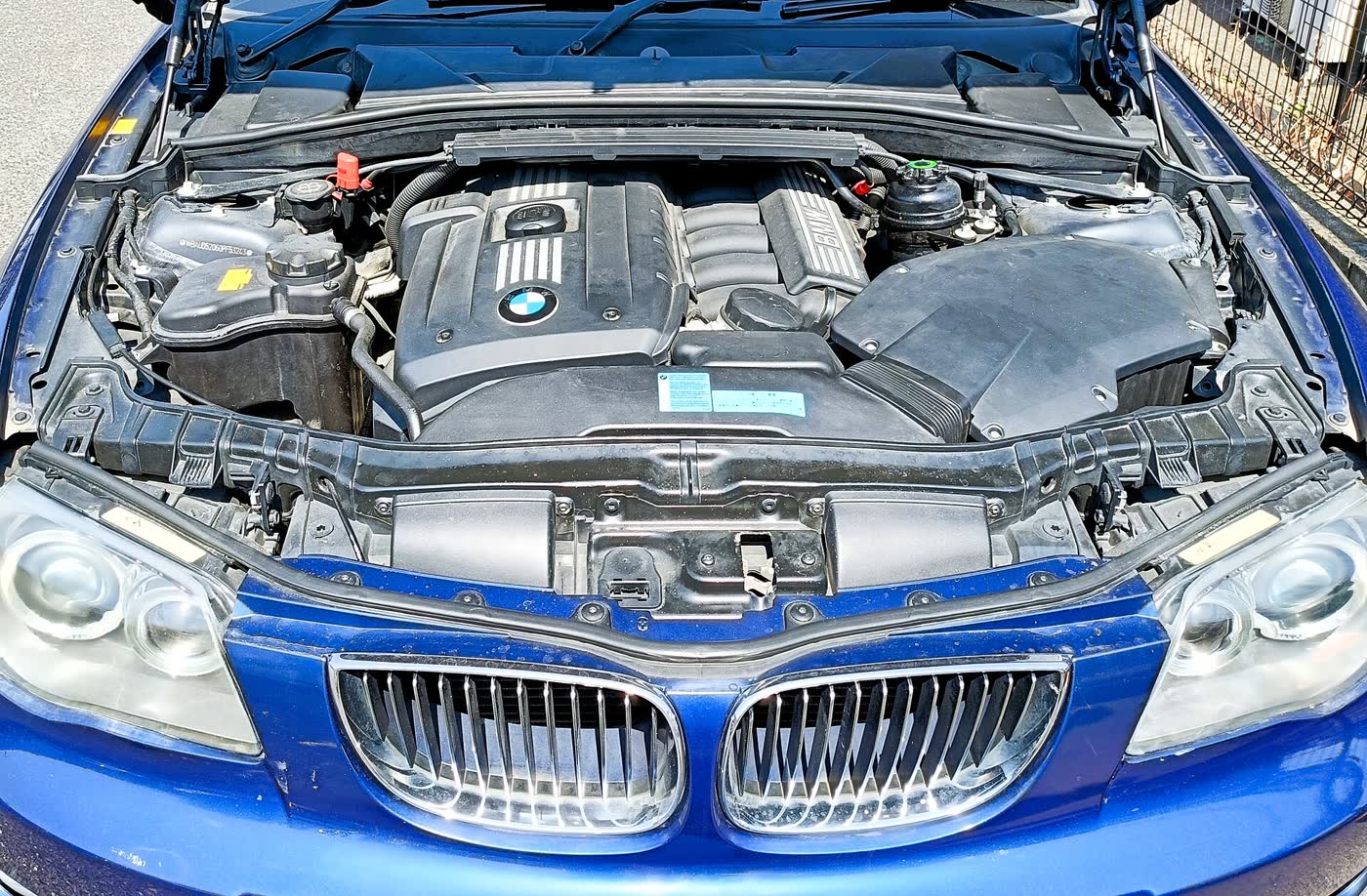
| Engine | 3.0 N52, naturally aspirated, port injected | BMW Tuning |
The Drive scores a 6. On pace it is mid-pack: quicker than the Civic Si and the GTI Mk6, slower than the 350Z, the G37 and the Genesis Coupe. Six point one seconds to 60 is respectable and not remarkable.
What is not mid-pack is the character. Rear-wheel drive, a naturally aspirated straight-six, port injection, and it sounds like exactly that. There is a smoothness to a six that four cylinders do not have, and this is one of the cheapest ways left to find out whether that matters to you.
A note on the weight figure, because it is a mistake we made and caught. The number in circulation for this car is 3,494 lb, and that is the convertible with the automatic. The coupe with the six-speed manual is 3,208 lb, which is 286 lb lighter, and correcting it moved power-to-weight from a wrong 15.2 to a correct 13.9. If you see the heavier figure quoted anywhere, including in older versions of our own research, it is describing a different car.
| Figure | 128i (2011-2013 Coupe, N52, 6MT) | Source |
|---|---|---|
| Total annual running cost | ~$4,852/yr | sum of the lines below |
| Fuel | ~$2,182/yr | derived from our fixed assumptions |
| Insurance, full coverage | ~$1,670/yr * | MoneyGeek |
| Tires, amortized | ~$300/yr | our estimate |
| Routine service | ~$700/yr | our estimate, BMW parts and labour |
| Fuel economy | 22 mpg combined (18/27) | Cars.com |
| Octane | 91, premium | Cars.com |
The Upkeep scores a 6, and it gets there by two opposite routes cancelling out.
The insurance is low. At $1,670 it is 20.8 percent of the car's value per year, which runs against the WRX's 21.2 percent and the NC Miata's 21.6. For a BMW badge that is counterintuitive, and it reflects what this car actually is: a low-power base-model coupe rather than an M car.
The service line is the BMW tax and there is no way around it. We put it at $700 a year against the $400 to $500 we use elsewhere in the tier, because parts and labour cost more on this car even when nothing is wrong. That is not a criticism of the engineering. It is just what owning the badge costs.
One caveat on the insurance figure, which carries an asterisk for a reason. It is coarse. MoneyGeek's 1 Series page gives no year-by-year breakdown and no split between the 128i and the 135i, and a 135i would insure meaningfully higher, which drags the average up. The true 128i figure is probably below $1,670, so if anything this car's Upkeep is understated rather than flattered. It wants a better source before anyone leans on it.
| Figure | 128i (2011-2013 Coupe, N52, 6MT) | Source |
|---|---|---|
| Worst realistic repair | ~$800, electric water pump and thermostat | BMW Tuning |
| Catastrophic failure mode | None | see below |
| Detection, water pump | No. It fails without much warning | BMW Tuning |
The Risk scores a 7, and this car has a shape we had not seen anywhere else in the tier. Call it death by a thousand gaskets.
Every other car down here has one thing that can end it: a slave cylinder, a paper gasket, a fuel pump, a ringland, a timing chain, a synchro. The N52 has none of those. It is routinely described as one of the more reliable engines BMW has built in the modern era, and that reputation is why this car exists on our Board at all.
What it has instead is about six items that will each cost $400 to $800: valve cover gasket, oil filter housing gasket, VANOS solenoids, the water pump, and so on. It will not grenade, and it will also never stop asking for money. That is a different ownership proposition, and it is the one the cheap-BMW cliche gets wrong in both directions at once.
The one to think about is the electric water pump, because it is the item you cannot inspect for. It uses a plastic impeller that goes brittle with age, it fails without much warning, and it can strand you and cook the engine if it lets go at the wrong moment. Failure is common between 60,000 and 100,000 miles.
Which produces an unusual instruction. Do not inspect for it. Replace it on purchase. At the 120,000 miles our tier prices at, and against BMW's own 50,000 to 80,000-mile guidance, budgeting $800 as part of the buy is the correct move rather than hoping the last owner did it. Then stop thinking about it.
Everything else on the list is visual and cheap enough to absorb.
And one thing to confirm before anything else: check that it is a 128i and not a 135i. The badge is the single most valuable fact about the car you are looking at, because the 135i is the one with the N54 and the reputation this car was built to avoid.
| Figure | 128i (2011-2013 Coupe, N52, 6MT) | Source |
|---|---|---|
| Seats / doors | 4 / 2, coupe with a usable boot | Edmunds |
| Cargo | Not captured | no figure sourced |
| Infotainment | No CarPlay. iDrive on some cars | derived |
The Daily scores a 6. It is a 2+2 coupe with a real boot and a driving position that is better resolved than most of what is down here, which is a thing BMW got right in this era and it still shows.
Against the tier it lands sensibly: clearly ahead of the two-seat Miata and 350Z, well behind the hatches and the G37 sedan on outright usefulness. It ties the Genesis Coupe by having a materially better interior in a materially smaller car.
If you sit in a lot of cars, this one is nicer than the score suggests. If you carry a lot of things, it is not.
| Figure | 128i (2011-2013 Coupe, N52, 6MT) | Source |
|---|---|---|
| SCCA Solo class | D Street (DS) * | SCCA Classification Assistant |
| Layout | Rear-wheel drive, 3,208 lb, near-neutral balance | derived |
| Lateral grip | Not captured | no instrumented figure sourced |
The Limit scores a 7, which is high for a car with no instrumented figures, and the reason is the chassis rather than the numbers. Rear-drive, 3,208 lb, near-neutral balance, and a car that stands comparison with the NC Miata's for how it behaves at the edge.
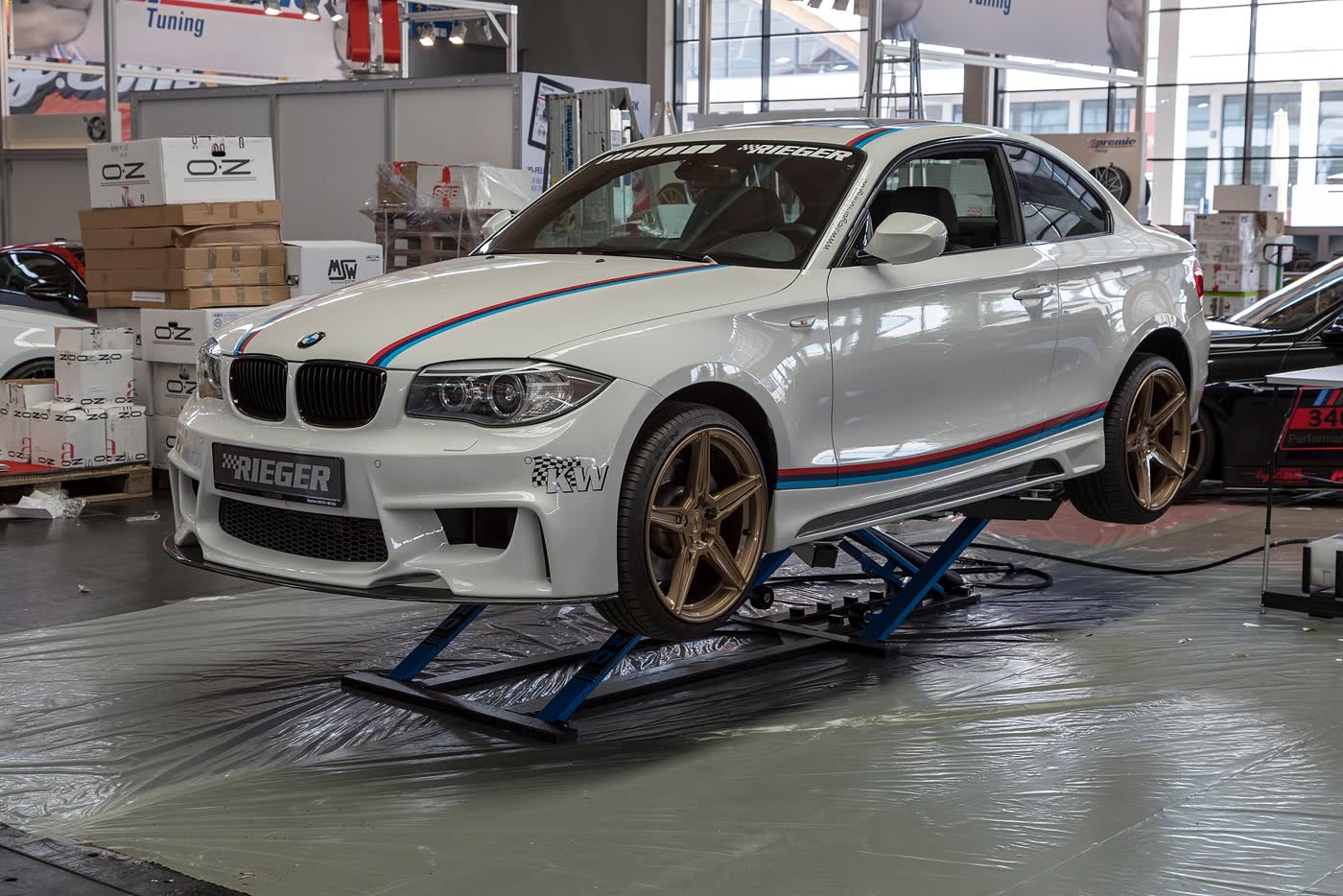
The interesting fact is the company it keeps. It classes D Street with the GR86 and the BRZ, which means an $8,030 BMW lines up against a Board car worth roughly three times as much, on the same entry form.
The class read is better corroborated than most in this tier: two independent lines of evidence agree, with the 2026 Appendix A extraction grouping the 128i with the GR86, BRZ, MR2 Spyder, 911 SC, 944 and E30 through E46 3 Series, and independent sources classing it D Street across the 2016, 2017 and 2021 rulebooks. We still treat it as single-source rather than verified, to hold the same standard we applied to the 350Z, because no 2026 running header was visible in direct context.
| Figure | 128i (2011-2013 Coupe, N52, 6MT) | Source |
|---|---|---|
| Cost per +100 whp | Not captured | no forced-induction route with a price was sourced |
| Aftermarket | Modest: chassis and suspension yes, power no | derived |
The Mods scores a 5. The N52 is naturally aspirated and near its ceiling, and there is no cheap power route on it. That is simply the engine you bought.
The honest advice is the same one the NC Miata gets: spend on tyres, suspension and brakes, and leave the engine alone. With a D Street chassis and near-neutral balance, that money goes further here than an extra 30 horsepower would.
There is one good thing hiding in that limitation. Modifying this car does not accelerate anything, because there is no pressure-fed failure mode to make worse. That is a different "no" from the Mazdaspeed3's and the WRX's, where the modification and the failure are the same activity.
45 out of 70. Buy the 128i badge, and replace the water pump on purchase.
This is the contrarian pick down here and it is a real one. A rear-drive naturally aspirated straight-six with a proper chassis, for eight thousand dollars, from the era when BMW interiors were still good.
It is bought because of what it does not have. No twin-turbo, no high-pressure fuel pump, no walnut blasting, no catastrophic failure mode of any kind. The 135i has all of that and costs more.
The honest closing line is the one from The Risk: it will not grenade, and it will not stop asking for money. About six items at $400 to $800 each, plus a $700-a-year service line that is just what the badge costs. If that sounds tolerable, this is a lovely car. If it sounds like a slow leak, the Civic Si asks almost nothing and gives up the six cylinders.
Two things to do when you go and look at one. Confirm the badge, because 128i and 135i are very different propositions. And ask when the electric water pump and thermostat were last done. No record means budget $800 and do it as part of the purchase, rather than waiting to find out on a motorway.
We scored the 128i as a 2011 to 2013 coupe with the N52 and the six-speed manual, and it landed at 45 out of 70, with a verdict of Buy the 128i badge, and replace the water pump on purchase.
This is the BMW you buy to avoid BMW problems. The 135i sitting next to it got the N54 twin-turbo and the entire reputation that goes with it; this got a naturally aspirated port-injected straight-six with none of that. The cheaper car is also the one with the better engine, which almost never happens in the used market.
What you are signing up for is not a catastrophe. It is a steady drip.
Eight thousand and thirty dollars, for a 2012 coupe in Good condition at 120,000 miles, private party, from Kelley Blue Book. The range runs $6,355 to $8,455.
That is $34.9 per horsepower for 230 horsepower, ahead of the Civic Si's $39.4 and the GTI Mk6's $45.4, behind the 350Z's $18.7 and the G37's $21.2. On its own, an unremarkable mid-pack result.
The reason it is on our Board is the car parked next to it. The 135i costs more to buy, and then it costs more to own: high-pressure fuel pumps, injectors, turbos, walnut blasting, all the things the N54 became famous for. Here the cheaper version has the better engine, and that inversion is the whole buying argument.
Mid-pack on pace and unusual on character.
Six point one seconds to 60 with the manual, from 230 horsepower and 200 lb-ft. That is quicker than the Civic Si and the GTI Mk6, and slower than the 350Z, G37 and Genesis Coupe. Nothing about the numbers will impress anyone.
What the numbers do not carry is the engine. Rear-wheel drive, naturally aspirated, straight-six, port injected, and it behaves and sounds like exactly that. If you have never owned a six, this is one of the cheapest remaining ways to find out whether the smoothness is worth something to you. Plenty of people discover that it is.
One note on the weight figure, because we got it wrong first and want to say so. The number in circulation is 3,494 lb, and that describes the convertible with the automatic, which is the heaviest thing in the range. The coupe with the six-speed manual weighs 3,208 lb, 286 lb less, and correcting it moved power-to-weight from a wrong 15.2 to a correct 13.9. If you see the heavier figure quoted, it is not this car.
About $4,852 a year, and it lands there by two opposite routes.
The insurance is surprisingly cheap. At $1,670 it is 20.8 percent of the car's value annually, running against the WRX's 21.2 and the NC Miata's 21.6. For a BMW that is counterintuitive, and it makes sense once you remember what this actually is: a base-model coupe with 230 horsepower, not an M car.
The servicing is not cheap, and that is the badge. We put it at $700 a year, against $400 to $500 for the Japanese and Korean cars in this tier. Parts cost more, labour costs more, and that is true even when nothing has gone wrong. Nobody should be surprised by this and plenty of people are.
A caveat on the insurance figure, because it carries an asterisk. It is coarse: MoneyGeek's 1 Series page has no year breakdown and no split between the 128i and the 135i, and the 135i drags the average up. The real 128i number is probably below $1,670, which means if anything we have understated this car rather than flattered it.
Predictable, and never zero.
Budget the electric water pump and thermostat at around $800 if there is no record of them, and there usually is not. Beyond that, expect one or two of the gasket items in any given year at $400 to $800 apiece.
There is no row on this table where the engine leaves the car, which is the point of buying this instead of the 135i.
Yes and no, and the distinction is the most useful thing in this review.
There is no catastrophic failure mode on this car. The N52 is routinely called one of BMW's more reliable modern engines, and it earns it: no pressure-fed timing chain waiting to go through the valves, no fuel pump chain ending in pistons, no ringlands, nothing that turns a good week into an engine-out weekend.
What it has instead is about six things that each cost $400 to $800. Valve cover gasket. Oil filter housing gasket. VANOS solenoids. Water pump. And so on, on a rotating basis, for as long as you own it. We started calling this shape death by a thousand gaskets and it stuck, because it is different from anything else in this tier.
So it will not grenade, and it will not stop asking for money. The cheap-BMW cliche gets this wrong in both directions at the same time: people expect it to explode, and it will not, and people who know it will not then underestimate the running total.
The one item that deserves a plan rather than an inspection is the electric water pump. It has a plastic impeller that goes brittle with age, it fails without much warning, it is common between 60,000 and 100,000 miles, and it is not meaningfully detectable in a pre-purchase check. If it lets go at speed it can strand you and cook the engine.
The correct move is therefore not to look for it. Replace it on purchase. At the 120,000 miles our tier prices at, and against BMW's own 50,000 to 80,000-mile guidance, treat $800 as part of the buying price and then forget about it.
And before any of that: confirm it is a 128i and not a 135i. The badge is the single most valuable fact about the car in front of you, because everything good about this review is about the engine that is not a twin-turbo N54.
If you do not carry much, yes. It is a 2+2 coupe with a usable boot and a driving position that is properly sorted, which is something this era of BMW got right and you can still feel.
Against the tier it is clearly more usable than the two-seat Miata and 350Z, and clearly less usable than the hatches or the G37 sedan. It ties the Genesis Coupe by being a nicer interior in a smaller car.
No CarPlay, and iDrive on some cars.
It classes as D Street, and this is one of the better-corroborated class reads in the tier: two independent lines of evidence agree, with the 2026 Appendix A extraction grouping the 128i alongside the GR86, BRZ, MR2 Spyder, 911 SC, 944 and E30 through E46 3 Series, and independent sources classing it D Street across the 2016, 2017 and 2021 rulebooks.
We still mark it with an asterisk rather than calling it verified, because no 2026 running header was visible in direct context, and we hold that line consistently after what happened with the 350Z.
The fun fact is the company. D Street puts this against the GR86 and the BRZ, which means an $8,030 BMW and a Board car worth roughly three times as much fill in the same entry form. Our Limit score of 7 is about the chassis rather than any figure, because we captured no instrumented grip or braking numbers: rear drive, 3,208 lb, near-neutral, and good at the edge.
Not the engine. The N52 is naturally aspirated and close to its ceiling, and there is no cheap power route on it worth the money.
The advice is the same one the NC Miata gets: tyres, suspension, brakes. On a chassis that classes with a GR86, that spend does more for you than 30 extra horsepower would.
There is a quiet advantage here too. Modifying this car does not accelerate anything, because there is no pressure-fed failure mode to make worse. That is a very different situation from the Mazdaspeed3 or the WRX, where enthusiasm and failure are the same activity.
These two are close on price, $8,030 against $7,760, and they are opposite answers to the same budget.
The Civic Si is front-drive, revs to the moon, has a helical limited-slip as standard, and asks very little of you: our Risk score for it is an 8 and its worst realistic bill is a clutch. It is the low-maintenance choice and there is no shame in that being the right one.
The 128i is rear-drive with a straight-six and a chassis that classes with a GR86, and it will hand you a $400 to $800 bill on a semi-regular basis forever. It is the character choice.
If your budget for surprises is small, buy the Civic Si. If what you actually want is a rear-drive six and you have room in the monthly numbers, this is one of the last cheap ways to have one.
Buy the 128i badge, and replace the water pump on purchase. Forty-six out of seventy.
This is the contrarian pick of our budget tier and it holds up. A rear-drive naturally aspirated straight-six with a good chassis and a good interior for eight thousand dollars, bought specifically because of what it does not have.
The honest closing line is the one from the risk section, and we would rather you hear it from us than learn it: it will not grenade, and it will not stop asking for money.
Two things when you go to see one. Confirm the badge. Then ask when the electric water pump and thermostat were last done, and if there is no record, budget $800 and do it as part of the purchase rather than finding out on a motorway.
Filming reference: cue sheet · for the hosts on set, not part of the review.
The frame that closes our video: the 128i at 45/70, with the Genesis Coupe and the GR86 alongside.