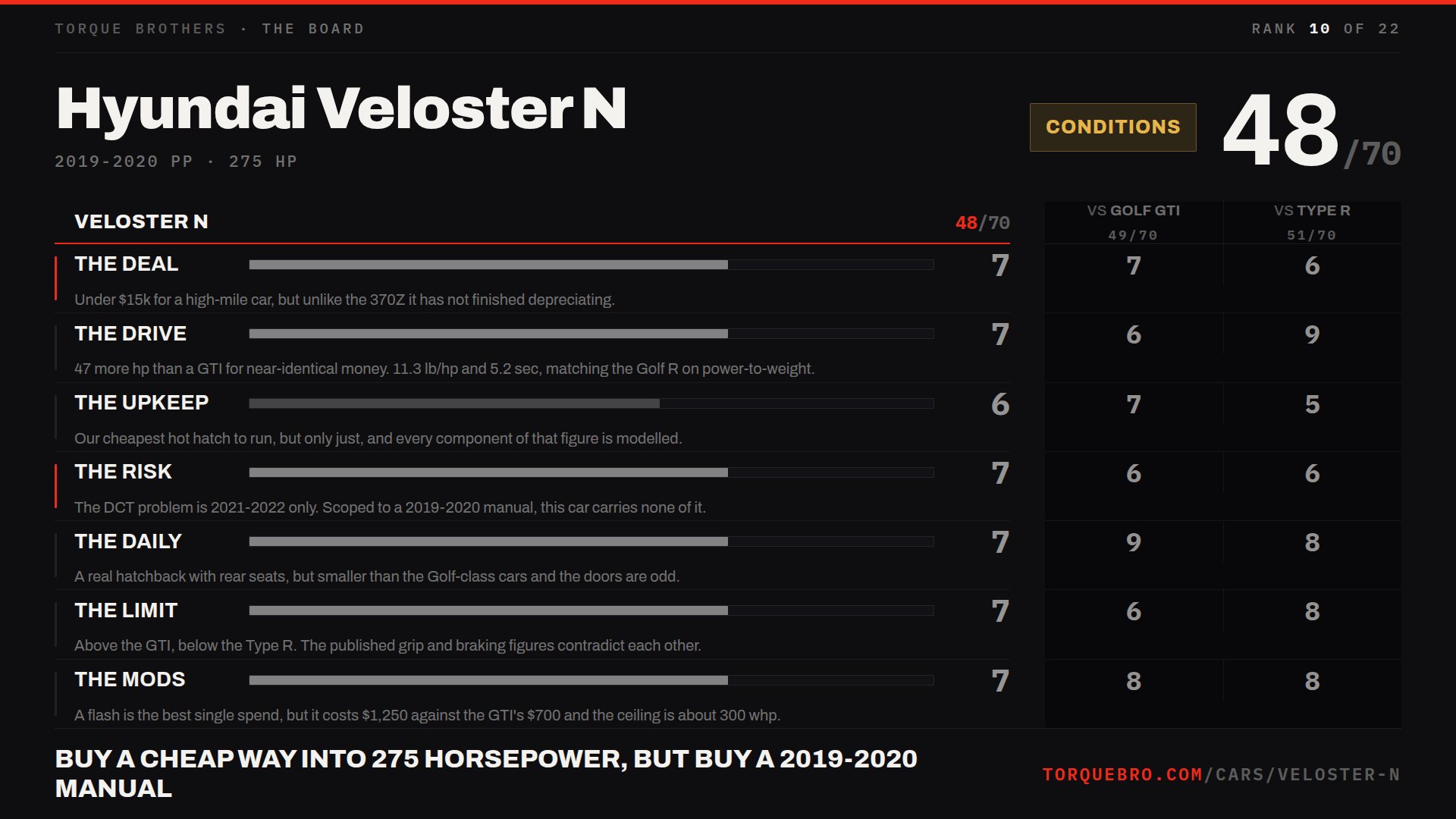
2019-2020 · Performance Package · Manual
Buy a cheap way into 275 horsepower, but buy a 2019-2020 manual with the Performance Package. That version is both the cheap end of the market and the one without the transmission that causes the trouble.
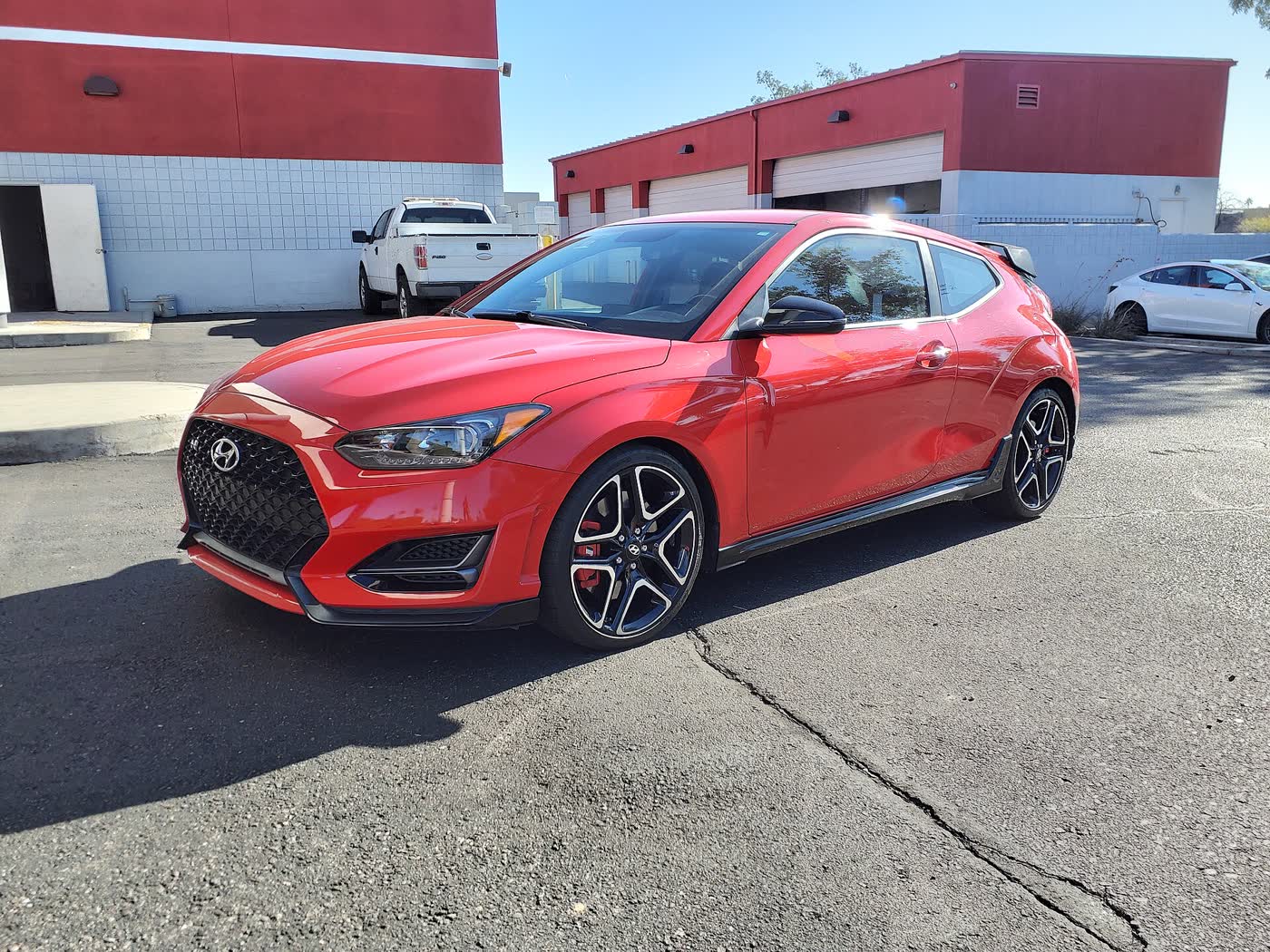
We scored the car as a 2019 or 2020 with the Performance Package and the manual, and it landed at 48 out of 70 with a verdict of Buy, with conditions.
That scope is doing more work here than on any other car we have covered. The Veloster N's headline risk is its dual-clutch transmission, and the DCT only exists on 2021 and 2022 cars. Scored as a 2019-2020 manual, this car carries none of it. Widen the scope and The Risk falls from 7 to around 5, and the total falls with it.
This car is for someone who wants 275 hp at a hot-hatch price and is happy to give up refinement, resale, and aftermarket depth to get it. If you want the car you keep for a decade, the GTI costs the same money and answers differently.
All money figures use a fixed set of assumptions so they can be compared to other cars we cover: 12,000 miles a year, premium fuel at $4.00 a gallon, and insurance for a 35-year-old driver with a clean record and full coverage. Insurance numbers are published averages, not personal quotes. Prices are from Kelley Blue Book.
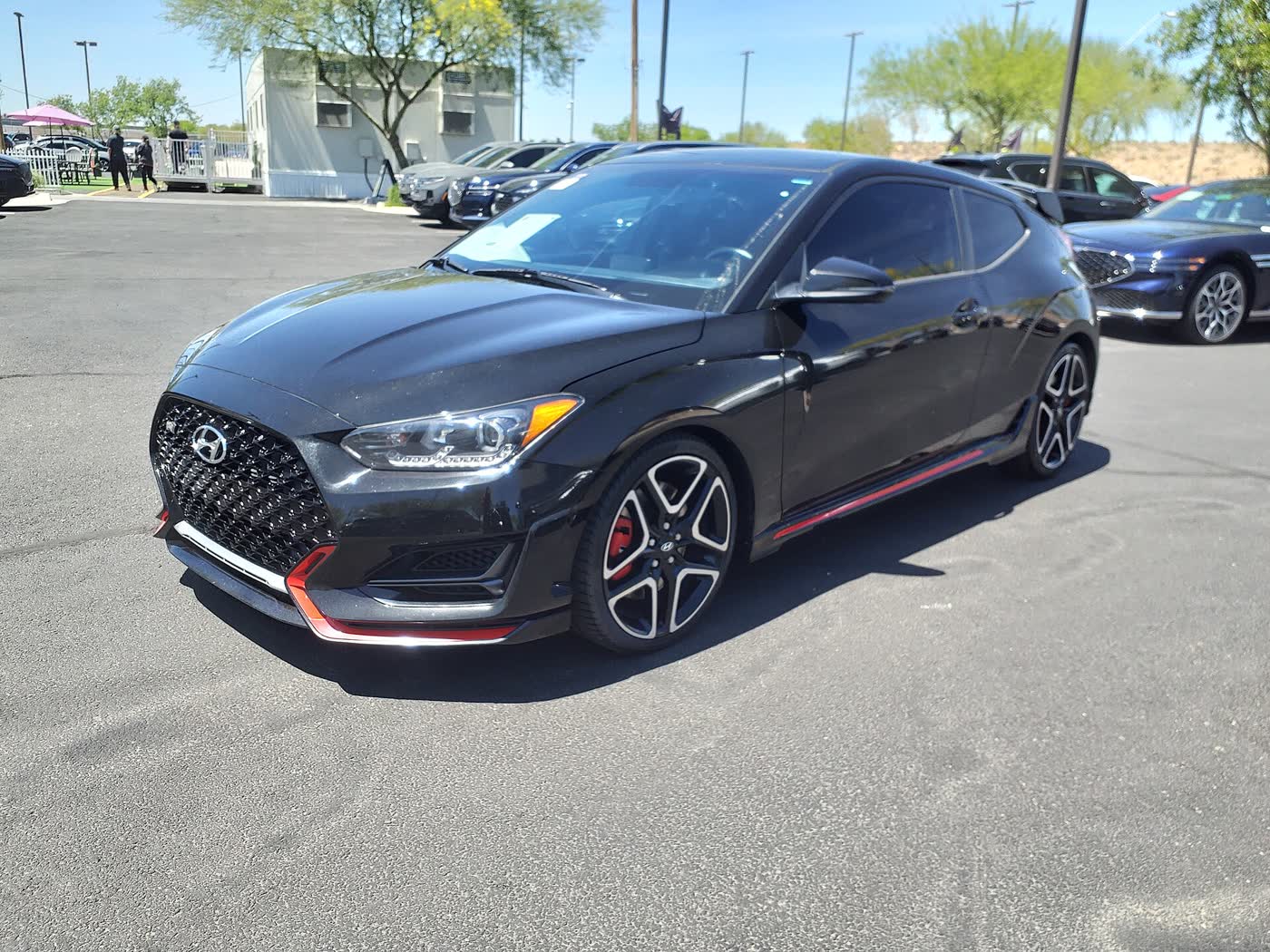
| Figure | Veloster N (2019-2020 w/ PP) | Source |
|---|---|---|
| Used buy-in (KBB private-party) | ~$19,500 | we found no published source for this figure |
| 2020 w/ PP, 54,780 mi | $21,499 | we found no published source for this figure (a dealer listing seen during research, no longer online) |
| 2020 w/ PP, 106,972 mi | $17,599 | we found no published source for this figure (a dealer listing seen during research, no longer online) |
| 2019, 104,835 mi | $14,899 | we found no published source for this figure (a dealer listing seen during research, no longer online) |
| Top of range | $28,990 | we found no published source for this figure (a dealer listing seen during research, no longer online) |
| Original MSRP | $27,820 base, $29,920 with Performance Package | MotorWeek gives $27,820 as the starting price and puts the Performance Package car under $30,000. The $29,920 figure is derived: $27,820 plus the $2,100 package |
| CARFAX 2022 average selling price | $23,656 | we found no published source for this figure |
| 3-year resale retention | Not captured as a percentage | not captured: no resale retention percentage was found for the 2019-2020 car |
~ our estimate, not a measured or quoted figure · * there is a caveat, and the note under the table explains it. Why we mark figures
This car's entry point is low. Our scored example at around $19,500 is essentially GTI money for considerably more power, and if you are willing to accept high miles the floor drops under $15,000, against the GTI's $19,000. Be precise about which number you are quoting, though: on the buy-in we actually score, the GTI is $500 cheaper, not more expensive.
The reason this is a 7 and not an 8 is depreciation, and it is worth being precise about the difference between this car and the 370Z. Both play the same structural role as the cheap entry point in their segment. But the 370Z is a decade-old car that has already found its floor, whereas the Veloster N is still falling. A 2019 car with 104,835 miles selling for $14,899 against a $29,920 sticker tells you how steep that curve has been, and there is no evidence yet that it has flattened.
One note on what you are buying. The Performance Package was a $2,100 option on 2019 and 2020 cars, and it is the difference between 250 and 275 horsepower. From 2021 the 275 became standard, but that is also the year the DCT arrived. For a 2019-2020 car, confirm the Performance Package is actually fitted before you agree a price.
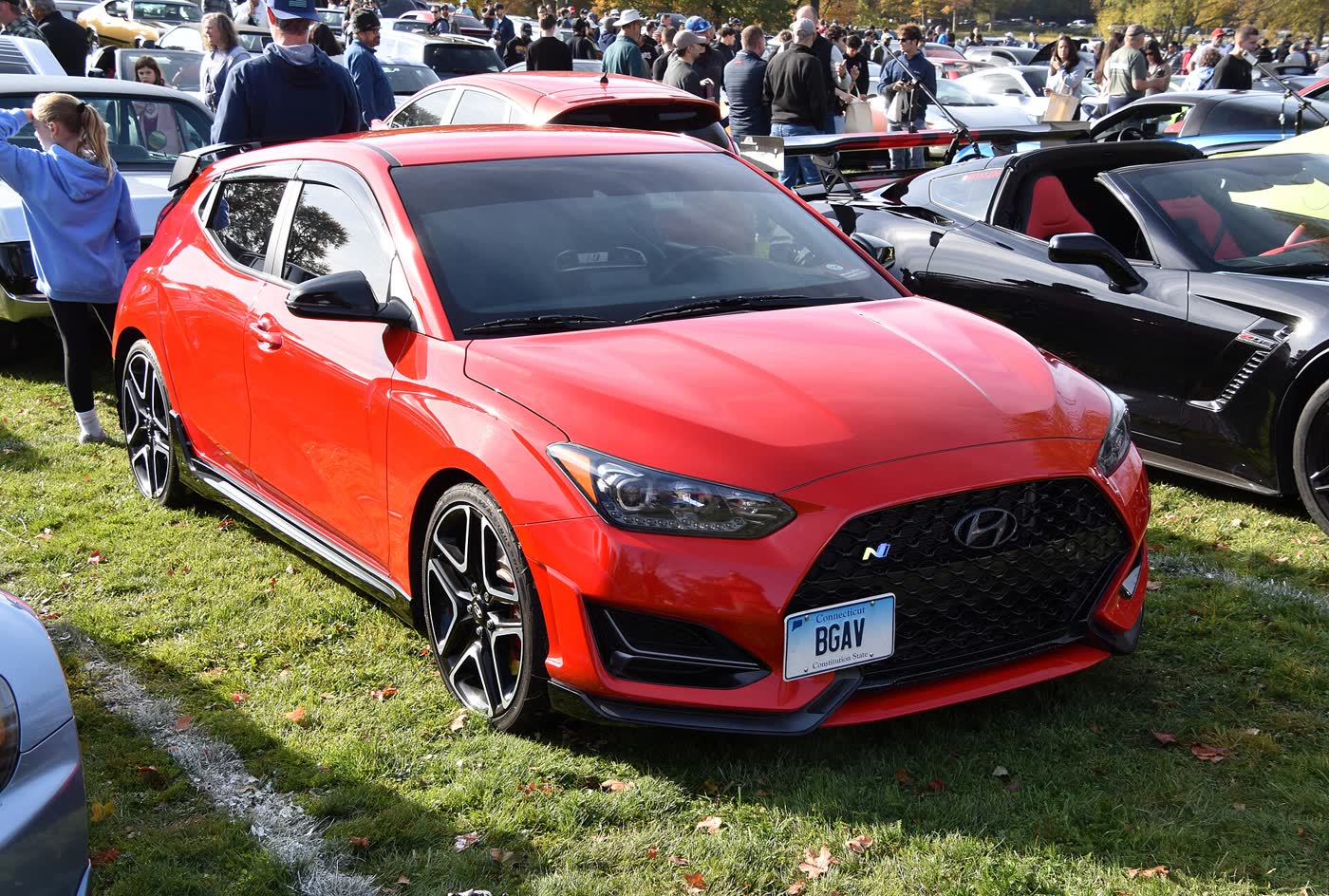
| Figure | Veloster N | Source |
|---|---|---|
| Power (Performance Package) | 275 hp | Hyundai 2019 Veloster N specifications (275 hp optional) |
| Power (base, 2019-2020) | 250 hp | Hyundai 2019 Veloster N specifications (250 hp standard) |
| Performance Package cost when new | $2,100 option | derived: $29,000 less $26,900 in Hyundai's 2019 Veloster N pricing release |
| 0 to 60 mph | 5.2 sec (MotorWeek, PP manual) | MotorWeek road test |
| Quarter mile | 13.9 sec @ 102 mph (MotorWeek) | MotorWeek road test |
| Torque | 260 lb-ft | Hyundai 2019 Veloster N specifications |
| Curb weight | 3,106 lb | Hyundai 2019 Veloster N specifications (the Performance Package car is listed at 3,106 to 3,117 lb) |
| Power-to-weight | 11.3 lb/hp | derived: 3,106 lb divided by 275 hp |
| Transmission | 6-speed manual (2019-2020); 8-speed DCT added 2021 | Hyundai 2019 Veloster N specifications (6-speed manual) · Hyundai 2021 Veloster N specifications (8-speed DCT) |
The argument for this car in one line: 275 horsepower for very nearly the same money as a 228 horsepower GTI. Forty-seven horsepower is a real difference and you feel it, and it is the reason the Veloster N exists as a proposition at all.
This score used to rest on horsepower and price alone. It no longer does. MotorWeek put a 2019 Performance Package manual on 19-inch Pirellis through an instrumented test and got 5.2 seconds to 60 and a 13.9 second quarter at 102 mph, which is the only published test of the exact car we score. Hyundai's own specifications give 3,106 pounds and 260 pound-feet, so the power-to-weight works out at 11.3 pounds per horsepower, identical to the Golf R. One caveat to keep: the published 0-60 figures still spread from 5.2 to 6.0 across outlets and nobody has explained why. We lead with MotorWeek because it tested our configuration, but name the outlet whenever you quote the number.
Where it gives ground to the GTI is refinement rather than pace. The Volkswagen is the more polished, more grown-up car, and that is a real part of what you are paying for when you choose it over this. The Veloster N's case is that you get more power and a lower price and you accept a rougher edge in exchange. Which of those you want is the whole decision.
| Figure | Veloster N (2019-2020) | Source |
|---|---|---|
| Total annual running cost | ~$4,940/yr | derived: fuel $1,920 plus insurance $2,220 plus tires $400 plus service $400 |
| Insurance | ~$2,220/yr (estimated) | our estimate: The Zebra's Veloster Turbo average of $180 a month ($2,160 a year, full coverage, 30-year-old male driver), plus about $60 a year for the N trim. The Zebra does not publish a Veloster N figure |
| Fuel | $1,920/yr (sourced, 25 mpg combined) | derived: 12,000 miles a year at 25 mpg combined (fueleconomy.gov 2019 and 2020), premium at $4.00 a gallon |
| Tires | ~$400/yr (estimated, 235/35R19) | our estimate; tire size from Hyundai 2019 Veloster N specifications |
| Service | ~$400/yr (estimated) | our estimate |
| Factory warranty | Not fully transferable to a second owner; check what remains | Hyundai 2020 Owner's Handbook & Warranty (the 10-year powertrain warranty is original owner only; later owners get 5 years or 60,000 miles) |
At roughly $4,940 a year it is cheaper to run than every hot hatch here except the GTI, which comes in at $4,380. One of the four lines is now sourced rather than modelled: the EPA rates this car at 25 mpg combined, confirmed for the 2019 model by MotorWeek, which gives $1,920 of fuel on our standard 12,000 miles at $4.00 a gallon. Insurance, tires, and service are still estimates. Treat the ranking as more reliable than the number.
The insurance estimate deserves a specific flag. It comes from taking The Zebra's Veloster Turbo figure of $180 a month and adding a step for the N trim. That is a reasonable way to model it, but it is a step on top of a proxy rather than a quote for this car, so it is a weaker basis than the Golf R's sourced $2,390. Get a real quote before you commit.
One thing in its favour is Hyundai parts and dealer service pricing, which is at the friendly end. One thing to check rather than assume: Hyundai's long powertrain coverage is not fully transferable to a second owner, so do not buy on the assumption that a ten year warranty comes with the car. Find out what actually remains on the specific example in front of you.
| Figure | Veloster N (2019-2020 manual) | Source |
|---|---|---|
| Worst realistic repair | None documented within this scope | our assessment: no common failure in scope turned up in the sources reviewed |
| The headline risk | The DCT, which exists only on 2021-2022 cars | our assessment of owner reports. Transmissions: Hyundai 2019 sheet lists a 6-speed manual; Hyundai 2021 sheet adds the 8-speed DCT |
| Documented DCT case | 2022 skipping gears; full transmission and dual clutch replacement at 2,624 miles | velostern.com owner thread |
| Owner consensus | 2019-2020 cars have fewer issues | velostern.com owner thread (one poster in the thread) |
| Manual cars | Reported as substantially more trouble-free | we found no published source for this figure |
| Repair costs | None captured; no common failure in scope | not captured: no repair-cost source was located for this car |
This is the section where the scope earns its keep, and the finding is useful rather than a technicality. The Veloster N's reputation problem is its dual-clutch gearbox, and there is a well-documented case of a 2022 car skipping gears, hanging at high revs while losing power, and needing a complete transmission and dual clutch replacement at 2,624 miles. That is alarming, and it is real.
It is also confined to 2021 and 2022 cars, because that is when the DCT was introduced. Owner consensus that the earlier cars have fewer problems lines up exactly with that timeline, and manual cars specifically are reported as substantially more trouble-free, with one owner reporting 28,000 miles on an intake and catback with no issues at all.
Put those two facts together and you get the most actionable thing on this page: the risk is concentrated at the expensive end of the price range. Every car at the cheap end is a 2019-2020 manual, so the version you would buy on price is also the version without the problem. That is why this scores a 7, higher than the GTI, the Focus RS, or the Type R. We have held it at 7 rather than pushing higher because the evidence is owner reports rather than survey data of the kind we have for the Golf, and because the platform simply has a shorter track record than a Mazda or a Honda.
| Figure | Veloster N | Source |
|---|---|---|
| Body style | Hatchback | MotorWeek road test (calls it a compact hatchback) |
| Cargo, seats down | 44.5 cu ft | Hyundai 2021 Veloster N specifications (same body) |
| Seats | 4 | KBB |
| Door layout | One door driver side, two passenger side, plus the hatch | Hyundai 2019 Veloster release (two-plus-one asymmetrical doors) · Veloster N features sheet (3-door body) |
| Cargo volume | 19.9 cu ft | Hyundai 2019 Veloster N specifications |
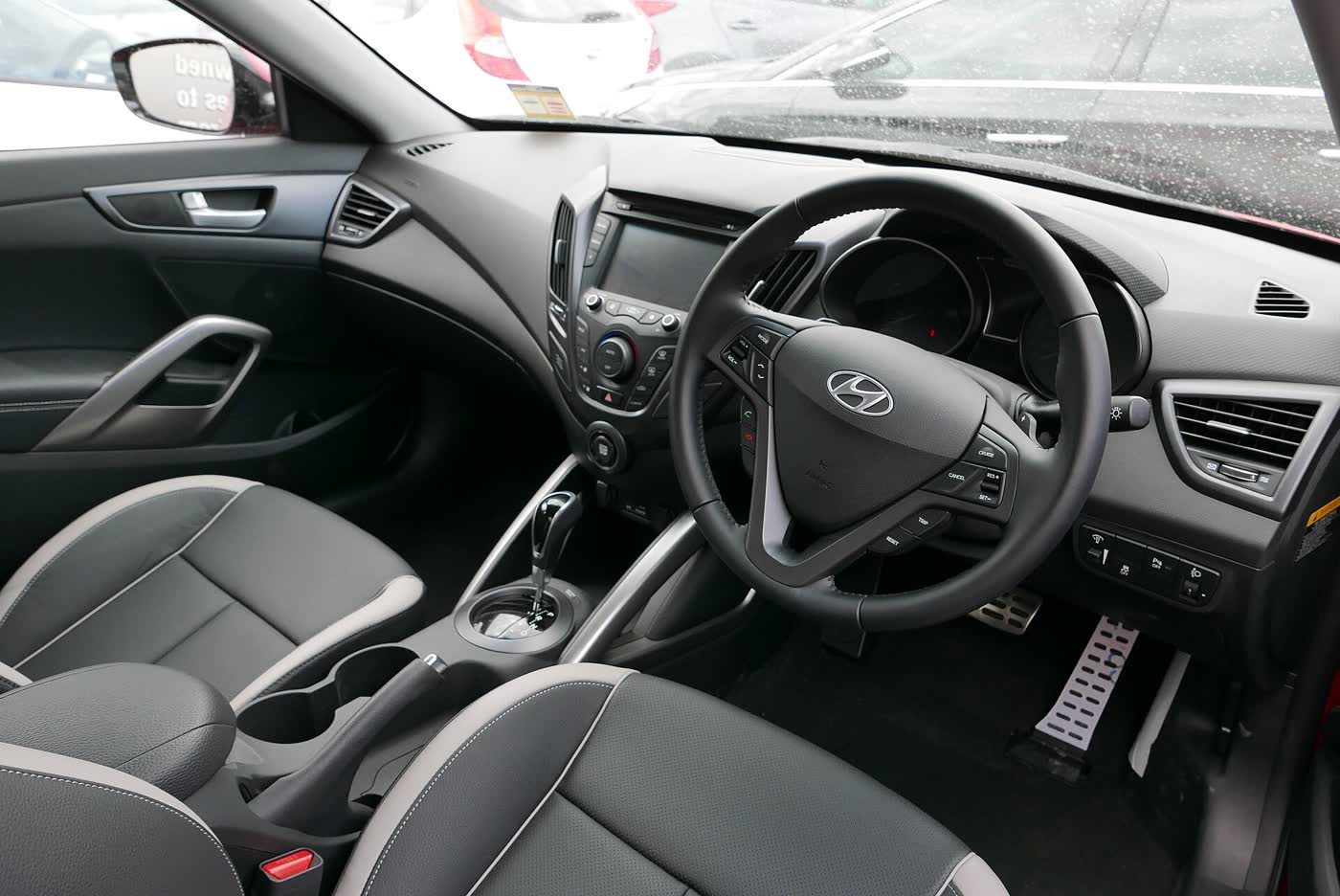
A real hatchback with usable rear seats and a boot, which puts the Veloster N in a completely different practicality class from the two-seat coupes further down our Board. If you need one car that can carry people and things and still be entertaining, this qualifies in a way a Miata or a Supra simply does not.
It sits below the Golf-sized cars for two reasons. It is a smaller car overall, so there is less of everything, and the door layout is unusual: one door on the driver's side and two on the passenger's side. Plenty of owners stop noticing within a week. Some never do, particularly if they regularly load passengers from the kerb on the wrong side.
The measurement backs up what the eye tells you. Hyundai's own specifications put the boot at 19.9 cubic feet with the rear seats up and 44.5 with them down, against 22.8 for the GTI and 25.7 for the Civic Type R. So it really does carry less than the other two, by a meaningful margin rather than a rounding error, and that is precisely the gap the 7 is expressing.
| Source | 0-60 | Braking | Skidpad |
|---|---|---|---|
| Edmunds | 6.0 manual / 5.4 DCT | 108 ft (60-0) | 1.04 g |
| C/D-format aggregate (2020, 250 hp) | 5.5 | 157 ft (70-0) | 0.99 g |
We are showing you two rows instead of one because the published figures for this car contradict each other, and picking a favourite would be dishonest. Note first that the two braking numbers are not even measuring the same thing: 108 feet is a 60-0 stop and 157 feet is a 70-0 stop, so they cannot be placed side by side at all. On grip, Edmunds has it at 1.04 g, which would put it ahead of the Type R's 1.02, while the aggregate has it at 0.99 g, which puts it behind the Civic Type R.
So here is a claim we are explicitly not making: we will not tell you the Veloster N out-grips the Type R until this resolves. That claim is circulating, it is built on comparing figures from different outlets using different protocols, and it may well turn out to be true, but it is not supported yet. This is an open research item and we would rather say so than pick the number that makes a better headline.
Fortunately our Limit score rates engagement and behaviour at the edge rather than instrumented data, so the conflict does not sink it. On behaviour, this is clearly a more playful and better equipped car at the limit than a GTI, and clearly less capable than a Civic Type R that stops in 142 feet and holds a Nurburgring record. A 7 places it between them, and that placement holds no matter which outlet turns out to be right.
| Path | Result | Risk |
|---|---|---|
| Reflash on stock hardware | Gain figure withdrawn pending a source check | Low |
| Stage 1 tune plus plugs | ~30 whp; transforms the car more than any bolt-on | Low |
| Stage 2 with supporting mods | ~300 whp, including an oil cooler | Moderate |
| LAP3 ECU flash | $1,250 | Sourced |
| LAP3 N Track eLSD tune | $850 | Sourced |
| JB4 piggyback | $619 | Sourced |
A reflash is the best single thing you can spend money on here, and forum consensus is that a Stage 1 tune with plugs transforms the car more than any bolt-on part you could buy for the money. We are going to stop short of telling you how much power it makes, though, and we want to explain why rather than just leave a blank. The gain figure this page used to carry traced back to a source we had already ruled out elsewhere on this site for being an affiliate blog. Until we can attribute it properly, it comes off. The tune is still the right first move; we just are not going to put a number on the result we cannot stand behind.
Two things hold this to a 7 rather than the GTI's 8. The ceiling is lower: Stage 2 with supporting hardware including an oil cooler lands around 300 wheel horsepower, which is a modest limit next to the 350 to 400 the GTI's stock internals will take. And the aftermarket is thinner, because the Hyundai and Kia 2.0T platform is younger and does not have the depth of support that Volkswagen and Honda enjoy.
What we can now tell you is the price, and it changes the value story. A LAP3 ECU flash for the 2.0T is $1,250, their N Track eLSD tune is $850, and a JB4 piggyback is $619. Set that against the roughly $700 a GTI owner pays for a Stage 1 flash and the picture shifts: the Veloster N is not doing the same cheap trick the GTI does. It costs the better part of twice as much to unlock, and the ceiling it unlocks is lower. That is worth knowing before you buy this car specifically to modify it.
Buy, and buy specifically: a 2019 or 2020 car with the Performance Package and the manual gearbox. That combination is simultaneously the cheapest end of this car's market and the version that carries none of the transmission risk it is known for, which is an unusually happy coincidence for a buyer. It scores 48 out of 70 by being a cheap entry with very few documented problems in scope, then giving ground on refinement, resale, and modding ceiling.
This car is for you if you want 275 horsepower for GTI money and will accept a rougher, less polished car to get it. It is not for you if you want the one you keep for ten years, because for the same money the GTI is the more complete car and its numbers are better documented than this one's.
So you want to buy a used Veloster N. Here is the short version, and it is unusual: on this car, the cheap examples are also the ones least likely to break. That almost never happens. Normally the cheap end of a model range is where the tired, neglected, and problematic cars live. On the Veloster N it is where the good ones are, and the reason is a specific gearbox that arrived in a specific year.
We scored it as a 2019 or 2020 with the Performance Package and the manual, and it landed at 48 out of 70. And that scope line is not filler: it is doing more work on this car than on anything else we have published. Widen it by two model years and this car's Risk score falls from a 7 to roughly a 5. So before anything else, let us establish exactly which Veloster N we are talking about.
This is the whole decision, so we are putting it first rather than burying it.
For 2019 and 2020, the base car made 250 horsepower and the Performance Package was a $2,100 option that took it to 275. Those years were manual only. From 2021, the 275 horsepower became standard equipment, and that same year Hyundai introduced an eight-speed dual-clutch transmission as an alternative to the manual.
Hold those two facts together, because their overlap is the entire article. The year the power became standard is also the year the problematic gearbox arrived. That means a listing advertising "275 horsepower" tells you almost nothing on its own. It could be a 2019 or 2020 with the Performance Package fitted, which is the car we recommend, or it could be a 2021 or 2022, which carries a risk the earlier cars simply do not have.
So: shop 2019 and 2020, insist on the manual, and confirm the Performance Package is actually fitted rather than assuming it from a horsepower figure in an advert. A 2019 without the package is a 250 horsepower car and should be priced as one.
This car's entry point is low, and the ladder of real listings shows how steep the curve is. A 2020 with the Performance Package and 54,780 miles came in at $21,499. The same car with 106,972 miles was $17,599. A 2019 with 104,835 miles went for $14,899. CARFAX put the 2022 average selling price at $23,656, and the top of the range sits around $28,990.
Our scored example is about $19,500. Original MSRP was $27,820 for the base car and $29,920 with the Performance Package, so the discount from new is enormous. Those MSRP figures are corrected from what we first published: the old pair did not add up, because a $27,600 base plus a $2,100 package does not make $30,675. MotorWeek's road test gives the $27,820 base and notes the package car came in under $30,000, which reconciles exactly.
Now a precision point, because we got this wrong ourselves at first and corrected it. It is tempting to call this the cheap one full stop. It is not, quite. On the buy-in we actually score, the GTI is $500 cheaper at $19,000. What the Veloster N owns is the floor: if you will accept high miles, it drops under $15,000, where the GTI stays at $19,000. Both statements are true and they mean different things, so be clear which one you are relying on.
The reason this scores a 7 rather than an 8 is depreciation, and the useful comparison is the 370Z. Both cars play the same structural role as the cheap entry point in their segment. But the 370Z is a decade-old car that has already found its floor, so what you pay is roughly what you will get back. The Veloster N is still falling. A 2019 selling for $14,899 against a $29,920 sticker tells you how steep that has been, and we have no evidence it has flattened out yet. We did not capture a three-year resale percentage for it, which is why that cell is blank rather than optimistic.
The one-line case: 275 horsepower for very nearly the same money as a 228 horsepower GTI. Forty-seven horsepower is a real difference and you feel it, and it is the entire reason this car exists as a proposition.
This used to be a poorly supported score, and it is not any more. MotorWeek took a 2019 with the Performance Package and the manual, on the 19-inch Pirellis, and instrumented it: 5.2 seconds to 60, and a 13.9 second quarter mile at 102 miles per hour. That is the exact specification we score, which is why we lead with it. Be aware the published figures still spread. Edmunds recorded 6.0 for the manual and 5.4 for the dual-clutch, and a Car and Driver format aggregate on a 2020 car making the base 250 horsepower returned 5.5. Nobody has explained the spread, and the fact that one of the quicker figures comes from the least powerful version is still odd. So quote MotorWeek by name rather than saying “it does 5.2” as though every outlet agreed.
Hyundai's own specifications give 3,106 pounds and 260 pound-feet, so the power-to-weight works out at 11.3 pounds per horsepower, identical to the Golf R. What that means is our 7 no longer rests on horsepower and price alone; there is measured pace behind it now. The one thing still worth scepticism is the outlet spread on 0-60, so name MotorWeek when you quote the 5.2.
Where the car gives ground to the GTI is refinement rather than speed. The Volkswagen is the more polished, more grown-up thing to sit in and live with, and that polish is a real part of what you are paying for when you choose it. The Veloster N's argument is that you get more power and a lower floor and you accept a rougher edge in exchange. Which of those you want is the whole decision between them.
Our figure is roughly $4,940 a year. That makes it cheaper to run than every hot hatch here except the GTI, which comes in at $4,380. The fuel line is properly sourced now, at $1,920 from the EPA's 25 mpg combined; insurance, tires, and service are still ours.
Two honesty notes about that figure. First, the comparison is not like for like: the GTI's number is built from captured fuel, tire, and service components, while every part of ours is modelled. Treat the ranking as more reliable than the number. Second, and more specifically, the insurance estimate here rests on a weak basis. It comes from taking The Zebra's figure for a Veloster Turbo, which is a different car, at $180 a month, and adding a step for the N trim. That is a step on top of a proxy. Compare it to the Golf R, where we have a directly sourced quote for the actual model. Get a real quote before you commit.
In the car's favour, Hyundai parts and dealer service pricing sit at the friendly end, which is a genuine ownership advantage.
And now the trap, which catches a lot of used Hyundai buyers. You will hear about Hyundai's famous ten-year, hundred-thousand-mile powertrain warranty, and you may reasonably assume it comes with the car. It is not fully transferable to a second owner. Do not build your ownership plan around coverage that expired the moment the first owner sold it. Check exactly what remains on the specific VIN in front of you, in writing, before you treat any of it as a benefit.
This is the section that justifies the whole article, so let us do it properly.
Start with the scary version, because it deserves to be taken seriously. There is a well-documented owner case of a 2022 Veloster N skipping gears, hanging at high revs while losing power, and failing to shift when it should have. The resolution was a complete transmission and dual clutch replacement at 2,624 miles. That is not a niggle. On a car with barely more than two thousand miles on it, that is alarming.
Now the turn. The dual-clutch transmission was introduced in 2021. It does not exist on a 2019 or 2020 car. Those years were manual only, full stop.
And the evidence lines up with exactly that timeline. Owner consensus is that the 2019 and 2020 cars have fewer issues, which is consistent with both the DCT and the additional driver aids arriving later. Manual cars specifically are reported as substantially more trouble-free, with one owner reporting 28,000 miles running an intake and a catback exhaust with no issues at all.
Put those together and you get the finding we opened with, stated properly: the risk on this car is concentrated at the expensive end of the price range. Every car at the cheap end is a 2019 or 2020 manual, so the version you would gravitate towards on price is also the version without the problem. That is a happy coincidence for a buyer and it is why this scores a 7 on The Risk, higher than the GTI, the Focus RS, or the Civic Type R.
We held it at 7 rather than pushing higher for two honest reasons. The supporting evidence is owner reports rather than structured survey data of the kind we have for the Golf platform, where TrueDelta sampled 2,651 cars. And the platform simply has a shorter track record than a Mazda or a Honda. A 7 reflects a car with no documented common failure in scope, not a car with proven long-term bulletproofing.
Yes, with one quirk you should sit in before you commit. It is a real hatchback with usable rear seats and a boot, which puts it in a completely different practicality class from the two-seat coupes further down our Board. Four seats, a hatch, and enough space to be somebody's only vehicle.
It sits below the Golf-sized cars for two reasons. It is a smaller car overall, so there is less of everything. And the door layout is unusual: one door on the driver's side, two on the passenger's side, plus the hatch. Plenty of owners stop noticing within a week. Some never do, particularly if they regularly load passengers from the kerb on the side with only one door. It is not a flaw exactly, but it is a thing, and a five-minute sit in one tells you which camp you are in.
Hyundai's own specifications put the boot at 19.9 cubic feet with the rear seats up and 44.5 with them down, against 22.8 for the GTI and 25.7 for the Civic Type R. So it really does carry less than the other two, by a meaningful margin rather than a rounding error, and that is precisely the gap the 7 is expressing.
Here we are going to show you two sets of numbers instead of one, because the published figures for this car contradict each other and picking a favourite would be dishonest.
Edmunds recorded 1.04 g of grip, a 108 foot stop, and 6.0 seconds to 60 for the manual. A Car and Driver format aggregate, on a 2020 car with the base 250 horsepower, returned 0.99 g, a 157 foot stop, and 5.5 seconds.
Notice first that the two braking figures are not even measuring the same thing. The 108 foot number is a 60-0 stop. The 157 foot number is a 70-0 stop. They cannot be placed side by side at all, and anyone who does so is comparing a sprint to a marathon. On grip, the gap matters enormously: under the Edmunds figure this would sit ahead of the Type R's 1.02 g, and under the aggregate it sits behind it.
So here is a claim we are explicitly not making. You will see it said that the Veloster N out-grips the Civic Type R. That claim is built on comparing figures from different outlets using different protocols. It may well turn out to be true. It is not supported yet, and we would rather tell you the data is unresolved than pick whichever number makes the better headline.
Fortunately our Limit score rates engagement and behaviour at the edge rather than instrumented data, so the contradiction does not sink it. On behaviour this is clearly a more playful and better equipped car at the limit than a GTI, and clearly less capable than a Type R that stops in 142 feet and holds a Nurburgring record. A 7 places it between them, and that placement holds regardless of which outlet turns out to be right.
A reflash is the best single thing you can spend money on here, and forum consensus is that a Stage 1 tune with plugs transforms the car more than any bolt-on part you could buy for the money. We are going to stop short of telling you how much power it makes, though, and we want to explain why rather than just leave a blank. The gain figure this page used to carry traced back to a source we had already ruled out elsewhere on this site for being an affiliate blog. Until we can attribute it properly, it comes off. The tune is still the right first move; we just are not going to put a number on a result we cannot stand behind. If you are the kind of owner who tunes a car in the first month, this platform rewards that instinct.
Two things hold it to a 7 rather than the GTI's 8. The ceiling is lower: Stage 2 with supporting hardware including an oil cooler lands around 300 wheel horsepower, against the 350 to 400 the GTI's stock internals will take. And the aftermarket is thinner, because the Hyundai and Kia 2.0T platform is younger and does not have the depth of support that Volkswagen and Honda enjoy. That matters more than people expect: it affects parts availability, tuner competition, and how much accumulated knowledge exists when something goes wrong.
What we can now tell you is the price, and it changes the value story. A LAP3 ECU flash for the 2.0T is $1,250, their N Track eLSD tune is $850, and a JB4 piggyback is $619. Set that against the roughly $700 a GTI owner pays for a Stage 1 flash and the picture shifts: the Veloster N is not doing the same cheap trick the GTI does. It costs the better part of twice as much to unlock, and the ceiling it unlocks is lower.
These two cost within $500 of each other and both score a 7 on The Deal, for completely opposite reasons. The GTI earns it on resale and documented running costs. The Veloster N earns it on outright cheapness and a floor under $15k.
The Veloster N gives you 47 more horsepower and a better Risk score, 7 to 6, thanks entirely to that scope finding. The GTI gives you better refinement, better resale at a documented 72 percent, running costs that are actually measured rather than modelled, a far deeper aftermarket, a higher tuning ceiling, and more practicality with 9 on The Daily against 7. On our Board the GTI takes it 50 to 48.
The way to choose is to ask how long you are keeping it. If you want maximum power per dollar right now, and you will tune it, enjoy it, and move on in a couple of years, the Veloster N is a lot of car for the money and the cheap ones are the sound ones. If you want the car you still own in ten years, the GTI is the more complete machine, and its numbers are better documented, which means fewer surprises.
Buy, and buy specifically: a 2019 or 2020 car, with the Performance Package confirmed as actually fitted, and the manual gearbox. That combination is simultaneously the cheapest end of this car's market and the version that carries none of the transmission risk it is known for. That is an unusually favourable coincidence and it is the single most useful thing we can tell you about this car.
It scored 48 out of 70 by being a cheap way into the segment with very few documented problems in scope, then giving ground on refinement, resale, and modding ceiling. Two things to carry away about the numbers on this page. The performance data is much better than it was, because MotorWeek tested the exact specification we score. But the running costs are still largely modelled, the insurance is a step on top of a proxy, and the Mods score is the one we would most expect to move: the tune costs nearly twice what a GTI owner pays, and the power figure that used to sit in that panel has been withdrawn pending a source check.
This car is for you if you want 275 horsepower for GTI money and will accept a rougher, less polished car to get it. It is not for you if you want the one you keep for a decade, because for the same money the GTI is the more complete car and its numbers are far better documented than this one's.
Filming reference: cue sheet · for the hosts on set, not part of the review.
The frame that closes our video: the Veloster N at 48/70, with the Golf GTI and the Type R alongside.